
Molly Gustafson, Maura Harvey, Makayla Krause, Tom McNamara, Harper Saglier, and Jovaughn Williams
Published February 12, 2025
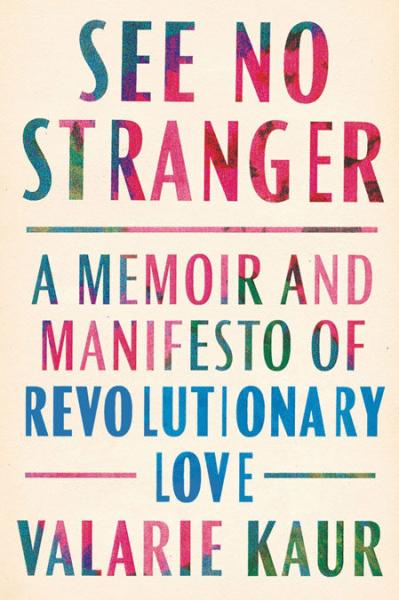
See No Stranger: A Memoir and Manifesto of Revolutionary Love, by Valarie Kaur. One World, 2021. $20.00
Activist and civil rights lawyer Valarie Kaur’s best-selling memoir See No Stranger: A Memoir and Manifesto of Revolutionary Love calls for vulnerable conversation across lines of difference. Kaur explains throughout that, when we allow ourselves to wonder about those who are different from us, we can make more genuine connections and create more productive discourse. Specifically, Kaur pushes readers to develop strategies of listening and understanding that she calls “revolutionary love,” “the choice to labor for others, our opponents, and ourselves in order to transform the world around us” (xvi). The concept is perhaps best exemplified by her documentarian work of the Oak Creek, Wisconsin Sikh community following a mass shooting at their gurdwara: in the wake of an immeasurable loss, she found community and love in complete strangers, many of whom were not members of her own Sikh faith.
The practices of revolutionary love for which Kaur advocates are sorely needed in today’s polarized rhetorical climate. Amid an increase in mass shootings, a rise in hate crimes, and growing anti-LGTBQ and racist rhetoric, Kaur’s book offers students and scholars of rhetoric an opportunity to learn how to effectively listen, converse, and deliberate with each other. Importantly, even though her book was not written for an audience of composition researchers and instructors, the text resonates deeply with scholarship and pedagogy concerned about our unhealthy national discourse. Indeed, her book in many moments puts into practice rhetorical strategies proposed in our field as alternatives to today’s racist and exclusionary public sphere.
For instance, See No Stranger is at its core a counterstory (Martinez), narrating Kaur’s post-9/11 activism to undermine racist stock stories that frame US citizens of Middle Eastern and South Asian descent as terrorists. She likewise enacts political philosopher Danielle Allen’s notion of political friendship, an approach to political dialogue that draws on practices of friendship in moments of troubled cross-cultural communication but noticeably lacks the emotional charge connecting friends. Perhaps most compellingly, Kaur provides a practical blueprint for rhetorical listening (Ratcliffe) and rhetorical virtue (Duffy) as she guides readers through her difficult encounters with racists. In many ways, it’s unsurprising that Kaur’s book extends and enriches these threads of rhetorical scholarship: like a previous generation of legal scholars influential in composition studies (e.g., Derrick Bell, Patricia Williams, Richard Delgado), Kaur deliberately eschews formal academic and legal writing genres, pursuing instead forms of storytelling she believes more conducive to today’s civil rights challenges.
Kaur’s practice of counterstory, political friendship, and rhetorical listening unfolds in three distinct sections. Part 1, which includes chapters titled “Wonder,” “Grieve,” and “Fight,” begins by inviting readers to look political opponents in the eye and choose to say, “You are a part of me I do not yet know” (xvi). Kaur argues that such wonder is where revolutionary love begins—and that the failure to wonder that epitomizes today’s political landscape is the beginning of violence. In her second chapter, Kaur urges readers to make space to grieve, to have the bravery to embrace their own pain and the strength to endure the pain of others. As is the case with wonder, grieving allows us to listen to others’ stories and rituals, creating deep and lasting relationships across lines of difference. In the third chapter, Kaur outlines how the social bonds created through wonder and grief enable us to begin forming coalitional movements to fight for justice.
As is her practice throughout the book, Kaur in these chapters outlines principles of revolutionary love by drawing on her own experiences as an activist, documentarian, and civil rights lawyer. Following 9/11, Kaur traveled the US documenting the surge of racist violence directed toward Middle Eastern and South Asian communities (and Sikhs in particular). The family of her Balbir Uncle[1]—murdered at his gas station in Mesa, Arizona, by a white supremacist—especially showed Kaur how intersectional movements for justice can emerge from wonder and grief. Kaur recalls how Balbir Uncle’s wife, who came to the US for the first time only after her husband was killed, refused to dwell in anger toward his murderer. Instead, she told Kaur what she recalled most about the days following her husband’s murder was the outpouring of community support that crossed racial and religious lines: “I had no friends or community there. But everyone gathered together. Hindu, Muslim, Christian. Everyone was crying. Sikhs were not the only ones who were crying. Everyone was crying” (55).
Where Part 1 calls readers to attend to their own wounds on the journey toward revolutionary love, Part 2 emphasizes the wounds of our opponents. For Kaur, reminding ourselves that our opponents have likely themselves been victims of trauma does not mean ignoring the pain and damage caused by perpetrators of hate, clear in the title of this section’s first chapter: “Rage.” Here, Kaur reminds readers that rage in response to injustice is a powerful catalyst. Yet, she cautions that we must not allow rage to so consume us that we lose the ability to see an opponent’s humanity. Instead, we must listen (the title of chapter 5) to our rage to refocus our energy for productive change. When we listen, she contends, we create opportunities to build coalitions and create new futures. “It’s a rhythm,” she writes: “Step away to rage, return to listen, and reimagine the solutions together” (134). It is this process that leads Kaur to finally forgive Balbir Uncle’s killer—and helps her to center revolutionary love in her own activist mission.
In Part 3, Kaur shows readers how tending to our own and our opponents’ wounds positions us to create new social and political realities. Drawing heavily on metaphors of childbirth—and Kaur’s experiences giving birth—Kaur counsels readers to breathe and push as they work to create a world in transition. In chapter 6, Kaur not only discusses the role of breathing in childbirth but also shares breathing strategies that provide space for personal repair and recovery: “When I was finally ready to love myself, I had to learn how to breathe and push through my grief, rage, and trauma. On the other side, I found what seemed utterly impossible before: healing, forgiveness, and even reconciliation” (253). In her final chapter, Kaur’s birthing metaphor comes full circle as she focuses on transition, the medical term for the final stages of labor. For activists striving for revolutionary love, transition also defines the moments when the future we strive for comes into view: “In such moments, I see glimpses of a nation waiting to be born, the society we aspire to be—an America that is multiracial, multifaith, multigendered, and multicultural, a nation where power is shared and we strive to protect the wellness and dignity of every person and work to save our earth and our collective future” (286).
As she concludes, Kaur brings readers back to Balbir Uncle’s murder, which had in the days following 9/11 propelled her activist journey. With Balbir Uncle’s brother, Kaur calls his murderer in prison, Frank Roque. While Kaur becomes angry that Roque refuses to take responsibility, Balbir’s brother tells Roque that he forgives him. “Rana [Balbir’s brother] had never wanted him to be put to death,” Kaur writes, “because it foreclosed the possibility of apology and transformation” (296). Rana tells Roque he will speak with him again, and Kaur sees the moment as an important step toward reconciliation, one that may not create immediate or systemic change but nonetheless enables Kaur and Rana to step out of victimhood and reclaim agency. For Kaur, this conversation with Roque is the spark of transition, a fleeting moment that shows the possibility of revolutionary love even when there is still much work ahead. Importantly, these turning points can help bring us to a new reality “where we can look upon any face—even those we might fear—and find recognition” (299).
We, a group of undergraduates who were enrolled in a rhetorical studies course (and their instructor), began to see the important lessons of See No Stranger for scholars and teachers of rhetoric when See No Stranger was selected as our campus common reader and when Kaur visited our university to lead a series of talks and workshops. Reading work by Martinez, Ratcliffe, Duffy, David Fleming, and others alongside Kaur, we kept grappling with one question: How do we prime the wider public to actually hear and thus recognize the humanity of others, that important first step on the journey toward revolutionary love? As Ratcliffe notes, listening has been undertheorized in contemporary rhetorical theory and pedagogy. Moreover, listening across difference has increasingly become a liability for political leaders, who routinely focus their energy not on persuasion but on courting the most partisan and extreme segments of the electorate. Indeed, a number of recent studies have found that, as our communities (Brown and Enos) and media ecosystems (Jurkowitz et al.) become more politically segregated, we have fewer opportunities to substantively encounter political difference.
Yet, Kaur challenges readers to seek and confront difference. She argues that doing so can birth new realities—and she even provides a toolkit for prioritizing one’s own wellbeing amid such difficult work. For teachers and scholars of rhetoric, there’s much to learn from Kaur. Similar to Kaur, we’ve imagined more ethical and productive public spheres and communicative habits, all with the goal of likewise creating new sociopolitical realities. However, our work too often remains in the realm of theory. Virginia Anderson memorably grappled with this disconnect between theory and practice in her 1997 CCC article “Confrontational Teaching and Rhetorical Practice,” and James Chase Sanchez’s recent work makes clear how difficult this practical work is in today’s “white supremacist rhetorical climate” (45). By recreating the complicated terrain of her actual encounters with difference, Kaur makes visible the messy work of actualizing rhetorical theories like rhetorical listening or political friendship. As Allen reminds us, the pursuit of more ethical rhetorics is an ongoing and untidy process, and Kaur provides a glimpse of how to manage the personal and interpersonal challenges of such work on the ground.
While our polarized and fractured public sphere provides little space for such work, composition classrooms can be (and perhaps already are) sites where students can develop the practices Kaur associates with revolutionary love. As Min-Zhan Lu, John Duffy, Catherine Prendergast, and others have reminded us, writing programs have a reach, by virtue of the nearly universal first-year writing requirement, that extends far beyond other campus instructional units, with countless numbers of undergraduates moving through our classrooms yearly. By foregrounding revolutionary love, and even using See No Stranger as a course text, our writing programs can help students cultivate habits of communication, listening, and self-preservation often absent in our larger culture.
Many of the staple assignments in our programs prepare us well for such work. After reading selections from See No Stranger, for instance, students could use Kaur’s insights about today’s public sphere as a frame for rhetorical analysis, documenting how our public dialogue about hot-button issues often falters because of our collective failure to listen. Further, Kaur’s skillful presentation of her story in a variety of modes (including a TED Talk that has been viewed over 3 million times) provides both content for rhetorical analysis and an example of how students might reach wider audiences through non-academic genres.
We could transform still more of our common first-year genres by following Kaur’s lead: literacy narratives could be reframed to invite students to explore, as Kaur did early in the book, how their schooling experiences helped or hindered their ability to develop rhetorical agency. See No Stranger even provides students a concrete model for conducting research, with Kaur’s discussion of her grant-funded undergraduate thesis showing the possibility for academic work to have a real-world impact. With Kaur as a guide, students might conduct fieldwork in their own communities about issues that matter to them, a move that aligns with the 2017 CCCC Position Statement on Undergraduate Research in Writing. Importantly, such projects would allow students to bring voices from their communities directly into the classroom, allowing all students the chance to hear perspectives and experiences they might otherwise never encounter. And, as Kaur reminds us throughout her book, encountering and actually hearing difference is the crucial first step toward birthing new social realities.
Note
[1] Balbir Singh Sodhi was a close family friend who Kaur called uncle. Kaur notes that he “was the first of nineteen people killed in hate crimes in the immediate aftermath of 9/11” (36).
Works Cited
Allen, Danielle. Talking to Strangers: Anxieties of Citizenship since Brown v. Board of Education. U of Chicago P, 2004.
Anderson, Virginia. “Confrontational Teaching and Rhetorical Practice.” College Composition and Communication, vol. 48, no. 2, 1997, pp. 197–214.
Brown, Jacob R., and Ryan D. Enos. “The Measurement of Partisan Sorting for 180 Million Voters.” Nature Human Behavior, vol. 5, no. 5, 2021, pp. 998–1008.
Conference on College Composition and Communication. “CCCC Position Statement on Undergraduate Research in Writing: Principles and Best Practices.” Mar. 2017, https://cccc.ncte.org/cccc/resources/positions/undergraduate-research. Accessed 10 Dec. 2023.
Duffy, John. Provocations of Virtue: Rhetoric, Ethics, and the Teaching of Writing. Utah State UP, 2019.
Jurkowitz, Mark et al. US Media Polarization and the 2020 Election: A Nation Divided. Pew Research Center, 2020, www.pewresearch.org/journalism/2020/01/24/u-s-media-polarization-and-the-2020-election-a-nation-divided/. Accessed 10 Dec. 2023.
Kaur, Valarie. “3 Lessons of Revolutionary Love in a Time of Rage.” Ted Talk. TEDWomen 2017, Nov. 2017, https://www.ted.com/talks/valarie_kaur_3_lessons_of_revolutionary_love_in_a_time_of_rage/. Accessed 10 Dec. 2023.
---. See No Stranger: A Memoir and Manifesto of Revolutionary Love. One World, 2020.
Martinez, Aja Y. Counterstory: The Rhetoric and Writing of Critical Race Theory. NCTE, 2020.
Ratcliffe, Krista. Rhetorical Listening: Identification, Gender, Whiteness. Southern Illinois UP, 2005.
Sanchez, James Chase. “Trump, the KKK, and the Versatility of White Supremacy Rhetoric.” Journal of Contemporary Rhetoric, vol. 8, no. 1/2, 2018, pp. 44–56.