
Anna N. McDonald, University of South Carolina
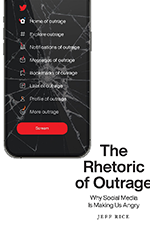
The Rhetoric of Outrage Why Social Media Is Making Us Angry, by Jeff Rice. University of South Carolina Press, 2023. $32.99 paperback; $114.99 hardcover
Social media and rational discussion complement each other about as well as orange juice and toothpaste in the morning. Social media provides a series of digital platforms, open to all, that often reduce complicated emotional reactions and happenings to the push of a button (i.e., downvoting comments, reacting with emojis, or “liking” posts). In mere seconds, lightning-fast gut reactions can transform headlines, catchy memes, and even bite-size videos into twisted jumbles and warped fragments that leave us grappling with often serious repercussions. In The Rhetoric of Outrage, Jeff Rice explores how outrage permeates digital landscapes, shaping our discourse and influencing our perceptions. Rice's assertion that outrage has become a common form of discourse in the digital public sphere implies questions about the functions, effects, and affect of digital outrage. Through a comprehensive exploration of various rhetorical devices such as the enthymeme, aggregated imagery, and the dynamics of assumed speech, Rice explores how outrage is both communicated and cultivated within digital spaces.
In his early chapters, Rice draws inspiration from Vilém Flusser and Roland Barthes to lay the theoretical groundwork for his various case studies that seek to demonstrate digital outrage as both a medium and a technology (10). He uses Flusser’s concept of the technical image (“a projection of an already held belief”) as a critical lens of analysis to integrate ideas of programming, aggregation, assumption, algorithm, etc. (Rice 12). Rhetorical scholars may find it particularly interesting how Rice relates Flusser’s concept of the technical image to Barthes’s study of imagistic rhetoric. Rice unites both concepts together through the idea of time, as Flusser’s technical image represents already held beliefs, while Barthesian images similarly aggregate to evoke certain feelings based on past experience. In “The Rhetoric of the Image,” Barthes uses the image of an Italian Panzani ad to demonstrate what he calls “Italianicity” (the way the ad evokes feelings of Italy or being Italian through the presentation of certain associated colors and culinary ingredients); and Rice later borrows the concept of “-icity” to coin his own term: “outragicity” (Rice 20).
After laying theoretical groundwork in his first few chapters, Rice focuses on tracing specific case studies in the body chapters. When examining relevant -icites, or technical images, Rice primarily focuses on the ideas of aggregation and the enthymeme. Aggregation is an affective concept, in that it “reflects not what something actually is…but what we believe it is,” thereby capturing an emotional, subjective reaction to media (Rice 21). Put into more digital terms, aggregation can be thought of as a data set that coheres based on viewers’ various experiences over their lifetimes. Rice later traces aggregation through various case studies to exemplify how outrage arises not from a single instance, but rather from a sequence of interconnected moments that individuals or groups undergo gradually through ongoing and repeated encounters.
Outrage operates as both a communicator and a mode of communication. Although most people feel that their online, emotional outrage has a specific target, Rice contends that outrage itself can be more discursive and free-floating, with the ability to latch onto whatever content fits the moment. Layered, embedded images evoke audience response based on stereotypes that emerge from profiling. To concretize this point, Rice uses the example of health care. Because health care is such an important and hotly debated topic, it is difficult to discuss without invoking already present and layered emotional outrage. Therefore, when governmental agencies attempt to introduce health care legislation of any kind, “the public becomes incensed from its own published and disseminated incensement,” meaning that the medium of public outrage only continues to fuel more outrage content (Rice 56). Rice uses several health care headlines (“Is The Health Care Ire Part of a Larger Anger?” and “Town Hall Anger Over Health Care Bill”) as examples of how published content about outrage can capitalize on existing public ideologies and drive the public to participate in the publishing of outrage. Essentially, projections of outrage that come from years of aggregated ideology continue to generate more outrage for dissemination and then the cycle repeats.
In his early framing chapters, Rice notes Michael McFarland’s claim that aggregation has the capability to turn human lives, even in the non-digital sense, into databases that can then be profiled and assumed (43). This programming diffuses through loose connections of social media acquaintances, which spread outrage far faster and farther than strong acquaintances, underscoring the influence of “weak ties” in the dissemination of outrage content. Later, in Chapter 4, as an example of this phenomenon, Rice traces the outrage content that spawned from the 2015 killing of Cecil the lion by an American dentist in Zimbabwe. In the hope of demonstrating their disgust, or outrage, at Cecil’s death, people flocked to social media to both shame the dentist who killed him and express their sadness over the death. Rice poignantly details how aggregation of Cecil’s technical image (the gentle name “Cecil,” the frightening perception of dentists, the ills of Western intrusion/colonialism, etc.) fostered outrage that spread like wildfire online, likely through weak ties on social media. Rice returns here to Barthes’ concept of “-icity” to fully define his own term, “outragicity,” as “the digital aggregation of a variety of items that produce the feeling or sentiment of outrage because of the aggregation created” (75). The formation of patterns across weak ties (tweeting broken heart emojis, demonstrating solidarity against the dentist) indicates an algorithmic presence that drives outrage.
The concept of algorithms returns in Chapter 6, not in the sense of algorithmic computer code, but in the sense of an ideological code. Drawing again on Barthes’s idea of imagistic code inferred from the viewer’s idiolect, Rice traces how these ingrained, ideological algorithms aggregate into widely circulated and digital imagery. Viewership, then, is defined as the embedding of our own ideologies into imagery so that we create an ideological image rather than processing only raw visual content. Rice argues that audiences are unaware of the interpretive complexity that they bring to such viewing of images, which means that they “assume meaning as an immediate (or even affective), and not a layered, algorithmic experience” (127). This unconscious experience on the part of the viewer is often shared by the self-focused messenger who makes oversimplistic assumptions about their audience. Through an exploration of notably controversial tweets by professors, Rice demonstrates in Chapter 7 how the concept of the enthymeme is closely tied to audience assumption. He adopts this concentrated focus on audience following Lloyd Bitzer’s “Aristotle’s Enthymeme Revisited” essay and specifically focuses on the missing elements of enthymemic discourse that audiences tend to emphasize when filling gaps to draw their own conclusions (Rice 139). As Rice points out, self-focus can lead some writers to assume that the audience they are reaching is likeminded and will therefore support and agree with the content being disseminated. With an inward focus, often perpetuated by social media, many forget that their social media content is reaching unstable, uncontrollable audiences who bring their own diverse ideologies to the interpretation of images.
Rice builds upon this concept of embedded imagery as a catalyst for belief and immediate reaction in Chapter 8 as he explores epideictic rhetoric. Instead of focusing on epideictic rhetoric in the traditional ceremonial sense of the term, Rice applies Michael Carter's definition of epideictic rhetoric, which is community-or-group-based, to digital spaces and examines the impact of ideological proximity (Rice 177). He traces two very different examples – calls for the resignation of a university president and an inaccurate viral headline concerning an oft-maligned country – to demonstrate how digital enthymemes quickly spiral because “the epideictic nature of the technical image can confuse a problem with the image of a problem” (167). This confusion then has the tendency to spread rapidly to audiences of all kinds and contribute to the circulation of potential misinformation or online mob-mentality motivated by a desire to demonstrate, or socially prove as Rice notes, agreement or disagreement with a popular, viral cause.
Rice’s journey through digital outrage asks readers to reexamine the role of social media platforms within this discourse. Each of his chapters builds upon previous content, allowing Rice to paint a vivid and convincing picture of how outrage dominates online exchange. While acknowledging the power of social media platforms in rapidly disseminating content, and thereby outrage, Rice contends that we, the users, possess the agency to generate outrage. Once outrage is dispersed, affective responses are communicated, and outrage snowballs into more outrage. Despite the prevalence of such anger, the outrage algorithms built into digital culture do not mean that social media itself is to blame for the constant output of outrage.
Rice is careful to emphasize that he has no argument for how to overcome the rhetorical phenomenon of digital outrage and subsequently transform digital platforms into a utopian platform for rational discussion. In thinking further about how social media users might digitally engage with one another more productively, my thoughts turned to Krista Ratcliffe’s concept of rhetorical listening, as it advocates for a nuanced and empathetic understanding of the challenges presented by all types of communication. Just as Rice presents no immediate solutions, rhetorical listening promises no quick fixes but rather promotes an engaged and patient approach to rhetorical deliberation. It involves listening not only to the content of messages but also to the underlying emotions, values, and assumptions that can fuel digital interactions. If rhetorical listening is approached as an avenue for “interpretative intervention,” then Ratcliffe’s idea of understanding as “standing under the discourses” can be applied specifically to the perpetuation of self-focus that Rice outlines (Ratcliffe 204-05). For Ratcliffe, standing under our discourses involves listening to the different discourses present within each of us and attempting to understand how those discourses inform our personal responses and our responses to others (206). Rice’s arguments highlight that social media promotes a great deal of focus on the self, and Ratcliffe provides a path for “listening” to the ideological images that we encounter online in a way that promotes patience with the complex politics, ethics, and biases that we each bring to the viewing experience. Perhaps there is a way that we can “listen” in this fashion to our own internal and visual algorithms. Standing under and engaging with our own discourses might also affect how we engage with others in digital spaces.
In a world that is still struggling with the impacts of an ever-changing digital culture, The Rhetoric of Outrage enriches our understanding of how outrage operates as a force that both unites and divides us within virtual spaces. Rice prompts us to question our digital interactions, the responsibility we bear as digital participants, and the implications that arise when our collective outrage meets the ever-evolving landscape of technology. Reading through this book, I felt myself noticing and questioning some of my own more problematic digital habits such as forming snap judgements based on a headline of an article I didn’t read. I am also paying more attention to the ways that my own experiences and biases inform my daily viewership of digital media, and I am attempting to promote habits of rhetorical listening by standing under my own discourses. The highly technical and complex ideas discussed in this book might heavily challenge nonacademic readers who want to understand why they are being angered by their social media feed. However, for rhetoricians, specifically those interested in understanding how digital rhetoric impacts social rhetoric, the theoretical background behind Rice’s various case studies provides a great addition to our conceptual toolboxes. By studying the interactions between rhetoric, imagery, and assumed speech, Rice facilitates a way for readers and rhetorical scholars to critically engage with the digital age's landscape of both shared and disparate beliefs, heated debates, and constantly evolving digital platforms.
Works Cited
Barthes, Roland. “The Rhetoric of the Image.” Image Music Text. Translated by Stephen Heath, Hill and Wang, 1977, pp. 32–51.
Bitzer, Lloyd. “Aristotle’s Enthymeme Revisited.” Quarterly Journal of Speech, vol. 45, no. 4, 1959, pp. 399–409.
Flusser, Vilém. Into the Universe of Technical Images. Translated by Nancy Ann Roth, U of Minnesota P, 2011.
Ratcliffe, Krista. “Rhetorical Listening: A Trope for Interpretive Invention and a ‘Code of Cross-Cultural Conduct.’” College Composition and Communication, vol. 51, no. 2, 1999, pp. 195–224.
Rice, Jeff. The Rhetoric of Outrage: Why Social Media Is Making Us Angry. U of South Carolina P, 2023.
Issue Number
35