
Helena Mazzarella, University of Pittsburgh
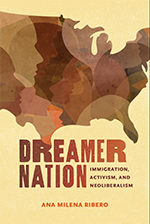
Dreamer Nation: Immigration, Activism, and Neoliberalism, by Ana Milena Ribero. University of Alabama Press, 2024. $29.95
The United States’ political landscape has changed drastically since former President Obama held office, especially in regard to immigrant rights. While the years of Obama’s presidency are the focal years of Ana Milena Ribero’s Dreamer Nation: Immigration, Activism, and Neoliberalism, her research on immigrant rights is especially critical in today’s political climate. On the very day President Trump took office for a second term, he signed multiple executive orders in support of his longstanding anti-immigration agenda, furthering his desire to terminate all prior immigration laws that interfere with his vision for mass detention and deportation. The consequences of his anti-immigration agenda have already surfaced, and they will continue to pose horrific challenges and suffering to the United States’ immigrant community.
The Dreamers are a group of undocumented young people advocating for potential opportunities to earn US citizenship and avoid deportation. “Dreamer” stems from the 2001 Development, Relief, and Education of Alien Minors Act. Despite the act not passing in the Senate, Dreamers have continuously advocated for immigrant rights. In 2012, the Dreamers found temporary relief in Obama’s announcement of the Deferred Action for Childhood Arrivals (DACA) program, but their struggle for recognition has been a continuous battle. Ribero’s book examines Dreamer’s use of strategic rhetorical decisions to support their activism. By analyzing Dreamers’ rhetorical decisions in Dreamer Nation, Ribero reveals how practicing “rhetorical flexibility” provides potential opportunities to further activist movements by “moving among different ideological positions to strategically respond to the present forms of domination” (8). The embrace of rhetorical flexibility, and Ribero’s Dreamer Activism, continue to challenge dominant notions of citizenship within the country amidst shifting forms of domination.
Ribero examines how Dreamers utilized flexible rhetoric during their activism throughout Obama’s presidency. Her book highlights how flexible rhetoric both met the evolution of Dreamer activism and helped it progress. Although Dreamer Nation does not cover every rhetorical situation set forth by Dreamers during Obama’s presidency, Ribero examines a handful. In doing so, she invites readers to explore a complex and nuanced way of thinking about “citizenship” that both includes and extends beyond that of Dreamers.
Ribero analyzes how Dreamers’ written, recorded, and performed texts helped construct Dreamer activism (20). She structures the book chronologically, each chapter exploring a specific moment in Dreamer activism. This structure reveals how Dreamers’ rhetorical flexibility influenced their fight for immigrant rights and activism, shifting and adapting as time and cultural contexts progressed. Ribero notes that her perspective on rhetorical flexibility is influenced by Gloria Anzaldúa’s notion of “nepantla” rhetorics– a term describing one’s transitional position between their multiple worlds made up of varying languages, nations, cultures, and identities (15). Dreamers embrace this state as they inhabit a unique space between documented US citizens and undocumented immigrants, positioned between both physical borders and the borders between neoliberalism and radicalism. Rhetorical flexibility and nepantla are consistent themes throughout Latinx and feminist rhetorics, specifically appealing to scholars within those fields.[1]However, while Dreamer Nation is a book vital to those studying Latinx and feminist rhetorics, it is, more broadly, a salient piece of scholarship to any person who wishes to “examine and question their and others’ practices of worldmaking” (9).
To respect Ribero’s decision to structure Dreamer Nation chronologically, I parallel that structure in the remaining portion of my review. I hope not to simply produce a linear summary of the text, but rather to do two things. First, I wish to emphasize the unstable positionality of Dreamer rhetorics that Ribero illustrates. Second, I hope to highlight one of the most striking features of the book: an evident appreciation for the multitude of complexly nuanced and, at times, contradictory positions and experiences that contribute to activist movements.
The first chapter of Dreamer Nation analyzes events from 2010, a time which “marked the beginning of a new phase of Dreamer rhetorics that presented a “both / and” approach to persuasion” (21). To establish this “both / and” nature, Ribero analyzes the Dreamers’ hunger strikes that sought to persuade Republican senator Kay Bailey Hutchinson to support the Dream Act (34).
The hunger strikes exemplify Ribero’s claim that Dreamer rhetorics are both neoliberal and radical. Dreamers’ hunger strikes made immigrant rights a matter of life and death, emphasizing a radical rhetorical shift from solely verbal rhetoric. Yet, the hunger strikes also created a paradox by giving the state power to determine the quality of Dreamers’ lives. If the state took action to end the strikes in the Dreamers’ favor, then the state upheld its power. Likewise, if the state rejected the strikes, its power remained. This paradox resulted in the Dreamers’ unintentional continued support for the unequal power dynamic between themselves and the government. Ultimately, the Dreamers “still believed in achieving their American Dream” (38) and were unwilling to die for their cause. Despite lacking subsequent legislative action, Ribero notes that the hunger strikes helped shape Dreamers’ future endeavors because they became aware of difficulties surrounding activism dependent on legislative action.
Chapter 2 begins in 2013 with both the Dreamers’ critique of the state’s power and their acknowledgment of that power’s ability to positively change their living conditions and documentation status. This chapter follows the Dream 9, a group of nine Dreamers born in Mexico, who immigrated to the United States as children. Each returned to Mexico for various reasons, but they all wanted to cross the border into the U.S. again because they felt as though it was their home (47).
Ribero analyzes a photo of the Dream 9 marching to the U.S. port of entry in graduation caps and gowns (61). She explains that their march toward the border, though radical, implies their investment in state values, one being that of university education. Their investment in education and the university shows the Dreamers’ continued–but amended–neoliberal values previously present throughout the 2010 hunger strike. The Dream 9’s march to the border both critiques the state’s immigration policies and acknowledges what could happen when immigrants act in a manner that supports the state’s value in a binary good versus bad immigrant narrative. Moreover, the progression of their activism exemplifies Ribero’s claim about how rhetorical flexibility influenced their fight for immigrant rights.
While seemingly contradictory in nature, Ribero’s analysis questions traditional notions of citizenship and urges readers to think about the validity of affective citizenship. She explains how affective citizenship includes an embodied experience of being a citizen that is not dependent on legislative status or cultural practice (52). The Dreamers’ embodiment of the United States’ traditional value in education, as seen by their utilization of graduation regalia, is evidence of their affective citizenship to the U.S. Simultaneously, their public march toward the border condones the United States’ narrow understanding of citizenship.
Ribero also explores additional limitations to the Dream 9’s initiatives, which mirror shortcomings of the prior hunger strike. She explains that Dreamers’ visual embodiment as students, as seen in their clothing, validates the state’s binary and neoliberal notions of who is a good versus bad citizen. By analyzing how the Dream 9 built their activist movement on the idea that a student implies a good citizen, Ribero’s second chapter shows how Dreamers reinforced the state’s neoliberal understanding of the ways “attachment to citizenship is associated with inclusions and exclusions” (70).
Ribero’s third chapter analyzes how Dreamers utilized new rhetorical strategies to match the increasing number of undocumented immigrants seeking citizenship following the Dream 9’s activism. She notes there was a clear rhetorical shift from Dreamers’ value of individual success as it paralleled that of traditional American values and toward “present[ing] a diverse group of undocumented people as part of one familia” (72). This shift is evident in her analysis of the rhetoric utilized by a group made up of about 150 undocumented immigrants, all of whom were of “various ages, nationalities, many of them parents, with or without children” (72). This group became known as the Reforma 150, and Ribero explains that their rhetoric showcased immigrant vulnerability and illustrated the nation as their “home.”
She emphasizes how “the mother” became a central rhetorical figure for this group, promoting a sense of vulnerability that made it possible for immigrants to cross the border in larger groups. Within these groups, each parent would cross separately with a child (73), making family unit less subject to deportation. Families had to play into a narrative that expressed fear and immigrant vulnerability, which is “often read as a feminine characteristic” (73). That vulnerability, although conforming to heteropatriarchal gender norms, is radical in its rhetorical ability to advance immigrant rights, again supporting Ribero’s emphasis on the “both / and” rhetorical flexibility practiced by Dreamers.
Further exploring gender and citizenship, Ribero’s final chapter illustrates the rhetorics employed by the undocuqueer community, as seen in the rhetorical shift from Obama’s presidency to the moments following the 2016 US presidential election. The undocuqueer community “[carry] a documentable stigma about having to ‘come out’ twice: as queer and undocumented” (96). Ribero specifically attends to art in activism (artivism), often employed as a mobilization technique for undocuqueer activists (97). Here, she extends the “both / and” mentality to new immigrant identities, arguing, “The flexibility of undocuqueer rhetorics is not just about being neoliberal and radical at the same time but about pushing the boundaries to imagine new queer worlds out of neoliberal realities” (98).
Ribero analyzes two pieces of art in varying forms, agreeing that both pieces—and art as a means of activism in general—are examples of nepantla rhetorics. Undocuqueer “artivists” (art activists) both engage in Dreamer activism through their artwork and create visuals that prompt the immigrant community to reflect on their own sexism, homophobia, and transphobia (97), further extending the “both / and” framework of nepantla rhetorics. Art is a way for activists to honor the past while depicting hopeful visions for the future.
The tangled, constellating rhetorics of the undocuqueer youth contribute to Ribero’s claims about the importance of complex and nuanced rhetorics that turn away from binary narratives of good versus bad immigrants, legal versus undocumented persons, and neoliberal versus radical. It is in this final chapter that Ribero conveys the importance of each person’s uniquely affective human experience—experiences that do not fit neatly into the boxes that determine documentation status.
Further, Ribero’s chronological structuring of the book is an effective strategy to highlight her findings about the complexity and rhetorical flexibility of Dreamer activism, as she shows how, despite Dreamers’ common goal of improving immigrant rights, each rhetorical situation is constructed with acknowledgment of those before it. The four chapters’ chronological and rhetorical evolution allow Ribero to argue that “Dreamer rhetorics have the flexibility to move among different ideological positions to strategically respond to different forms of domination” (8).
The nuance woven throughout Ribero’s rhetorical analysis of Dreamer activism stands out in comparison to texts traditionally recognized as “academic.” While many academic texts work to untangle complex topics, Dreamer Nation brings attention to the nuance and complexity that is entwined in matters of citizenship. Further representative of her complex analysis, the forms of evidence she analyzes in Dreamer Nation span beyond those of written texts. Dreamer Nation includes the analysis of visual, performative, and traditional textual evidence, illustrating how a text conforming to a traditional academic structure is not capable (or deserving) of analyzing the Dreamers’ activism.
Ribero’s decision to lean into the “both / and” moments evident throughout Dreamer rhetorics during and beyond the Obama era cultivates a refreshing perspective on immigrant rights. Ribero herself practices the “both / and” framework she observes in Dreamer rhetorics throughout the book— offering both a truthful (and sometimes complexly tangled) analysis of the past and suggestions for potential rhetorical paths of the future. In doing so, she makes clear that we must challenge what we believe we know about our ideas of citizenship, the nation, and our communities. We must honor what becomes possible by critically examining and questioning both our perspectives and those of others.
[1] For additional perspectives on nepantla, see De Los Santos Upton; González Ybarra; Martinez; Ruiz.
Works Cited
De Los Santos Upton, Sarah. “Nepantla Activism and Coalition Building: Locating Identity and Resistance in the Cracks Between Worlds.” Women’s Studies in Communication, vol. 42, no. 2, 2019, pp. 135–39.
González Ybarra, Mónica. “‘Since When Have People Been Illegal?’: Latinx Youth Reflections in Nepantla.” Latino Studies, vol. 16, no. 4, 2018, pp. 503–23.
Martinez, Amanda R. “Monstrosities in the 2016 Presidential Election and Beyond: Centering Nepantla and Intersectional Feminist Activism.” Women’s Studies in Communication, vol. 40, no. 2, 2017, pp. 145–49.
Ribero, Ana Milena. Dreamer Nation: Immigration, Activism, and Neoliberalism. U of Alabama P, 2023.
Ruiz, Iris D. “Desconocimiento: A Process of Epistemological Unknowing through Rhetorical Nepantla.” Writing Across Difference: Theory and Intervention, edited by James Daniel Rushing, Katie Malcolm, and Candice Rai, Utah State UP, 2022, pp. 56–76.
Issue Number
35