Kim Fahle Peck, York College of Pennsylvania
Kevin E. DePew, Old Dominion University

Published February 20, 2025
Prior to 2020, one of the areas that we studied in online writing instruction—synchronous video courses (SVCs)—was very niche because asynchronous modalities dominated (Mick and Middlebrook). Despite their niche status and the fact that they countered the first word of online education’s primary marketing slogan of “anytime, anyplace education,” SVCs made us curious to explore them further, recognizing that more writing programs might experiment with this modality as videoconferencing became more widely and inexpensively available. Our previous work on analyzing interfaces of synchronous instruction (DePew and Lettner-Rust) and interactions in synchronous courses (Peck) and the stories that we recounted to each other about students in our SVC classes led us to a shared interest in and collaborative research about the spatial considerations of SVCs. Namely we became interested in the spaces students chose to participate from, how these spaces shaped their individual experience, and how the display of these spaces within the virtual classroom shaped the collective experience of the class. At times we questioned the efficacy of this research; despite our enthusiasm about this mode of online learning, we recognized how uncommon its use was in writing studies, both at our institutions and nationally.
This of course all changed due to the COVID-19 pandemic; suddenly, SVCs became ubiquitous across education as institutions sought to continue offering instruction despite shuttering their physical locations to support social distancing, making the traditional classroom no longer the primary location where teaching and learning was happening. Instead, living rooms, kitchens, bedrooms, and cars parked in proximity to Wi-Fi connections became the spaces where teachers and learners connected together virtually. Students and teachers found themselves teaching and learning in both an unfamiliar format and in unfamiliar locations, at least in terms of seeing these spaces as sites for teaching and learning. Unsurprisingly, many instructors sought to replicate the traditional classroom experience—to approach writing instruction and pedagogy as they had always done; yet, the technological mediation and spatial dislocation of SVCs challenged many instructors and learners to interact, teach or learn in ways they were not used to. Their experience in SVCs did not feel like the traditional classroom experience.
As institutions were forced to confront how the affordances of the technologies used to mediate SVCs during emergency remote instruction impacted all their students, they observed instructors struggling to pedagogically leverage meeting technologies’ affordances and students unable or reasonably unwilling to fully leverage those affordances. In response, institutions began to initiate new policies regulating the expectations that students and instructors should have for interacting in these virtual, visual spaces. Because of to the relative dearth of scholarship on this mode of online learning, it remains difficult for instructors, administrators, and researchers to approach and contextualize such policies to consider how they support or constrain student learning and agency. In this article, we provide a theoretical foundation rooted in assemblage theory for approaching the unique spatio-temporality of SVCs to ground the pedagogy writing instructors use within them and also offer a starting place for future research on this suddenly ubiquitous teaching and learning modality whose continued adoption is being debated at many institutions.
This article explores how SVCs create complex networks of location and expectation for students. We respond to Stacey Pigg’s call for “more research that analyzes how student writers simultaneously and actively navigate—and become influenced by—physical and virtual environments” (254). We do so by operationalizing Johndan Johnson-Eilola and Stuart Selber’s application of assemblage theory for technical communication pedagogy to the adoption of SVCs. We first consider what prior scholarship has revealed about the role of environments and physical space on writers and students. Then, we present a definitional framework of what we are calling an “assemblage classroom” that can be used to understand the intertwined physical and virtual space of SVCs as one starting place for designing effective pedagogy for this mode. Our definition synthesizes previous scholarship as well as draws on interviews with students taking SVCs. While the assemblage of SVCs includes more than just the physical environments from which students participate—including the interfaces of the digital applications and programs students use and encounter on the devices they use to mediate SVCs (i.e., chat spaces, email, social media, etc.)—this article focuses primarily on physical space, unpacking the impact of place on this virtual learning modality.
We want to start by interrogating the trope of anyplace learning within online education. For the first two decades of the twenty-first century, online education was driven by a business model of anytime, anywhere education because of a sense that students with many extracurricular responsibilities wanted and needed the freedom to take courses whenever and wherever they desired. This trope’s prominent presence in publicity materials is illustrated by the University of Phoenix’s 2016 national commercial titled “More than Brains,” described in detail below. Essentially, institutions were selling to students the agency to take their courses within their chosen spaces; therefore, online became articulated with the trope of showing up to class at the kitchen table wearing pajamas with a warm cup of caffeine.
This focus on anyplace is often front and center in the marketing of any program or institution offering online classes to students. For instance, the University of Phoenix’s national commercial “More than Brains,” featured scenes of students learning and working in various locations while juggling other responsibilities, including reading a book by tractor light in a field, working on a laptop on a stool in a restaurant’s backroom, working on a laptop while breastfeeding a baby in a diner’s booth, annotating a book in a truck bed surrounded by other workers, and reading while standing in a busy subway car ("More than Brains"). These marketing messages acknowledge potential students’ working-class status and signal that their online education fits the path to upward mobility into their current lives––education will come to where they physically are. This is an important message since it demonstrates the ways that online learning promises educational access to students who, for a variety of reasons, cannot access traditional, in-person learning.
The literal presentation of anyplace for online learning is worth deeper consideration. Although it may be true that learning or writing can happen “wherever,” we know that not all places will be equally conducive to learning or writing. These tropes often fail to reflect some realities of online education. For example, the cover of Beth Hewett and Kevin DePew’s edited collection, Foundational Practices of Online Writing Instruction (fig. 1), depicts a student sitting isolated in the middle of a lush field, a place unlikely to provide the internet connection needed for online courses.[1]
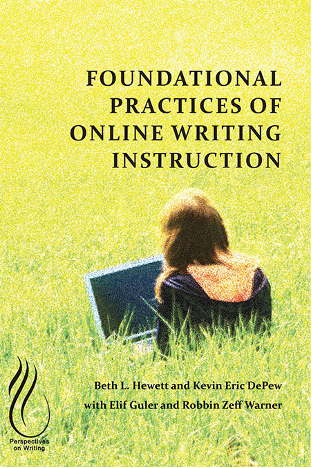
Figure 1. Cover of Foundational Practices of Online Writing Instruction Depicting Anyplace Learning. Hewett, Beth L. and Kevin Eric DePew, editors. Foundational Practices of Online Writing Instruction. Parlor Press, 2015.
Additionally, while the students in the University of Phoenix commercial are portrayed as having universal access to their education, the reality is that they might experience many challenges participating in their education as depicted in these spaces: restaurants employers may have policies not allowing schoolwork while on the clock; reading by headlights or on a subway may make concentration and comprehension difficult for the most able bodied students and can be almost impossible for students with certain disabilities; and a woman breast-feeding in a public space may be subjected to harassment. So, while anyplace education can technically occur anywhere, there may be real limitations and impediments to doing it well. Moreover, the corporate message of accommodating any prospective student with “anyplace” education ignores another value: the location’s potential to enhance the learning experience as an emplaced context with potential resources.
As we know from talking to students in SVCs prior to the pandemic, the practices students create to learn from anyplace are not new. Yet, as the COVID-19 pandemic has made clear, practicing education from anyplace is not always equal. Therefore, it is important to move beyond the anyplace trope to interrogate how students are thinking about the spaces in which they take SVCs.
Composition studies has increasingly considered how writing does not take place in abstract anyplaces but instead in material, physical spaces. In her editor’s note for a special issue of College Composition and Communication on space and place in writing studies, Kathleen Blake Yancey asks, “Where do we write? And what difference, if any, does the location of our writing make? How does our location influence what we write and how we share our writing?” (5). These questions have been increasingly explored by writing studies scholars as part of the material turn in the field as interest extends beyond just the cognitive or social, but also to the embodied experience of writers. Hannah Rule declares, “writing activity is never not emplaced: composing processes only happen through things, spaces, time, action, and bodily movement” (404, emphasis). Some scholars, like Paul Prior and Jody Shipka, have investigated how private writing spaces impact individual composition processes, seeking to understand “the dispersed, fluid chains of places, times, people, and artifacts that come to be tied together in trajectories of literate action” (181). Others have considered how writers work in public spaces. Reflecting on his preference for writing in a particular coffee shop, Michael Faris explains his preference for public writing spaces: “These locations for writing offer something that the isolation of an office cannot: a lively, social atmosphere with ambient sounds, movements around me that serve not to distract but to help me focus, and my own ability to move" (22). Brian McNely et al. similarly highlight how particular spaces promote and inspire invention and collaboration with composition much like the assemblage makerspaces Johndan Johnson-Eilola and Stuart Selber celebrate. Others, like Stacy Pigg have explored how student writers have to navigate and negotiate public spaces such as cafes or university learning commons to make them hospitable for composing.
These scholarly works on space highlight that there is no consensus about the ideal place to compose; while some bodies need to tap into the energy of a bustling cafe, others perform best in the solitude and stillness of an isolated space. This knowledge about emplaced writing is incredibly useful as the question of “anyplace” learning has been pushed to the forefront of composition studies in new ways. Many students and instructors have suddenly found themselves being asked to learn and teach in environments they may not have ever imagined. As several classes recently moved to video conference platforms, the anyplaces that were private to the individual because of their separation from the educational institution are now displayed to instructor and peer audiences. SVCs encourage instructors and scholars to reconsider the role of the physical environment in composition instruction and explore how students negotiate their position as student while simultaneously occupying a physical and virtual space outside of the classroom with peers similarly engaging in this dual-space occupancy.
Traditionally, what have we believed the space in which students interact with teachers and classmates should look like? We presume that, for many people, the face-to-face classroom provides an exemplar; it is often a space where twenty to fifty people sit in individual desks or within rows at long tables. Others might imagine a tiered auditorium facing a professor performing their role on a stage to one hundred or more students. In the introduction to their edited collection, Classroom Spaces and Writing Instruction, Ed Nagelhout and Carol Rutz claim, “For teachers at all levels, the classroom represents a physical, material place for learning, a bounded space within which teachers and students meet for a specific purpose” (1, emphasis ours). They and many of the authors in the collection argue for the interconnection between the physical classroom and the activities and experiences in writing classes (Mirtz; Norgaard). Others like Kevin DePew and Heather Lettner-Rust, drawing upon Foucault, argue that the standard classroom arrangement bestow instructors with authority due to their ability to surveil students and judge whether they are “behaving appropriately” and whether students are “disciplining themselves” (178). The arrangement of space in traditional classrooms often signals a clear power relationship between teacher and student and provides opportunities for instructors to monitor whether students’ behavior is appropriate for that bounded, designated learning space. Calls for attending to the physical arrangements of classrooms from scholars like Julia Voss, who advocates for spatial arrangement that encourages active learning or collaboration through the use of movable furniture or pod seating, are grounded in an understanding that space impacts what we do or what we feel we are allowed to do. From their long histories within classroom spaces, students often enter these spaces with knowledge of what this appropriate behavior is, a notion that SVCs challenge.
Jonathan Mauk asks, “What happens to writing pedagogy, and the practices of learning to write, in the absence of traditional university geography?" (369). Mauk compares the sense of dislocation of a commuter community college campus versus a traditional residential college in the early 2000s. So, while he was not considering virtual learning in his consideration of this “absence” of traditional geography, the rise in online education has made this question even more pertinent. When considering space in SVCs, students are no longer sharing the same physical space of the traditional classroom but instead share a virtual space, which creates an intersection between individual spaces where students are physically located and the shared virtual space of the online classroom interface. Steve Harrison and Paul Dourish call this hybrid space “which comprises both physical and virtual space, and in action is framed simultaneously by the physical space, the virtual space and the relationship between the two” (72). Michelle Kazmer draws on hybrid space as a framework to understand synchronous online learning spaces[2]. Kazmer claims, “The key characteristics of the online classroom as a hybrid space are: students occupy online space at the same time they are occupying and engaging with their local physical space; and the circumstances of their physical surroundings shape the shared online space.” This dual occupancy means that while each individual’s experience is impacted by their “idiosyncratic local environments,” the shared virtual space of the online classroom connects these experiences, directly and indirectly shaping the experience of everyone. Just as Mauk wonders how the geography of a commuter community college campus impacts the pedagogies that are effective in those spaces, we wonder how the hybrid space of SVCs can and should shape the pedagogical strategies used within them.
These scholars have argued that the space of composing and the space of learning matter. From the ways that institutions and instructors design and use these spaces to the effect these spaces have on individual bodies and psyches to the tangible, mental, and emotional resources or obstacles these spaces afford, no space is universal. Although most institutions often expect individuals to uniformly perform the same in any space they are placed within, these performances, even the act of being a student, are affected by obvious and subtle affordances. So, while considering learning spaces, some students may thrive in some space or persist in spite of obstacles, and other students may struggle and become inactive. Instructors would therefore benefit from understanding how students' composing and learning spaces affect their performances and how they can help students leverage the resources available to them in their spaces or help them strategize how to overcome the absence of certain resources.
Prior to the COVID-19 lockdowns, we, as instructors of SVC classes, tried to reimagine the possibilities of literacy education using the affordances meeting applications like WebEx, Zoom, Skype, or Microsoft Teams offered. Yet the chaos and uncertainty that ensued with the mass migration to these online spaces during the pandemic’s early months, as well as the desire to create equity where inequities were quickly discovered, led institutions to develop policies that attempted to standardize experiences. Although we understood the institutional instinct to create stability for faculty and students, especially those new to these teaching applications, we saw a failure to adopt the wealth of wisdom from the scholarship about composing spaces because, anecdotally, remote emergency online education prioritized the day-to-day enactment of education over designing sound pedagogy. Considering the current ambiguity with the term hybrid, we would like to offer a different term and theory to understand and approach SVCs: assemblage, as presented by Gilles Deleuze and Félix Guattari.
To explain assemblage, Deleuze and Guattari employ the metaphor of the strata on a cliff wall to understand history: while we learn something by examining the entire cliff wall, there is also much to learn by examining each strata and the connections between the strata––the relationship between the constituent pieces to the overall knowledge gleaned from the cliff. Johnson-Eilola and Selber further make assemblage theory accessible using a puzzle metaphor: “In one sense, an assemblage is just some objects put together, like a puzzle. But an assemblage is a puzzle in which putting pieces together may deform some pieces, push other pieces out, include pieces that are social, psychological, economic, technical, and/or material. Assemblages are simultaneously simple and maddeningly complicated” (6). As all teachers know from trying to adopt SVC technologies to replicate the “simplicity” of the face-to-face classroom, these technologies introduced many complexities into the instructional space––complexities that theories of space and assemblage suggest could have enhanced students’ education but were often shunned in order to, understandably, simplify a chaotic situation.
For example, we could examine the courses’ constituent “substances” (or the molecular units Deleuze and Guattari describe), such as the field of study, the curriculum, the instructor, the individual students, how each of these stakeholder corporally present themselves (e.g., clothes, cosmetics, hair style, demeanor, ability), the mediating application, the quality of each stakeholder’s oral contributions, the strength of the internet connection, the devices each individual uses to mediate their participation, and how each stakeholder presents the space they take the course from—whether this is a deliberate decision or not. Instead, we chose to focus on the form consisting of the relationship between the substances of the physical spaces classes are taken from and the interface of the meeting application. The form, or the stabilizing structure Deleuze and Guattari describe, is essentially the course. In other words, the space we see through the screen is simultaneously classroom and private space with all of its substances that support and challenge our reading of that space as “classroom.” In their examination of the notion of assemblage and its uptake in geography, Ben Anderson and Colin McFarlane claim, “The term is often used to emphasise emergence, multiplicity and indeterminacy, and connects to a wider redefinition of the socio-spatial in terms of the composition of diverse elements into some form of provisional socio-spatial formation” (124). Every session of an SVC creates a new socio-spatial formation of learners and teachers along with the environments that they are learning and teaching in. Yet this emergence may happen without much forethought, particularly on the part of students who are not practiced with the responsibility of arranging and co-constructing learning spaces. For the purposes of this article, we place the students’ physical spaces at the center of the nexus to inquire how their connection to other substances shapes the course's meaning for students.
To theorize SVCs as an assemblage, we draw on two foundational concepts of assemblage theory: coding and territorialization. In the sections below, we define each concept, situating it within current literature about emplaced composing and learning, and offer representative student perspectives on these ideas from student interviews. These interviews come from an IRB-approved study we began in Fall 2019 exploring the choices students made about their environments while taking SVCs. We recruited students in Old Dominion University’s only SVCs offered by the English department that semester: PhD classes[3], one master’s level writing course that was part of the M.A. in English and fulfilled requirements for the Rhetoric and Composition and Teaching of English concentrations and one undergraduate writing course that was a 400-level special topics course on digital writing. We interviewed five students: one PhD-level student, three students in master’s or post-baccalaureate certification programs, and one undergraduate student. Though our data was collected prior to the mass shift towards remote instruction driven by the COVID-19 pandemic, the insights students provided regarding the choices they made about their spaces and environments are useful when thinking about SVCs broadly, especially considering the current backlash to “Zoom Universities” (Nelson and Vee). Of course, with such a small sample size, the perspectives we share are not generalizable to all students taking SVCs. Our goals are twofold: first, we want to use participant experiences as exemplars that help unpack assemblage theory to interrogate the educational puzzle many institutions now face when determining if and when to offer SVCs. Next, we hope to help SVC instructors think about the relationship building opportunities along with the privacy concerns inherent in the new and sometimes conflicting spatial expectations this mode of teaching and learning creates. Stakeholders need to simultaneously examine the “big picture,” constituent resources, and various combinations of relationships between these resources.
Coding within assemblage theory describes the understood but often implicit rules that govern actions within an assemblage. In other words, it is the order and expectations users assign to the substance, or constituent pieces. Places as territories are coded with particular rules for appropriate action. Harrison and Dourish explain:
Physically, a place is a space which is invested with understandings of behavioral appropriateness, cultural expectations, and so forth. ... It is a sense of place, not space, which makes it appropriate to dance at a Grateful Dead concert, but not at a Cambridge college high table; to be naked in the bedroom, but not in the street; and to sit at our windows peering out, rather than at other people’s windows peering in. (69, emphasis original).
Yet for many instructors and students, videoconference meetings, and SVCs in particular, are new environments which do not already have deeply ingrained coding that they are bringing to bear to shape their expectations of what is and is not acceptable in these spaces. Mary Stewart even suggests that videoconferencing interfaces function as “nonplaces” and instead are intermediaries between actual physical spaces, highlighting that, at least at this point in our experiences with them, videoconferencing environments lack the coding carried by physical spaces. Advancing the adoption of makerspaces over the traditional classroom for technical writing, Johnson-Eilola and Selber argue that the former’s resistance to coding supports innovation that the codified design of the latter makes difficult. While the SVC may not have been imagined as fluid as a makerspace yet, the affordances that space theories would identify as present in them are substances that are often excluded when these spaces are strictly codified as traditional classrooms.
In fact, SVCs as both physical and virtual spaces create potentially conflicting expectations for behavior, with students simultaneously occupying a private space, like a bedroom, and a virtual classroom space. The proliferation of popular, COVID-19-inspired resources about “Zoom etiquette” for academic and professional video meetings––with rules like wear pants, keep people and pets offscreen, and no eating (Ferguson; Moulton)––suggests a discrepancy in how private space is coded when it becomes part of the classroom. Academic institutions try to facilitate learning by encouraging students to re-code their private environment as the classroom through SVC-specific syllabus policies. Yet this desire to compel individuals to re-code their spaces is challenging because, as Nedra Reynolds argues, “As they exist in our memories, in our daily lives, in our rooms or our imaginations, places and spaces are a swirling combination of metaphor and materiality. We carry this swirl of spatialities—some perceived, some conceived, some lived—around with us in every encounter with a place” (175); Reynolds suggests our coding of the places we occupy is deeply ingrained within us.
Additionally, this demand for re-coding private spaces into extensions of educational institutions presumes that classroom-expected behaviors are the best ways to learn. Because students are not physically located in the classroom, however, they have more autonomy to follow the coding of their current place. Sometimes, this conflicting coding can lead to students making decisions that might actually better support their learning. This is exemplified by Wendy, a student we interviewed, who explained where she liked to be for her SVC:
Sometimes I'm in my bed. Um, I have a lot of chronic pain. So, if I have sat at the desk too long, it gets really uncomfortable. So, I'll, you know, go sit in my bed, um, to ease that pain.
Wendy’s decision to be in bed challenges the expected appropriate classroom behavior of sitting at a desk, but it is also an action which might actually benefit her learning because it attends to her body’s material reality. In many ways, sitting in bed for an SVC may help her learn more effectively than sitting in an institutional classroom desk.
While instructors may hope that students choose what they believe are the best environments for learning, students can be constrained to specific environments. In one of our interviews, Eliza reflected on this conflict:
I used to work at a hotel front desk, and I would work the night shift and take my classes there. And I would sometimes have to stop and have people come up to me and check them into their hotel room. Or, you know, nowadays if, um, if my husband's not home from work on time to handle everybody, I will sometimes have a dog, you know, sitting on a bed with me or I will have a kid, you know, wanting a snack and I'll have to pause, and, and run away and come back.
Eliza here shares two different physical locations from which she has participated in online classes: her work and her home. In both locations, there are expected actions for her to undertake based on the other individuals who share that physical space with her. When participating in class in each of these two spaces, Eliza tried to simultaneously enact two place-based identities, either service provider within the hotel or caregiver at home, and the other of a student within the virtual classroom. Because of the educational environment that she has chosen, Eliza, in both locations, perceives the coding of her physical location ultimately taking precedence over the coding of the virtual classroom, helping a hotel customer, or attending to her children. Eliza’s experience shows how complicated the anyplace trope of online education is because the physical locations students choose to learn from are not anyplaces, but specific concrete places with expectations for the individuals within them. The assemblage of physical and virtual space within SVCs necessitates that participants resist, negotiate, or re-code the sometimes-conflicting coding between physical and virtual spaces. While the coding of the face-to-face classroom directs students’ attention to their respective education, the SVC presents access to education in non-traditional contexts as one of its primary resources. Students who may not otherwise have access to a classroom-like setting now have the resource of being able to fulfill their non-academic responsibilities while learning during classroom time. Although this may not be the ideal educational situation, many students who do not have the luxury of experiencing the ideal need access to these multiple resources to change their current socio-economic situation.
Additionally, SVCs create freedom and responsibility for students to select or create environments that will support their learning; thus, they have an active role in the spatial coding of the SVC assemblage classroom. It is important, therefore, to help students think consciously and critically about what Prior and Shipka call “environment-selecting and -structuring practices" or "ESSP’s” (181). While Prior and Shipka’s examination of ESSP’s focus on participants’ representations of the environments in which they write on their own, their examination of material environments and their constituent items and individuals’ impact on learning has relevance to how students compose their learning spaces. For example, another student we interviewed, Alex, shared his thought process when selecting the environment to participate in class from:
For this class at, um, [I log into the videoconference] at work. I go into a separate office… I could go home, but it's one of those things where I just want to say I'm here in the office just in case… And [home] also presents a challenge because I have a dog. She's needy so she can get loud. And I know everyone's always understanding. It's just somewhat to that as you don't want any interruptions, um, during that type of environment, a learning environment.
We see evidence that Alex codes a “learning environment” as one where a student can concentrate; therefore, his home environment conflicts with this coding because of potential canine distractions. Interestingly, when he mentions his work environment, he does suggest that he chooses this environment so that if something arises within that physical space that needs to be dealt with, he can quickly transition from his role as student to his role as employee and deal with the situation, echoing Eliza’s description of moving in and out of her roles as student and customer service representative. Yet Alex contrasts his workplace office with his home, suggesting the former presents fewer interruptions and thus better aligns with a learning environment.
Another participant, Beth, similarly chooses her household environment for its limited distraction:
I am usually from this space where I am right now, which is the attic of my house surrounded, uh, out of the frame by Legos and other toys and things my children have scattered around. This is a space where they can be vanished from pretty easily, and the noise from the rest of the house doesn't travel up here...The little corner that I'm in is very clean and calm, but if you step, you know, two feet out of that, it's a bit, it's a bit chaotic... I mean, everything that I need is up here. Like it's comfortable workspace. There's, it's quiet. Um, it's removed from the rest of the house, so I'm not hearing them and they're not hearing me.
Beth, carving out a separate piece of the domestic space of her home, chooses a learning space away from the “noise of the rest of the house” and one that could arguably be coded as institutionally sanctioned. Some students, however, might be impacted by outside forces when selecting a place from which to participate in an SVC. For example, Eliza explained:
It largely depends on what's going on in my house. Sometimes in our office. You know, if my kids are in there doing homework, I'll sometimes sit on my couch in the living room or I'll go upstairs in the bedroom. Um, there's no set place. It just kind of depends on the dynamic in my household at any given time.
Despite the anyplace trope, Eliza, like many students, is constrained by the material realities of her life and the beings she shares it with. Furthermore, unlike Faris, who relishes bustling spaces as productive spaces, these students all coded their typical private classroom spaces as ones that are quiet and either free from distractions or where they can often select their distractions. But this raises the question as to whether they do this for their own productivity or for their instructional and peer audiences based upon assumption about how these spaces are expected to be coded. Additionally, environment-selecting often goes hand-in-hand with environment-structuring to create an ideal environment for writing and learning. As described above, Beth’s attic has the resources she needs to learn, including comfort. Although she did not specifically explain those things she feels she needs or what makes the space comfortable for participating in class, she provides evidence of environment structuring––Beth has thought about her needs and comfort to support effective learning. This also includes the physical arrangement of her technology, noting:
Right now, my laptop is propped up on a stack of like six books so that I'm not staring straight down at the camera, but it's a little bit more level with me.
Beth has adjusted physical objects in her space to create an environment that supports her SVC participation. Sometimes, though, environment structuring is less about the arrangement of substances or physical materials within a space and more about an individual’s efforts to control the other bodies that occupy that space, as seen with participants' consideration of their pets and children. Specifically, Eliza explained:
I think the only adjustment that I've really had to make is just making sure I shut the door and tell everyone, okay, I'm going to do this. I need you to not burst in in your underwear or, you know, let the dogs in or do anything crazy while I'm on camera.
Eliza’s environment-structuring practices create boundaries on who is allowed to occupy what space and what they can do. These boundaries might differ from the normal coding her family has for those spaces, which institutionalizes parts of her family’s private space for her and her peers’ academic benefit.
Writers’ need to code or re-code their space for writing and learning is not new. Prior and Shipka’s and Rule’s explorations into the private spaces of writers and Pigg’s exploration of semi-public spaces like coffee shops and learning commons remind us that “[i]n physical space as well as on screens of their writing devices, academic composers must set and maintain the scenes of their own process once they leave classrooms” (Pigg 253). Yet online learning and, in particular, SVCs, has collapsed the distinction between classroom and non-classroom space, allowing students to leverage the available resources to code an educational space most conducive for their situation.
While the coding of physical space and its impact on learning is applicable to many different learning modalities, another key concept of assemblage theory, territorialization, is useful for thinking about the agents’ interplay between the meeting application’s interface and the elements of the spaces they occupy. Unpacking this idea, Anderson and McFarlane explain, “Assemblages always ‘claim’ a territory as heterogeneous parts are gathered together and hold together” (126). SVCs attempt to claim the places that students choose to participate from as part of the classroom for the duration of a class session. For example, Johnson-Eilola and Selber describe makerspaces as “assemblages that include higher education and technology development, crossing a phase-state boundary, deterritorializing education” (9). Where traditional education tends to be territorialized as the sage-on-the-stage disseminating knowledge to dozens or hundreds of attentive students, the fluidity of a makerspace allows learning to occur by any combination of present substances––sometimes combinations that occur serendipitously. Similarly, courses taught through video meeting applications, also deterritorialize education, having less control over the ways that students might learn, such as ideas and links shared through the chat as well as teachable moments created within the students’ spaces. But for some students, unlike the makerspaces which invite disparate elements into a single space, the SVC’s deterritorialization of the classroom can be disconcerting. In a New York Times published in May 2020 shortly after the mass pivot to emergency remote instruction, Karen Strassler alludes to this deterritorialization when thinking about the new intimacies synchronous video creates within an educational context:
As we discuss our readings, I observe the posters, photos and tapestries that decorate my students’ walls. I watch their partners and pets moving like shadows in the background...These Zoom intimacies are often endearing, and at times I welcome the strange, unexpected ways this period of enforced isolation brings about new kinds of closeness with others.... But I’m also aware that these glimpses into my students’ homes violate the implicit contract of the classroom, where students have some measure of control over what parts of their lives outside of school come into view (Strassler).
SVCs provide a window into the places students occupy, which as Strassler notes, creates a unique opportunity for instructors to learn more about their students and for students to learn more about each other; however, this presents challenges to traditional privacy boundaries. S.L Nelson and Annette Vee, summarizing Manyu Jiang, describe similar experiences for SVC instructors:
At Zoom University, we are constantly being surveilled by colleagues and students. Our gestures or mics are often muted, but we learn anyway about each other's children, pets, parents, roommates, and living situation. We experience ‘Zoom exhaustion’ from repairing the missing gestures and social cues, listening carefully through audio glitching, and filtering out the irrelevant visuals in other people's backgrounds (16-17).
The students we interviewed discussed unease or at least cognizance of the implications of their classmates and instructor seeing into their environments. Eliza, constrained in her environment-selecting process by what was going on in her household, preferred a location in her house that set boundaries between what should and should not be part of the classroom:
I like to be in my office. I can close the door. It's more of a professional looking setting. I don't feel like people are like looking at the walls in my bedroom while I was talking to them.
Eliza’s desire to project a “professional looking setting” instead of inviting others to view her bedroom demonstrates a desire to demarcate which spaces in her house are private and which can be integrated into the digital learning environment. Her environment-selecting was therefore influenced by the territorialization of her space informed by expectations of video presence within SVCs.
Students’ environment-structuring is also influenced by the knowledge their space will be territorialized and on display to their instructor and peers. One participant, Mike, spoke at length about his choices of what to make viewable on camera:
I'm like an obsessive, neat freak and a collector of antiques...people had commented on the paintings I have in my room. I have a lot of fine art. And, um, I was aware of the fact that I had a, one of the paintings behind my bed that people could have seen was like a, a 19th century impressionist nude. So, when I realized I had a painting of a woman bathing, um, and I was gonna, my bedroom was visible to everybody, I moved a painting of a cat there and moved the painting of the nude just to, uh, above the computer where nobody could see it.
Mike is comfortable having aspects of his personality, like his love of fine art, on display, but also is cognizant of what might be considered appropriate or not for the shared virtual classroom environment. This notion of thinking about what is and is not visible echoes Beth’s description of her attic space in which she is surrounded off-camera by her kid’s toys despite the tidy corner that she created for herself. Though she did not explicitly state that this spatial arrangement of keeping her children’s toys out of frame was done to obscure them from her instructor or classmates, this notion of projecting a “clean and calm” space connects to Eliza’s preference to participate in her home office as a “professional looking setting.” While Prior and Shipka’s discussion of ESSPs focuses on the private experiences of writers within their environments, the territorialization inherent in the assemblage of SVCs creates an audience for environment-selecting and structuring. For some students and instructors, SVCs have the reverse effect and territorialize the spaces they occupy (such as a home or an office), which may result in a self-consciousness and an alteration of how they present themselves academically. Or it may cause them to choose other, potentially less conducive places, to do education.
Some students may not feel comfortable with having their spaces territorialized in general, preferring instead to eschew the use of a camera that displays their space all together. For instance, Wendy noted:
I keep my webcam off most of the time unless I absolutely have to turn it on. Um, I just, I don't know. It's kind of uncomfortable to think that somebody can see into your space. Yeah. So, I think that's probably like, keep it off all the time. If I have to turn it on then, yeah, I guess I would at least make sure it's pointing in a direction where, you know, nothing... I wouldn't have, like myself, isn't being able to be seen, dirty laundry and all of that stuff.
While Wendy was the only participant we interviewed who specifically articulated a desire to keep her camera off, student attitudes and instructor policies towards use of cameras in SVCs has become a frequent topic of conversation since pervasive SVC use in response to COVID-19. Frank Castelli and Mark Sarvary recently published a study of students’ attitudes towards camera use in online and remote classes. They found that the main reasons students did not want to use cameras during SVCs were 1) concern about personal appearance; 2) concern about other people and physical locations being seen in the background; and 3) weak internet connection (Castelli and Sarvary 3569). They suggest these reasons may disproportionately affect minoritized individuals (Castelli and Savary 3570). Using these findings, Catselli and Sarvary advocate camera use not be required; instead, it can be encouraged through explicitly recommending camera use while establishing norms and expectations and addressing potential distractions and surveying students about challenges with camera use at the beginning of the course (3570-3572). In this article, we are not arguing for or against camera policies. Instead, our aim is to help instructors think about SVC’s inherent territorialization as a feature of this modality; it is one that instructors need to be trained to think critically about within their local contexts in order to help their students think critically as well.
The concept of territorialization also helps us think carefully about what instructors can/ cannot or should/should not control related to the inclusion of students’ private or chosen spaces into the virtual classroom. In a tweet pushing back against attempts to appropriate these spaces and code them as educational or professional contexts, Tressie McMillian Cottom wrote, “Employers and schools cannot dictate your home environment and I really want some landmark legal case on this. This is such crap.” Cottom’s tweet encapsulates the tension between teachers, institutions, and students over the authority of individual spaces and thus authority over the entire space of the assemblage classroom. Like Cottom, we resist the notion of faculty taking on a policing role in SVCs related to students’ environments. Instead, we think it is important for instructors to recognize their responsibility to help students make reflective decisions about their chosen[4] learning places since they now have a shared responsibility in creating not only their own learning environment but the class’s shared virtual environment.
Although scholars have begun to explore accessibility and privacy concerns with SVCs, they are not as engaged with discussing the collective impact SVCs have on the entire class’s experience––thus the notion of assemblage is useful. From our interviews with our limited pool of participants, we saw students discuss how the territorialization of their classmates’ spaces challenges them. One participant specifically noted the issue of distraction that can arise from being able to see into others’ spaces. Alex explained:
I try to set up the WebEx where I can only see the person that's talking and the share screen, because sometimes you see a cat just pop up or a dog started barking. And as much as I try not to let that distract me, it is distracting. And when people are not unmuted[sic], you just start hearing the weird things.
The assemblage classroom has created a complex visual and aural collage as the backdrop of the learning environment, opening up the opportunity for what happens in each individual’s physical space to impact their classmates’ experiences.
We understand the anxiety this territorialization creates for many students, but we also see opportunities it can create. For example, instructors can encourage students to reveal parts of themselves and their private lives that their peers would not normally see, and the students feel comfortable sharing; this exchange can leverage SVCs’ affordances for students to create personal connections that benefit their learning (Garrison et al. 99–101). In our interviews, students noted how the territorialization of their classmates' spaces actually served to connect them to each other. Beth discussed how seeing her classmates’ spaces helped her learn more about them:
I kind of enjoyed thinking, you know, how does this person decorate their living room or what's on that poster that I can't quite make out behind them?... You know and as you can see from behind me, like it's pretty plain up here. Um, so I haven't made any effort to, to do anything interesting, but I can definitely get the sense from some classmates that they've kind of positioned themselves so that their space is neat.
For Beth the visual cues about her classmates’ lives and interests became resources that she could use to find ways to connect with them.
As students territorialize their private spaces for academic use, they are positioned to make a series of complex decisions, such as determining what spaces have the least distraction. From what spaces can I attend to my other responsibilities? How should I present my private space, if at all? Some academic institutions want to dictate how students make these decisions by territorializing these private spaces with uniform academic coding. Because we are applied rhetoricians, we see this decision-making process as a learning opportunity for online students, one that university policies could take away from them.
Using Deleuze and Guattari’s strata metaphor, an examination of the SVC assemblage classroom reveals its instructional potential and the opportunities for student learning it affords. Yet, when examining a different combination of substances within the strata, we see familiar social and educational challenges recalcitrantly sedimented into the structure, obstructing instructors’ abilities to achieve this potential. The experiences described by the students we interviewed illustrate both the potential and the perils of SVCs as assemblage classrooms––many of which played out on a much larger scale during the COVID-19 lockdowns. Similar to the makerspaces that Johnson-Eilola and Selber contend deterritorialize education[5], SVCs’ conflation of public and private spaces offers opportunities for students to learn within “the classroom” outside of the coded parameters of a classroom. Students, like Eliza, deterritorialized the virtual educational space to include professional and familial responsibilities. Despite their apparent distractions, Eliza’s learning spaces are emplaced, and like Faris’s preferred writing trips to busy cafés, her learning still happens “through things, spaces, time, action, and bodily movement” (Rule 404) in ways that are conducive for her life. Similarly, by avoiding the institutional furniture that are the substance of college classrooms, Wendy creates an embodied learning experience that meets her needs; she re-codes her bed into an educational space to occupy for each class’s duration. For instructors, including the substances of all participants’ private spaces into the institutional learning space gives all of them the opportunity to kairotically make these substances part of the class’s learning experience.
This potential of the assemblage classroom, however, becomes difficult to achieve because SVCs, as assemblage classrooms, exist within a deeply coded culture. To use assemblage theory to explain Nelson and Vee’s argument, the spring 2020 shift to “Zoom University”––their moniker for a specific digitally mediated SVC––highlighted the substances that coded these digital instructional spaces, such as capitalism, surveillance, racial inequity, class disparity, and gendered objectification. Understanding how these substances territorialized the student learning experience, policies were instituted by instructors, programs, or institutions to diminish some effects (e.g., no mandatory camera activation) while reifying others (e.g., mandatory use of the SVC technologies despite the technology’s collection of student data; see Nelson and Vee). Whether it is Wendy turning her camera off, Alex moving his painted nude, or Cottom inviting a “landmark legal case,” individuals understand how social substances shape synchronous video interaction. While some individuals comply with the prevailing practices that support SVCs’ learning potential, others understandably resist them, caring more about their physical and emotional comfort.
We do not believe this stalemate between the potential and the perils of SVCs can be overcome with a pithy recommendation. As administrators and instructors know, it is seemingly impossible to look at the strata without contending with the present substances, nor should they try to. As much as administrators and instructors want to focus on the future that can be, what we experience in the present is deeply shaped by the past. Until we are able to extricate these problematic substances from the strata and place some in a museum and others in history’s waste bin, we need to find ways to mitigate their effects; sometimes that means administrators and instructors engaging in the uncomfortable conversations about designing pedagogies and developing policies that hamstring our ability to achieve the SVC’s potential.
While dismantling pernicious social monoliths is beyond the scope of this article, we do not want to conclude without hope. Writing instructors teach applied rhetoric; therefore, they have the tools to rewrite social futures. Understanding SVCs’ potential to deterritorialize education, they have the tools to imagine paths to the potential; moreover, they have the tools to help students imagine those paths. We believe that it is within the SVC space that instructors can best prompt students to examine their emplaced experiences in relation to their embodied experiences and their institutionalized experiences. As the prominent users of these anyplace technologies, instructors need to ask them to imagine what they want these spaces to be and do––and then ask them what they can do to get there.
As students experience anyplace education, teachers, according to Reynolds, “need to know more about the spatial practices that students bring with them and how to tap into their embodied practices” (175). SVCs create a ready-made opportunity to tap into students’ embodied and emplaced composition experiences, providing diversely coded resources that deterritorialize the educational space. And with the instructor’s guidance to analyze their own spaces and to discuss the unease of sharing their spaces and experiences, students can collaboratively map ways to leverage the assemblage classroom’s potential while respecting individuals’ concerns. This is not a kumbaya, happy compromise; instead, this is an acknowledgement of the boundaries that individuals place around their experiences and why they make these decisions. Pigg argues that “[t]o assume that all students will acquire strategies for effectively locating mobile composing habits on their own is likely to privilege some students while leaving others underprepared” (269). Similarly, while the deterritorialized assemblage space has the potential for learning to happen in unanticipated ways, instructors probably need to guide most students, for many will be stuck in the traditional classroom’s coded expectations or fail to easily reconcile conflicting codes of their physical spaces and the virtual classroom.
We deliberately narrowed the scope of this discussion to focus on emplaced and embodied spaces presented through video technologies. We understand that the assemblage also includes various communication technologies that students encounter while participating in SVCs, including both those that are sanctioned and part of the official course ecology, like synchronous chat, collaborative documents, and learning management systems, and those that are unsanctioned, like text messaging and social media. Additionally, instructors often have very little control or even knowledge of how students engage with these technologies on their own devices while participating in SVCs. Instructor-guided students and future researchers might extend our exploration of the SVC assemblage to focus specifically on the digital applications and interfaces students navigate while participating, and instructors might need to also guide students to think critically about the technologies that are mediating their learning experience. For example, students might be introduced to the concept “affordances” and be taught how to interrogate what specific digital technologies, like the applications that mediate SVCs, were designed to do, cannot do, and can do even though it probably was not intentionally designed to do. Students can play with the applications’ capabilities and analyze their limitations to understand how designers have coded them as users and to strategize practices for deterritorializing the applications.
We believe that educational institutions should (re)examine SVCs’ instructional potential––both in terms of their logistical opportunities and the lessons to be learned from analyzing and understanding the coding and territorialization of the spaces as an important step in developing effective pedagogical strategies for them. SVCs give students the opportunity to interrogate how the convenience and/or necessity of synchronous video instruction can be negotiated with the visual, aural, and gestural expectations created by the meeting’s purpose. While instructors would assume students come to these decisions through “common sense,” using overt instruction would acknowledge that they sometimes do not, and, more importantly, we, as a society, do not all share the same “common sense.” Instead, SVCs as assemblage classroom provide opportunities and resources for students and instructors to actively co-create learning environments, and maybe even recreate education, with the goal of supporting individual writers as well as the collective community of the class.
[1] We would like to recognize Michael Palmquist’s hard work in designing this cover based upon Kevin’s suggestions. Our critique is not of the decisions he made in collaboration with the authors but the popular tropes that the image features and how they conflict with the reality of many students’ online education experiences.
[2] The courses Kazmer studied did not have any video components, so often the impact of each individual environment only indirectly impacted the rest of the class. In SVCs, however, individual environments can be on display within the shared virtual space, making this impact more direct.
[3] Old Dominion University's English PhD program offers both in-person and online options and at the time of our research all classes, including those in rhetoric and composition or literature, were either taught completely through synchronous video or had a synchronous video section for online students.
[4] It is important to note that racial and class inequities might drive an individual's discomfort with their space being on display. While some platforms, like Zoom, have features like virtual or blurred backgrounds, these features may not be available on certain devices or may require high levels of internet speed, meaning that those who might most need or benefit from these features to protect the privacy of their spaces might not have the technological ability to use them.
[5] To extend Johnson-Eilola and Selber further, we would demonstrate and argue for the agency of the SVC technologies. But again, an examination of specific digital technologies is outside of this article’s scope.
Anderson, Ben and Colin McFarlane.“ Assemblage and Geography” Area, vol. 43, no. 2, Jun. 2011, pp. 124–127.
Castelli, Frank R. and Mark A Sarvary. “Why Students Do Not Turn on Their Video Cameras During Online Classes and an Equitable and Inclusive Plan to Encourage Them to Do So.” Ecology and Evolution, vol. 11, no. 8, Jan. 2021, https://doi.org/10.1002/ece3.7123
Cottom, Tressie McMillian [@tressiemcphd]. “Employers and schools cannot dictate your home environment and I really want some landmark legal case on this. This is such crap.” Twitter, 2 Sept. 2020, https://twitter.com/tressiemcphd/status/1301207947855433735
Deleuze, Gilles and Félix Guattari. A Thousand Plateaus: Capitalism and Schizophrenia. Translated by Brian Massumi. University of Minnesota Press, 1987.
DePew, Kevin and Heather Lettner-Rust. “Mediating Power: Distance Learning Interfaces, Classroom Epistemology, and the Gaze” Computers & Composition, vol. 26, no. 3, Sept. 2009, pp. 174–189
Faris, Michael J. “Coffee Shop Writing in a Networked Age.” College Composition and Communication, vol. 66, no. 1, Sept. 2014, pp. 21–24.
Ferguson, Matthew. “From One Student to Another: Zoom Etiquette Tips.” WSU News, 29 April 2020, https://www.wichita.edu/about/wsunews/news/2020/04-april/zoom_etiquette_5.php
Garrison, D. Randy, Terry Anderson, and Walter Archer. "Critical Inquiry in a Text-based Environment: Computer Conferencing in Higher Education." The Internet and Higher Education, vol. 2, no. 2–3, Spring 1999, pp. 87–105.
Harrison, Steve, and Paul Dourish. "Re-place-ing Space: The Roles of Place and Space in Collaborative Systems." Proceedings of the 1996 ACM Conference on Computer Supported Cooperative Work, November 16–20, 1996.
Johnson-Eilola, Johndan, and Stuart A. Selber. "Technical Communication as Assemblage." Technical Communication Quarterly, vol. 32, no. 1, Spring 2023, pp. 79–97.
Kazmer, Michelle M. “Cats in the Classroom: Online Learning in Hybrid Space.” First Monday, vol. 10, no. 9, Sept. 2005, https://journals.uic.edu/ojs/index.php/fm/article/view/1278/1198.
Mauk, Jonathan. “Location, Location, Location: The "Real" (E)states of Being, Writing, and Thinking in Composition.” College English, vol. 65, no. 4, Mar. 2003, pp. 368–388.
McNely, Brian J., Paul Gestwicki, Bridget Gelms, and Anne Burke. “Spaces and Surfaces of Invention: A Visual Ethnography of Game Development.” enculturation, vol. 15, Feb. 2013, https://www.enculturation.net/visual-ethnography
Mick, Connie Snyder, and Geoffrey Middlebrook. "Asynchronous and synchronous modalities." Foundational Practices of Online Writing Instruction, edited by Beth L. Hewett and Kevin Eric Depew, Parlor Press, 2015, pp. 129–148.
Mirtz, Ruth M. “The Inertia of Classroom Furniture: Unsituating the Classroom.” Nagelhout and Rutz, pp. 13–28
“More Than Brains University of Phoenix HD Commercial.” YouTube, uploaded by Xad Clicker, 26 May 2016, https://www.youtube.com/watch?v=UabtBNRAc14
Moulton, Lex. “Finding a Middle Ground on Zoom Etiquette.” The State Press, 11 Sept. 2020, https://www.statepress.com/article/2020/09/specho-students-and-instructors-struggle-to-navigate-classroom-etiquette
Nagelhout, Ed and Carol Rutz, editors. Classroom Spaces and Writing Instruction, Hampton Press, 2004.
---. “Introduction: The Spaces of the Classroom.” Nagelhout and Rutz, pp. 1–12.
Nelson, S.L. and Annette Vee. “The View from ‘Zoom University:’ Surveillance and Control in Higher Ed’s Pandemic Pedagogy Pivot.” enculturation, vol. 34, Feb. 2022, https://www.enculturation.net/zoom_university
Norgaard, Rolf. "An Archeology of the Classroom." Nagelhout and Rutz, pp. 153–166.
Peck, Kimberly Fahle. “‘Anyone? Anyone?”: Promoting Inter-Learner Dialogue in Synchronous Video Courses.” Computers and Composition, vol. 62, Dec. 2021, https://doi.org/10.1016/j.compcom.2021.102671.
Pigg, Stacey. “Emplacing Mobile Composing Habits: A Study of Academic Writing in Networked Social Spaces.” College Composition and Communication, vol. 66, no. 2, Dec. 2014, pp. 250–275.
Prior, Paul, and Jody Shipka. “Chronotopic Lamination: Tracing the Contours of Literate Activity.” Writing Selves, Writing Societies: Research from Activity Perspectives, edited by Charles Bazerman and David Russell, WAC Clearinghouse, 2003, pp. 180–238.
Reynolds, Nedra. Geographies of Writing: Inhabiting Places and Encountering Difference, Southern Illinois UP, 2003.
Rule, Hannah J. “Writing Rooms.” College Composition and Communication, vol. 69, no. 3, Feb. 2018, pp. 402–432.
Stewart, Mary. “Student-Teacher Conferencing in Zoom: Asymmetrical Collaboration in a Digital Space/(Non)Place.” Kairos, vol. 25, no. 2, Spring 2021, https://kairos.technorhetoric.net/25.2/praxis/stewart/index.html
Strassler, Karen. “What We Lose When We Go From the Classroom to Zoom.” The New York Times, 4 May 2020, https://www.nytimes.com/2020/05/04/sunday-review/zoom-college-classroom.html#click=https://t.co/j5Rw8WD7iC
Voss, Julia. “WPAs as University Space Managers: Theorizing and Guiding the Creation of Effective Writing Classrooms.” WPA: Writing Program Administration, vol. 43, no. 2, Spring 2020, pp. 109–130.
Yancey, Kathleen Blake. "From the Editor: Locations of Writing." College Composition and Communication, vol. 66, no. 1, 2014, pp. 5–11.
Comments