
Allison D. Carr, Coe College
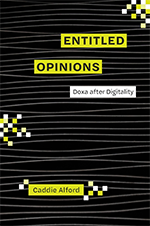
Entitled Opinions: Doxa after Digitality, by Caddie Alford. University of Alabama Press, 2024. $34.95
I have been thinking about doxa more or less constantly since reading Caddie Alford’s debut monograph Entitled Opinions: Doxa After Digitality (2024). To put that “since” into scale, fully five months have passed since my first reading, during which time my efforts to gather my thoughts into these paragraphs has been stymied by the confounding experience of seeing, everywhere and all of the time, the threads of Alford’s (astonishing, compelling, provocative) theorization of “commonly held opinions” as the bedrock of persuasion. Which, I suppose, is exactly the point: Alford writes in her introduction, “To ‘aim at commonly held opinions’ is to begin practicing rhetoric—to begin the practice of noticing and carrying forward ‘the persuasive’ of the given” (14). The challenge, for me, has been in establishing enough distance from the subject to think and write critically about it, which is no small feat when the subject is “the givenness” everyday discourse, doxa.
The challenge I describe is an illustration (encapsulation?) of what I find so important and exciting about Entitled Opinions: it simultaneously makes strange and re-familiarizes readers with the rhetorical constructed-ness of it all [::gesturing broadly::], this sea (of beliefs, attitudes, bullshit, false truths, true truths, entendres, memes, rejoinders, bot spam, false equivalencies, TikTok dances, ratios—vectors for identification, pleas for attention, yearnings for connection) we swim in. That Alford is able to pull it off without, presumably, sinking slowly into the sea, driven mad by the always-unfolding, mobius-strip-like structure of doxa is a marvel, evidencing a precise and meticulous mind.
To put it plainly for readers: Entitled Opinions is a book about the internet, but more specifically, it is a book which takes as given that “the internet” is no longer a discrete “location” separate from “real life.” Like it or not, the internet is real life. And here, as has been the case for millennia, “real life”—by which I mean the norms, truths, codes, flows of power, organization of resources, etc.—is made “real” by consensus (big if true!). This is what Aristotle means when he says that the rhetorical arts ensure the “truthful” position will win out, and this is also what Plato means when, via Socrates, he characterizes rhetoric as, well, bullshit. Alford begins here, rooting in this presumed conflict to show that, no matter which way you slice it—doxa, “the opinions that intertwine the individual with publicity” (16) and companions endoxa, “the shared truths that create assemblies of communities,” and adoxa, “opinions that lack orientation to sociality because they lack status and evidence” (16)—are “the essential ingredient” (32). Doxa are the baggage that people carry, the judgments they make, the predispositions they reason from, the “gut feelings” they follow or ignore. There is no knowledge “out there” which is not made possible, conditioned, disseminated without so-called knowledge “in here,” e.g. “common sense.” Therefore,
Increasingly, rhetoric’s reason for being stems not so much from the friction between knowledge and doxa but from the relations between opinions, widespread values, and the decidedly improbable underbellies of each. . . . [O]pinions are the most fundamental materials for rhetoric’s most social tasks. Opinions help define communities and assemblages. Opinions are stakes in public matters of concern. Opinions are culturally interwoven. Opinions make the very act of connecting to one another possible. . . . With opinions, rhetoric has available means; without opinions, rhetoric has empty pockets. (22-23)
Alford builds out this line of thought in the book’s first body chapter, “Doxa + Sociality,” which both establishes the broader theoretical framework and works through multiple contemporary use cases to make her primary terms salient. It would be a disservice to Alford’s work for me to attempt summary here; her work on such cases is highly detailed and context-dependent, but readers exit the chapter understanding that the doxa triad, now supercharged by algorithms, both socializes and individuates individual people. And this is particularly relevant in the case of adoxa, which in a pre-digital society may have been suppressed due to a lack of opportunity for social expression/development (individuating negatively), but which now manage to find traction, charting paths (digital and real) that form the perimeters of whole new realities (individuating and socializing positively, that is, finding personal validation in social reinforcement). When we say, “I feel like so-and-so is living in an alternate reality,” there is truth to the observation: by distributing and assigning rank and relevance to each and every opinion, no matter how adoxastic, algorithms help adoxa constitute itself as endoxa in a both-and arrangement (“adoxastic endoxa?”), which over time can also emerge as doxa. Said more plainly: opinions that are bonkers, bananas, or otherwise socially reprehensible come to be made ordinary or “agreeable” (common sense) within the confines of niche “realities” of individual online experiences. In a pre-digital era, we may have believed that doxa were relatively stable and widely understood. In an algorithmically mediated world, Alford shows that multiple presumed-coherent realities run up against each other.
In the book’s four remaining body chapters, Alford walks readers through the iterative multitudes that unfold from this central finding. These “iterative multitudes” are organized along four additional “sites of inquiry” (15) for doxa’s formation and dissemination. In “Doxa + Infrastructure,” Alford theorizes opinions as the operating infrastructure of social media environments for both human and non-human users: “Each dragged cursor and quick swipe travel the pathways that opinions lay out” (17). In “Doxa + Bodies,” extending Arendt, Alford homes in on the “sensate-ness” of common sense, calling doxa “extra-sight, extra-hearing, extra-touch[,] . . . the senses rendered rhetorical” (80). In this chapter, readers are reminded of all the ways their engagement with social media is mediated by the body, a body that clicks, swipes, and “likes,” on devices that provide haptic feedback, in networks on which we are increasingly reliant for proof of self-in-community, in a manner of speaking. Those bodies are necessarily impacted by platform moderation, which is the primary focus of this chapter. Discussing the decision made by social media platforms such as Twitter and Facebook to rely on vague “community standards” and opt-in reporting for content moderation, Alford observes:
Social media users learned with content moderation: moderation guidelines performed how to do what is right and good by feeling what is right and good. . . . At the very same time that moderation expressed its own commonsense, platforms were also “algorithmically reward[ing] the most popular and outlandish” (Gillespie 203). Eventually, we all learned that if we wanted visibility, we had to play the algorithmic game. What therefore became reasonable was the user-body who learned to click on everything, to comment on everything, to follow up on everything that seemed interesting. (85)
“Doxa + Time,” explores the temporality of opinions in social media environments, correlating “the latency period of a virus” to “how doxa take root, come to the surface, and shed within broader contexts” (108), asserting that “it would be wise to think of opinions . . . like endogenous retroviruses—ties to the past that remain open to what might lie ahead” (114). And finally, in “Doxa + Invention,” Alford addresses the “so what” of it all. How can users find or make coherence in a fundamentally incoherent reality? Alford returns readers to a familiar starting place, invention, with—in my case—a new understanding of its purpose, “to make something unrecognizable for just a split second.” Readers of enculturation will recognize this chapter as an update to Alford’s 2016 article on doxa (“Creating”), which was my first introduction to the lines of thoughts she’s now spent nearly ten years developing. The book also includes a postscript, which gathers and remediates some of the more prominent findings and observations of the book in something like a meditation on the implications of the adage, “Everyone is entitled to their own opinion.” In so doing, the postscript shows that Alford’s work is not limited to the moment: the method and apparatus for study in this work can be adapted to as yet unknown evolutions in digital media and the digital commons.
Early on in the work, Alford describes her project as “one of the first sustained models of rhetorical theory that takes seriously what social media is doing to rhetoric and what rhetoric is doing—and might be able to do further—to social media” (14). This is not a realm of scholarship I stay connected to beyond a sort of curious perusal; that is, it is not my research area, and so I am taking Alford (and her publisher) at her word as to the book’s position among work that explores these topics. That said, I mentioned before that I have been thinking about doxa and Alford’s treatment of it more or less constantly since reading Entitled Opinions five months ago. I think about it in relation to my teaching; it will inform my contributions to a community lecture series I’m part of this winter; and I am planning to re-read Entitled Opinions alongside one of my undergraduates in the context of an independent study this coming spring: none of which is “about” social media, but all of which is “about” rhetoric.
Maybe more to the heart of the matter, Alford’s work here looms in my mind like a Surgeon General’s warning on a pack of cigarettes. I am a person many might describe as “terminally online,” which is to say, online is probably killing me. Or at the very least, doing some harm. I’m not an uncritical user of social networks, but I do notice that too much time in the tunnel conditions a particular kind of isolation or loneliness that is, at times, maddening. In this context, I receive Alford’s attention to the “noise” comprising that experience as a necessary wakeup or reality check on my habits and, yes, my opinions. I’m learning to develop more discipline in my use. I’m more conscientious of my inclinations, and of the paths I travel. I’ve been thinking of doxa as “desire lines,” that poetic term referring to footpaths through grass or gardens that evidence collective-individual eschewal of predefined and manicured walking paths (Bachelard; Bramley). What are the affordances of those paths, and what damage do they signal? What work are they doing on users?
I have many other thoughts that aren’t developed enough to share here, though I allude to them in service of a final point: this is a book that sticks. It directs its reader’s gaze simultaneously to this contemporary moment, to the long histories of known, implied, and even unknown influence, and to our rhetorical and lived horizons. Undoubtedly readers will find fascinating and generative tensions with other work across disciplines and subfields. In my own reading, I find it has much in common the work undertaken by Debra Hawhee in A Sense of Urgency (also reviewed at enculturation) for how it observes and theorizes the ways that social conditions are shaping rhetoric anew, and it has much to add to conversations around the rapid growth of fascist politics and corresponding efforts among activists and organizers to stymie that growth and/or respond to the moment (Nathan Crick’s recent collection The Rhetoric of Fascism comes to mind, as does journalist Max Fisher’s recent The Chaos Machine, which approaches many of the same questions and phenomena as Alford confronts, but from a more logistical perspective). It is also—I wish to emphasize—written with an animating attention to language that is too rare in scholarly publishing. One comes away with the sense that Alford has labored over every line, as a poet might, taking care to invite readers into her assemblages of meaning and to take some readerly pleasure there. In this respect, the work as a whole serves another end, beyond its theoretical aims; it shows the work that language can do to make that knowledge meaningful, and memorable.
Works Cited
Alford, Caddie. “Creating with the ‘Universe of the Undiscussed”: Hashtags, Doxa, and Choric Invention.” enculturation: a journal of rhetoric, writing, and culture, vol. 23, 2016.
---. Entitled Opinions: Doxa After Digitality. Alabama UP, 2024.
Bachelard, Gaston. The Poetics of Space. Translated by Maria Jolas. 1964. Penguin, 2014.
Bramley, Ellie Violet. “Desire Paths: The Illicit Trails that Defy the Urban Planners.” The Guardian, 5 Oct. 2018, www.theguardian.com/cities/2018/oct/05/desire-paths-the-illicit-trails-that-defy-the-urban-planners. Accessed 29 Jan. 2025.
Crick, Nathan, editor. The Rhetoric of Fascism. U of Alabama P, 2022.
Fisher, Max. The Chaos Machine: The Inside Story of How Social Media Rewired Our Minds and Our World. Hatchette, 2022.
Gillespie, Tarleton. Custodians of the Internet: Platforms, Content Moderation, and the Hidden Decisions that Shape Social Media. U of Connecticut P, 2018.
Hawhee, Debra. A Sense of Urgency: How the Climate Crisis Is Changing Rhetoric. U of Chicago P, 2023.
Purfield, John. “Review of Debra Hawhee’s A Sense of Urgency: How the Climate Crisis Is Changing Rhetoric.” enculturation: a journal of rhetoric, writing, and culture, vol. 34, 2023.
Issue Number
35