
Kelsey I. M. Chapates, University of South Carolina
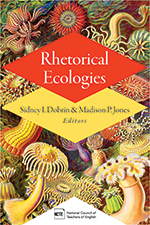
Rhetorical Ecologies, edited by Sidney I. Dobrin and Madison P. Jones. NCTE, 2024. $39.99
When first introduced by Richard Coe in 1975, “eco-logic” recognized texts as part of larger socially inflected systems that drew on contextual elements as well as traditional rhetorical features to enrich rhetorical analysis. Today, eco-logic has evolved into what are more commonly known as “rhetorical ecologies.” Following Jenny Edbauer’s call to recontextualize rhetorical situation as historical, temporal, and lived ecological encounters in “Unframing Models of Public Distribution: From Rhetorical Situation to Rhetorical Ecologies,” the concept has flourished, supporting complex and socially inflected rhetorical analyses. In the years following her article, ecologies have gained prevalence in rhetorical theory. Sidney I. Dobrin and Madison P. Jones’s edited collection Rhetorical Ecologies provides a varied look at how rhetorical ecologies are theorized and employed in contemporary scholarship. The result is a wide breadth of case studies, theoretical entanglements, and definitions, all of which find a generative tension in the multiplicitous term “rhetorical ecologies.”
Instead of defining rhetorical ecologies as a singular concept, Dobrin, Jones, and their contributors go about “gathering” ecologies. Their collection is organized under the book’s four section headings: “Counter-Ecologies,” “Social and Ecological Justice,” “Ecologies of Place,” and “Writing Worlds and Relations.” Each section articulates its own understanding of the privileged affordances rhetorical ecologies provide. The collection opens with counter-ecologies, which serve “to interrupt the idea that we can trace any form of singular history of rhetorical ecology and by extension no single or unified definition” (27). The remaining three sections follow from and interact with the disruptions and dissensus laid out by Byron Hawk, Chris Ingraham, Matthew Halm, and David M. Grant in the “Counter-Ecologies” section. In the “Social and Ecological Justice” section, contributors discuss the imperatives contemporary rhetoric must respond to in terms of social justice, emphasizing the new routes rhetorical ecologies open for engaging with human created social ills. Meanwhile, chapters in “Ecologies of Place” connect land and environmental ethics with social justice, carrying over many of the same concerns from the previous section while centering non-Western ecological attunements in many of their arguments. The collection concludes with “Writing Worlds and Relations,” which looks at pasts, presents, and futures of rhetoric. The authors here emphasize the relational engagements afforded by rhetorical ecological perspectives with specific attention to writing and technology’s role.
Combined, the sections use, define, and imagine rhetorical ecologies in multiple directions that allow readers to trace their own interests in the unfolding interpretations of the term. Some authors look to physical objects like John H. Whicker’s interrogation of writing-objects’ agencies, Jennifer Clary-Lemon’s discussion of endangered chimney swifts, and Bridie McGreavy et al.’s tidal mudflats near Acadia National Park. Others use less tangible objects like Laurie E. Gries’s analysis of the triple-parenthetical marks used by far-right and white supremacist groups, Jason Collins et al.’s engagement with renewable energy efforts in rural communities and tribal nations, Samantha Sena-Cook’s reflections on her time at a nonprofit sustainable agriculture community in Japan, Denise Tillery’s concern over environmental discourse on digital platforms, Casey Boyle’s physical and literary consideration of space exploration, and Byron Hawk’s attention to rhythm. Others still reach for more theoretical connections to discuss rhetoric and ecologies in terms of boundaries, like Ingraham and Halm’s attention to materiality, Grant’s turn toward thermodynamics, Leah Heilig’s discussion of madness and social boundaries, and Candace Rai et al.’s use of ecologies as a critical methodology for Writing Programs. The resulting definitions and uses of “ecology” are as varied as the case studies themselves. While many find ecologies as more than metaphorical ways of engaging with their objects of study or theories that drive rhetorical interconnection, others, like Tillery, openly use ecologies as metaphors for systems of activity. Contributors develop a spectrum of ecological perspectives spanning from discrete physical objects to abstract ways of engagement. As a result, the collection rejects a clear consensus of what an ecology is or how rhetoric engages with ecologies.
Importantly, the boundaries of the sections are “permeable membranes” that allow less obvious gatherings to develop (16). The authors interact across sections through their discussions of climate change, colonialism, and temporality. Themes—and anxieties—emerge surrounding rhetoric’s ability to contend with the Anthropocene and with defining the term “rhetorical ecologies” itself. One notable gathering is the tension between the authors’ visions for better futures and the deeply embedded disciplinary commonplaces that rhetorical scholars have difficulty moving beyond. Beginning the collection with counter-ecologies primes readers to question how the following sections not only add to but differ in their conceptions of rhetorical ecologies. The editorial move also creates an inherent tension in the collection between the “Counter-Ecologies” section and the later sections it supposedly counters. “Counter” works similarly to “post,” as with posthumanism, to mark a change in views. Naming the section “Counter-Ecologies” implies that the section is responding to a preexisting understanding of rhetorical ecologies despite claims in the introduction that no strict definition exists. Moreover, the “counter” section aligns with later sections in part due to its decidedly nonhuman emphasis. The authors emphasize relationality, circulation, and co-emergence as critical components of ecologically oriented rhetorical practices that carry through the remaining sections. For Grant, rhetorical ecologies are ways “to think of rhetoric before life and the living” (84). He views living beings and physical matter as participating equally in rhetorical work through their relations. Ingraham and Halm, similarly, claim that circulation within an ecology “is movement of the ecology itself [,] … carrying entities with it over its shifting terrain” (75). “Entities” in this case is Ingraham and Halm’s term for living beings and physical materials whose interactions create ecologies. Along with Grant, Ingraham and Halm posit that ecologies themselves have an agential nature. Their agency is enacted through interactions and relationships among entities, a theme many address in later sections, including those by Clary-Lemon, Rai, Anselma Widha Prihandita, Nolie Ramsey, Tillery, and Boyle.
Beginning with counter-ecologies acknowledges the active role of the nonliving within ecologies as they co-create conditions of possibility for futures that counter rhetorical commonplaces, not ecologies themselves. The section pushes against anthropocentric rhetorical readings that persist within the rhetorical tradition, even with material and animal rhetorics movements, and more directly calls for readers to imagine rhetoric as more-than-human. Many contributors offer different ways of understanding rhetoric without an anthropocentric emphasis, which ultimately justifies the varied uses and definitions of rhetorical ecologies that follow. For example, Hawk’s discussion of three futures for rhetorical ecologies hinges on scholars enacting them. The section can be read as a generative incommensurability with, not a counter to, other definitions of rhetorical ecologies that move toward multiple futures for rhetoric, ecologies, and resulting research. The tensions that arise throughout the collection are a byproduct of taking seriously the agential nature of ecologies and choosing to enact them.
A critical part of acknowledging ecological agency is resisting humancentric tendencies. Writers attribute agency to ecologies, materials, and land throughout the collection, and several invoke indigenous knowledge, emphasizing nonhumans’ participation in rhetorical considerations. McGreavy, Anthony Sutton, and Gabrielle Hillyer, for example, interject Wabanaki languages throughout their chapter. The Wabanaki are a collective of four indigenous tribes who live in what is now known as Maine. Using their languages legitimizes the tribes’ languages and experiences as forms of knowledge, which highlights the attunements to land afforded by working with tribal communities through what Senda-Cook calls “habitual resistance” or mundane habits that resist normative, in this case Western, practices (227). Similarly, Collins, Kristin L. Arola, and Marika Seigel argue for a rhetorical understanding of land as an agential force that moves beyond metaphors. Land, in the case of the Keweenaw Bay Indian Community Lake Superior Band of Chippewa Indians strategic plan, is an agential force in decision-making practices. The strategic plan materializes cultural beliefs, like McGreavy et al.’s use of Wabanaki, while acting as an information repository that recalls Debra Hawhee’s description of “elemental witnessing” in A Sense of Urgency. Hawhee uses elemental witnessing as one form of rhetorical intensification to draw attention to the role of nonhumans in climate change responses. One of Hawhee’s examples is plaque that memorializes the death of a glacier. The plaque addresses future humans who will read it; it will undoubtedly outlast the rock it is affixed to as a memory of the glacier and the horrors that caused its death. The strategic plan functions similarly as an example of how materials remember and place ethical demands on human actors. Collins et al.’s and McGreavy et al.’s entanglements of land-place knowledge with ecological attunements demonstrate the flexibility of rhetorical ecologies and the role materials have in rhetorical processes, especially when placed in conversation with ongoing work on climate change. As ecologies increasingly pervade rhetorical thought, they must engage with (in)justice and colonial forces and be allowed to bear witness to the violence wrought in the name of “progress.” Responding to those injustices with indigenous thinkers enriches rhetorical ecologies and gives readers alternatives to commonplace Western assumptions about material engagements such as land being a resource for human consumption. Implicit in this perspective shift is the need to take material forces seriously. Doing so renews climate change conversations and resists colonial land-use perspectives that objectify materials. Instead, materials are acknowledged as integral agents, impacting rhetorical ecologies similarly to humans. Responding with more-than-Western assumptions also embodies a complex notion of circulation that productively incorporates dissensus as ecologies require “disruption and disorder to diversify and evolve” (122).
Yet, evolution takes on a specific meaning in light of capitalism’s impact on notions of progress. As Clary-Lemon details, the violent nature of human relationships with nonhumans leads to failed engagement with materials due to “progress.” Acknowledging violence as “humans’ main mode of relating” with the environment and nonhumans, Clary-Lemon positions rhetorical ecologies as a new lens for decentering capitalistic gain, especially when coupled with indigenous thought to allow materials agency (144). Like Nathan Stormer and McGreavy—who note that “violence is an aspect of the vulnerability of power” in their article “Thinking Ecologically About Rhetoric’s Ontology”—Clary-Lemon’s examination of chimney swift conservation efforts demonstrates the pitfalls of humancentric enactments that minimize nonhuman roles (14). Recognizing colonial violence and capitalist ventures embedded in conservation efforts enables a productive tension for more honest futures that resist Western notions of progress. Clary-Lemon’s work is complemented by Gries’ discussion of hate and Heilig’s work on madness. Together, these authors widen the idea of ecologies through dissensus, by not replacing violence, hate, or madness with their opposites, but by bringing such notions into conversation with other ways of engaging with the world.
McGreavy et al.’s discussion of tidal ethics offers readers another example of how expanded material engagement via rhetorical ecologies can counter Western capitalistic perspectives. Tidal ethics is based on listening with an understanding that life is beyond our control, so we need to live with incommensurabilities, differences, and relationships simultaneously. McGreavy et al. use tidal ethics to counter the belief that knowledge is possessed by individuals and gained through linear progress. The practice of releasing control plays out in their discussion of temporality. Tidal time, following from tidal ethics, relies on a multiplicitous understanding of time that disrupts chronos and creates “a rhythm to life that is impossible to control” (208). Releasing control is one way of moving away from a linear (and colonial) sense of progress to an “embodied presence” that emphasizes listening and indigenous forms of knowledge (212). For McGreavy et al., listening is coupled with breathing to recognize connections across and respond to incommensurabilities. Although some chapters maintain an ecology-as-a-site-of-action approach, the majority adopt an enacted view of ecologies, which mirrors Coe’s own desire for entangled relationality. The resulting complexity necessitates readers’ acceptance of incompatibility as an opportunity for greater rhetorical gain as it opens rhetoric to possible futures through co-emergence. Refusing clean application of rhetorical ecologies, and embracing the tensions that arise, allows authors to imagine new ways of knowing, being, and enacting, also allowing for an “ongoing morph” that is open to non-chronos characterizations of progress (260).
Almost all the writers discuss the constant flux of ecologies, their precarity, iterative nature, and the ways ecologies skew temporality and create an “unfolding present” by considering inanimate objects’ agency (79). In each instance, though, humancentric tendencies creep back in. Boyle’s closing chapter critically engages with the tensions that result from anthropocentrism, relationality, and circulation that arise throughout the text, with an eye toward imagined futures. Echoing Clary-Lemon, Boyle uses spacefaring examples to illustrate how “human’s self-appointed stewardship of this world has failed” (311). He focuses on the emergence of imaginary beings as they gain a “real existence” through a circulation of aesthetics that allow us to attend to multiplicities of different realities (314). Boyle calls for us to “more actively leverage imagining against the imaginary to multiply reality” (329). The hope is to become less fixated on a singular future. Instead, Boyle argues, scholars ought to engage with multiples and break away from progress as a fixation on reaching a specific end. Rhetorical ecologies become one approach for “generative grappling” with publication practices, capitalistic engagements with nonhumans, and the exclusion of indigenous thought (326). We can use tensions to imagine futures and worlds that are otherwise without reasserting a singular way forward for humanities scholarship. Fortunately, as Hawk and Senda-Cook point out, scholars don’t have to wait for conditions that enable such enactment. Instead, Hawk, Sendra-Cook, and Boyle each maintain that we can “create other worlds to inhabit” by writing futures and “co-producing the conditions for their future emergence,” much like the authors of this collection (311, 47).
Dobrin and Jones’ introduction shares Boyle’s desire for multiplicity, as do the other authors. The collection imagines futures for rhetorical ecologies. However, it also charts their histories. While claiming the book does “not seek to outline a complete map of rhetorical ecologies as unified concept,” Marilyn Cooper’s afterword astutely states that “family resemblances” do emerge throughout the shared citations (23, 332). In many ways, this text does what it claims to try to avoid. Gathering ecologies is inherently exclusionary. Positioning the text’s examples as uses of ecologies provides touchstones for what counts within rhetorical ecological research. Therefore, the text implicitly expresses what is not an accepted use of ecology. The family resemblances are definitional no matter how open-ended they may be. Rhetorical Ecologies clarifies what rhetorical ecologies are: complex circulations, nonlinear, based on dissensus, material, and discursive. As inclusive as that may sound, a selective disciplinary history still informs ecological thinking. The book shows how rhetoric and composition have arrived at their current configurations of the term “rhetorical ecologies” through shared citations that current rhetorical ecological research ought to engage with.[1] The authors solidify, however implicitly, a roadmap for rhetorical ecologies. This limitation is part of any theory building, as no theory can, nor should, do everything. However, the stated avoidance of a definition is misleading. Dobrin and Jones do provide a definition for rhetorical ecologies by way of their contributors. Acknowledging their own assumptions as frameworks for the collection would aid in understanding the scholarly connections they see among the pieces and how the book collectively defines rhetorical ecologies.
Importantly though, Dobrin and Jones’ collection offers a way of determining how rhetorical ecologies have developed as a concept thus far. As noted, the counter-ecologies section “interrupts” a single history or definition but that is true for the whole collection. Rhetorical Ecologies is part of the history and definition of the term, disrupting what we know as rhetorical ecologies. We are half a century from Coe’s eco-logic but in many ways still struggling with the same desire for complex, yet accessible, engagement with the otherwise mundane, nonhuman forces influencing our rhetorical understanding. Rhetorical Ecologies takes that complexity at face value and opens the term rhetorical ecologies to a multiple of futures that only need to be imagined and enacted by scholars moving forward.
[1] This review is equally complicit in the citation codification being discussed.
Works Cited
Coe, Richard M. “Eco-Logic for the Composition Classroom.” College Composition and Communication, vol. 26, no. 3, 1975, pp. 232–37.
Dobrin, Sidney I., and Madison Jones, editors. Rhetorical Ecologies. NCTE, 2024.
Hawhee, Debra. A Sense of Urgency: How the Climate Crisis Is Changing Rhetoric. U of Chicago P, 2023.
Rice [Edbauer], Jenny. “Unframing Models of Public Distribution: From Rhetorical Situation to Rhetorical Ecologies.” Rhetoric Society Quarterly, vol. 35, no. 4, 2005, pp. 5–24.
Stormer, Nathan, and Bridie McGreavy. “Thinking Ecologically About Rhetoric’s Ontology: Capacity, Vulnerability, and Resilience.” Philosophy & Rhetoric, vol. 50, no. 1, 2017, pp. 1–25.
Issue Number
35