
Mafruha Shifat, Ohio State University
Ann Hill Duin and Isabel Pedersen, Augmentation Technologies and Artificial Intelligence in Technical Communication: Designing Ethical Futures, Routledge, 2023. 282 pp. ISBN 9781032263755.
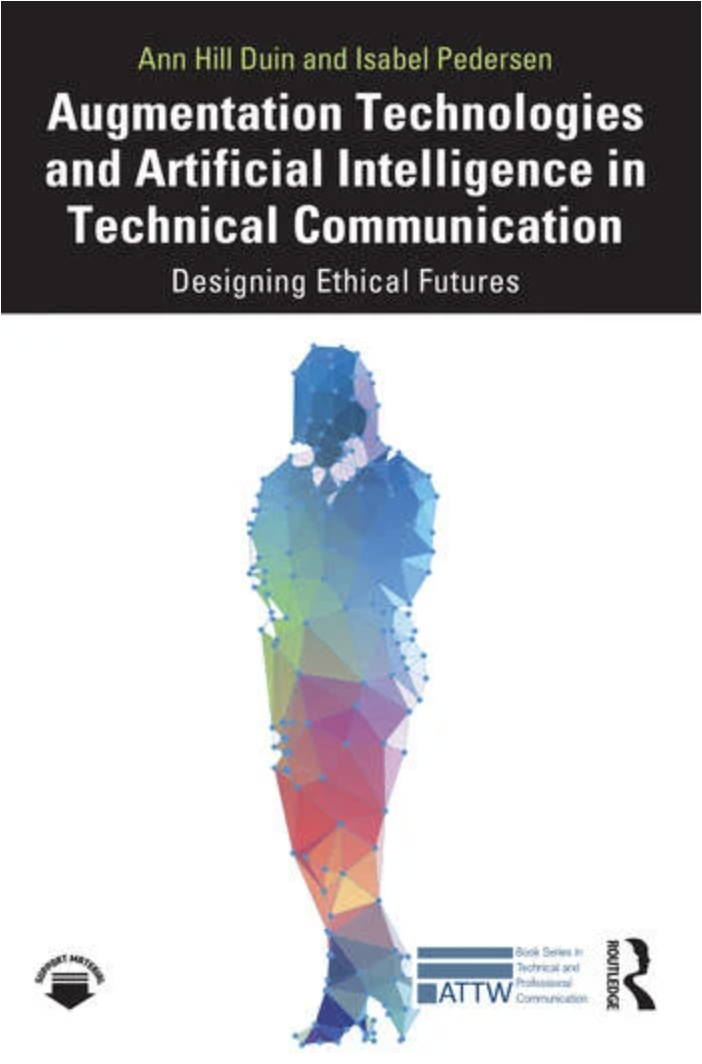
Augmentation Technologies and Artificial Intelligence in Technical Communication: Designing Ethical Futures by Ann Hill Duin and Isabel Pedersen is a comprehensive exploration of the intersection of Artificial Intelligence (AI), augmentation technologies, and human experience. This book offers essential tools for the ethical design and adoption of emerging technologies within technical communication. It is an important read for students, scholars, and professionals in technical and professional communication (TPC), user experience design, computer science, and related fields, providing, in the authors' words, "greater depth for understanding augmentation technologies and, amid enhancement of professional capabilities, a strong focus on building technical and professional communication ability, and strategic knowledge to articulate its benefits, risks, and relevance" (19). Further, it includes links to an online archive, "Fabric of Digital Life," which offers a wide range of materials curated with detailed meta-tagging.
Rhetorical and professional communication scholars Heidi A. McKee and James E. Porter argued in 2017 that, "increasingly, humans are communicating with AI agents, often without knowing they are doing so" (135). They continue, "The implications of AI for professional communication and for organizations and business professionals who deploy AI agents are profound." From a similar viewpoint, Duin and Pedersen believe that the purpose of their research on augmentation technology and AI "is to cultivate an even deeper understanding of human augmentation and AI technology, build technical and professional communication capacity to articulate its benefits and risks, and provide direction for future practice and collaboration" (3). Considering McKee and Porter's conversation on human-AI interaction as their framework, Duin and Pedersen emphasize the importance of integrating ethical principles into developing and applying augmentation and AI technologies in their book. These principles include ensuring privacy, upholding accountability, guaranteeing safety and security, maintaining transparency, fostering fairness and preventing discrimination, adhering to professional responsibility, and advancing human values.
The authors also analyze the societal value systems that shape augmentation technologies, such as beliefs surrounding enhancement and automation. For example, when discussing AI's potential emotional enhancement, they argue, "Critical to emotional enhancement is that ethical design practices must underpin all work in this area to ensure that human rights are always respected" (53). Duin and Pedersen also showcase the socio-technical complexities and ethical implications of human augmentation technologies, challenging the conception of technology as neutral and emphasizing the need for a context-driven approach.
While discussing the "Agency, Affordances, and Enculturation of Augmentation Technologies," Duin and Pedersen opine that advanced, evolving, and integrated augmentation technologies will positively impact various aspects of life, including literacy, culture, art, economy, and social settings. They define augmentation technologies as the catalyst of enhancing human capabilities or productivity "by adding to the body in the name of efficiency and automation" (85). In this leg of the book, the authors provide a helpful analysis of the social and ethical implications of current augmentation technologies, investigating the complexities of human-non-human agency, the role of marketing, and the emerging realities of digital landscapes like the Metaverse.
It is essential to acknowledge the challenges posed by dynamic market forces, political influences, and social disparities that could hinder the implementation of the book's proposed ethical frameworks. While the authors comprehensively document recent technological developments, questions remain regarding the adaptability of these ethical principles amid rapid technological shifts. However, the authors invite a deeper analysis within the text, encouraging a discussion on whether the proposed ethical foundation is robust enough to withstand future technological changes or if it risks obsolescence in the face of evolving digital phenomena. Nevertheless, Ann Hill Duin and Isabel Pedersen's work is an invaluable roadmap for those in the TPC field, prompting a necessary dialogue that urgently needs to be taken up by a broader audience. This book raises the bar for ethical engagement in our technologically augmented lives, urging us to be proactive rather than reactive in shaping an equitable digital future.
Works Cited
Duin, Ann Hill, and Isabel Pedersen. Augmentation Technologies and Artificial Intelligence in Technical Communication: Designing Ethical Futures. Routledge, 2023.
McKee, Heidi A., and James E. Porter. Professional Communication and Network Interaction: A Rhetorical and Ethical Approach. Taylor & Francis, 2017.
About the Author(s)
Mafruha Shifat is a Master's Student and Graduate Teaching Assistant in English at North Dakota State University, Fargo, USA.
Issue Number
35