Issue 18
Image
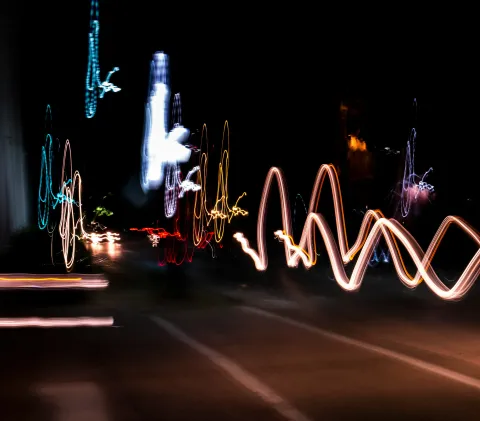
Long-exposure photograph of city lights at night creating swirling, wave-like trails of white, blue, red, and yellow against a dark background.
Inventive Rhetorical Ecologies
2014

"The voice is no longer a medium for conveying language, but rather an unutterability suited to clothing itself in language—always carrying a material excess."

—Erin Anderson, "Toward a Resonant Material Vocality for Digital Composition"
Photo by Ellery Sterling on Unsplash


Articles

Steve Holmes
While a great deal of writing has explored the relationship between neoliberalism and rhetoric, scholars have yet to fully engage this new era of algorithmic regulation and rhetorical micro labor. This lack of engagement leaves us with a pressing question as to how we might analyze and respond to contemporary examples of gold farming, such as Bitcoin.
Erin Anderson
To the extent that it has been explicitly acknowledged as a component of sonic rhetoric, voice is often taken up either as a function of song in the so-called non-representational realm of music or as a welcome return to rhetoric’s roots in classical oratory and live, embodied speech. While these conversations have been instrumental in highlighting the non-verbal, affective affordances—the tone, the emotion, the “grain”—of the voice-in-performance, they have also frequently fallen back on familiar notions of the “human element” or “aural presence” of voice without stepping back to consider the problematic metaphysical associations that such terms provoke.
Ryan Weber
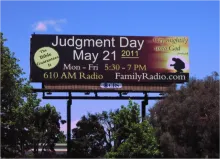
Ironic apocalyptic rhetoric raises a serious rhetorical conundrum. Meant to satirize hysterical prognostications about the world's end, these events could end up fueling sensationalism, prompting hysteria, and convincing unwitting victims of the prophesy's legitimacy. If misinterpreted, Rapture Relief could cause audience members to stake their claim with the Harold Camping camp.
Alexandra J. Cavallaro
If you stood outside the venue of Centerville's fourth annual Pride Festival, you might not know that anything out of the ordinary was happening. There is little to indicate that there is any disruption to the usual activities of this small, Midwestern mall, that is, until you see a young teen wearing a Pride flag as a cape on her way through the door, or maybe you notice an unusual concentration of Human Rights Campaign bumper stickers in the parking lot.
Malea Powell, Daisy Levy, Andrea Riley-Mukavetz, Marilee Brooks-Gillies, Maria Novotny, Jennifer Fisch-Ferguson, and The Cultural Rhetorics Theory Lab
The article you're about to read was written collectively—six of us sitting around a table generating each move together. We've styled the article like a play—a classic three-act with Prologue and Epilogue—the kind Aristotle liked best. It has a number of characters

Response Essays

Katie Zabrowski

Published December 2, 2014

Rhetorical Powerhouses is a series of podcasts that explore the rhetoricity of material objects. With each episode the series repeats a similar mode of engagement with objects that performs the rhetorical and ontological work of coming to know objects better by being with them. Each spends time with objects by tracing how they relate and partner with other objects in the making of their worlds.

Reviews