
Issue 12
Image
A radial kaleidoscopic pattern in shades of blue and teal, with concentric rings of pointed geometric shapes and glowing light points emanating from a central core.
McLuhan at 100—Picking Through the Rag and Bone Shop of a Career
2011

"The depth and breadth of McLuhan’s work . . . offers gems, garbage, and often traces of something useful for understanding games, language, literature, (new) media, rhetoric, technology, teaching, or writing in the electric, digital age."

—Kevin Brooks and David Beard, "Picking Through the Rag and Bone Shop of a Career"
Photo by Galactic Nikita on Unsplash
Articles

Kevin Brooks and David Beard
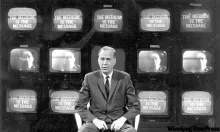
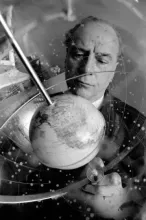
Marshall McLuhan would have turned 100 on July 21, 2011. We launch this collection of essays on December 31, 2011, thirty-one years to the day of his death. His work, ideas, and methods are alive and well in the field of Media Ecology, and some excellent scholarship in the past 10 years has re-assessed his relevance for the 21st century.
Jeff Rice
Stories of invention are rich with the joy of the accidental discovery. The accident, we are led to believe, functions as a heuristic: it shows us what convention, logic, or purpose would not have shown because such areas of influence can be constrained by structures and formalisms
Rex Veeder
Marshall McLuhan deserves to be re-evaluated as a rhetorician because he has described and demonstrated a perspective on rhetoric that remains significant. That perspective involves aesthetic, social, and cultural elements that gravitate around a mythos of (w)holistic understanding: an auditory experience, which is the evolutionary result of electronic media.
Michael MacDonald
This essay examines a neglected dimension of McLuhan's media theory: its treatment of media technologies as instruments of military power. McLuhan's analysis of the information revolution offers insights into contemporary warfare, and his rhetorical—rather than cybernetic—approach illuminates emerging forms of Information Warfare (wetwar, softwar, gray war, neo-cortical war, perception-space warfare) that wage permanent campaigns against civil society to shape its desires, beliefs, and behavior.
Steven Hammer
A special issue on the “rag and bone shop” of Marshall McLuhan’s career seemed to immediately invite an alternative and mixed media approach; several of McLuhan's texts veered away from traditional and linear arrangement, almost inviting one to hear the text. I have undertaken a remix of McLuhan's perhaps less-known work, War and Peace in the Global Village (WPGV). I wanted to both present a remix that re-presented WPGV as a standalone McLuhan work and also suggest more recent manifestations of his central argument: that environments resulting from technological innovation create pain, resistance, and war.
Jane Slemon
This essay argues that the Body Worlds exhibit transforms the human cadaver into a technological and cultural spectacle, presenting the body as seemingly neutral while obscuring its ties to history, politics, and identity. Drawing on media theory and posthumanism, it shows how plastination reshapes our perceptions of life, death, and the human body.

Reviews