Issue 6.2
Image
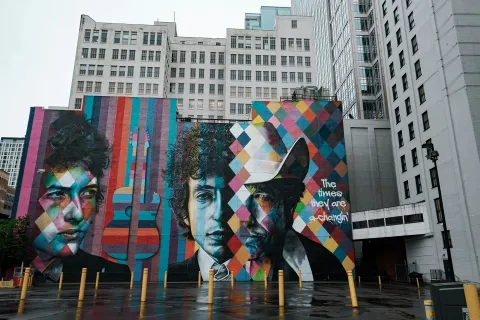
Colorful mural of three Bob Dylan faces painted on the side of a city building with the phrase, "The times they are a-changin'" painted to the right of them.
Image Events
2009

"We consider rhetoric the art of discerning and deploying the available contingent means of constructing, maintaining, and transforming social reality in a particular context."

—Kevin Michael DeLuca and Joe Wilferth, "Foreword"
Photo by weston m on Unsplash

Articles

Rebecca Jones
Perhaps, in some ways, we are a culture of spectacle in the midst of a pictorial turn, consuming and being consumed by images.  If this is true, contemporary activists answer Taylor’s and Debord’s call to take control of public images. Groups like The Truth and MoveOn have entered the political and social arena through television commercials or print ads, venues primarily used by companies to sell their products. However, the creation of image events and the employment of image as protest are more complex than simply following cultural trends or using the same tools corporations and politicians employ to sell themselves.
Jo Littler
It is sometimes easy to think of what this collection terms "image events" as de facto subaltern, radical, and leftwing. To focus on this aspect is both a means of being optimistic and a way of thinking about how their progressive potential can be expanded. However, at the same time, it is clearly the case that corporations have produced their own versions of image events, and that corporate discourse interacts with the visual and rhetorical strategies deployed by the more "radical" variants of image events in complex ways.
Kelly McGuire
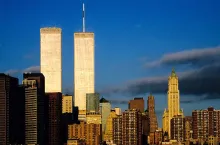
Since 2001, responses to 9/11 have shifted from descriptions of the day to discussions of its impact, usually conceived in terms of permanent alteration.  Conference panels and journal articles with post-9/11 in their titles address everything from television to teaching practices, from cinema to the role of language. 
Hunter Stephenson
Image events allow us to better understand those (generally) non-linguistic rhetorical strategies employed by various groups to further their particular positions. Bringing together rhetorical protests (created through action and images), social movements, and the media, image events provide a useful tool for identifying and conceptualizing how activist groups have impacted debate in the public sphere.
Galia Yanoshevsky
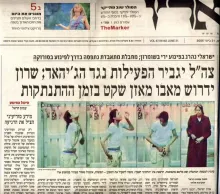
Image events are a subcategory of visual arguments. They are defined as "staged acts of protest designed for media dissemination" that offer a powerful way to appeal to audiences. Image events provide "fragments of arguments" that break away from established order, in opposition to common or conventional logic. They foster public discussion by offering fresh, new ways to look at issues at hand by supplying new claims and refutations that fuel debates in the public sphere.
Kristine Fleckenstein
An image event is a visual performance, scripted or spontaneous, that carries persuasive power. It encompasses visual, linguistic, technological, and phenomenological (i.e., experiential) elements. Generally associated with the twentieth-century rise of mass media, especially television, image events are also important to persuasion throughout Western history.
Jason Edward Black
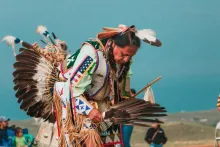
American Indian protest rhetoric reflects a crucial tension between internal and external purposes. Rather than serving solely to mobilize movement members or gather like-minded individuals, Red Power rhetoric operates on dual fronts. This combination of aims enables American Indian agitators to reawaken and strengthen Indigenous identities while simultaneously appealing to dominant American society in pursuit of meaningful social change
Derek Foster, Brock University in St. Catharines, Canada
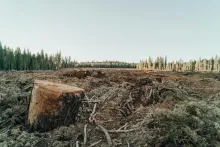
Greenpeace’s continued use of image events, more than 30 years after they initiated their use, and how image events are employed differently today compared to the past, even as they remain part of an ongoing articulation agenda for environmental consciousness-raising. The case study for my analysis will be Greenpeace Canada’s campaign to highlight the problem of boreal deforestation.
Amy Shore and Joe Wilferth
The “Drop Dead Day” protest showcases image event rhetoric as it used a dramatic visual performance—1,200 volunteers collapsing at once—to create a powerful message designed for media coverage. Rather than relying on speeches or written arguments, the truth® campaign crafted a staged spectacle that television cameras and photographs could easily capture and distribute to a wide audience. This visual strategy transformed a daily death statistic into a memorable image, using symbolism and public display to persuade viewers and hold the tobacco industry accountable.
Eric Mason
Image events function as visual enthymemes, connecting the circulation and success of persuasive imagery to a form of rhetorical argument whose historical flexibility makes it well-suited to theorizing visual — not just verbal — forms of rhetoric. This conception of the enthymeme is not word-based but thumos-based, resisting the tendency to subordinate images to language and grounding visual argument instead in the affective and embodied dimensions of rhetorical experience.
David Sheridan, Tony Michel, and Jim Ridolfo,
One of the reasons "image event" is such a fitting concept is that it calls attention to the situated moment.  "Image event" rejects the myth of a stable rhetorical object with a transcendent power that is effective in any situation (the speech that is effective everywhere and for all time because of its formal features and its compelling logic) and embraces a more time-sensitive model in which always-fluxuating contextual factors converge into a happening. 
Jonathan M. Gray
Some environmental activists have little regard for postmodern celebrations of the arbitrariness of language and representational schema.  Although articulations of the social construction of nature are persuasive and certainly pervasive, many environmental activists and advocates find these arguments dangerous and potentially disempowering to the environmental movement(s).  Broadly defined, the threat of social construction to nature is that it robs the imperatives of materiality—that is, a finite natural world of limited resources and carrying capacity. 
Cindy Spurlock
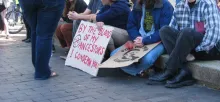
Protest and dissent have long played a crucial role in the project of American democracy. Indeed, democracy requires it. The act of taking to the streets, pamphleteering, marching, and/or speaking out about perceived injustices, from the early days of the American Revolution to the Haymarket Riot of 1886, the 1963 March on Washington, the Seattle WTO protests in 1999, and the recent anti-war protests of 2003 to 2005, has made a significant imprint on public policy and public opinion.
Virginia Kuhn
Innovations in digital technologies have rendered the language of images more accessible to more humans than ever before: Visual media saturates daily life, and Web 2.0 tools allow people to produce visual media. As such, universities should foster critical engagement with the image-rich media that inundate student fields of vision daily.  This critical engagement requires disciplined analysis or the ability to “read” images as well as the ability to produce visual texts or “write” with them.
C. Richard King
This discussion begins with an overview of the staging of “Holocaust on Your Plate.” On this foundation, I unpack the meanings and affects of the image event, in part by attending to public responses. In conclusion, I work through the significance of ”Holocaust on Your Plate,” outlining its implications for an understanding of the limitations of image events.
Christine Tulley
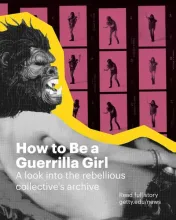
The Guerrilla Girls have long been recognized as the voice of conscience in the traditionally male-dominated art world, and their signature style of rhetorical parody has changed little over the past 20 years they have been in existence. Initially blending old school “cut and paste” zine-style methods of collage and pastiche with the billboard format, and later expanding these techniques into all media sectors such as video, television, and the Internet, their activism repeatedly cultivates a media spectacle that reaches far beyond their original focus of combating discrimination in the art world.