Issue 33
Image
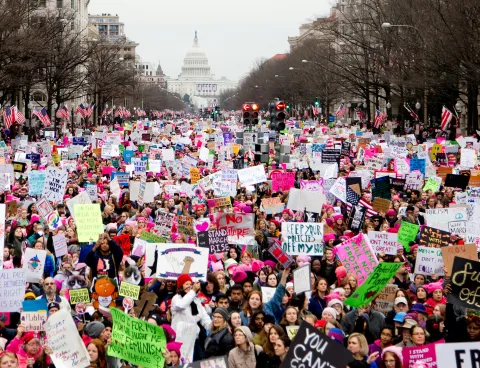
Massive crowd of demonstrators carrying colorful signs and wearing pink hats fills a broad avenue stretching toward the U.S. Capitol building on an overcast day.
Approaches to Rhetoric in a Post-Truth Age
2022

"Dominant cultural narratives embedded with white supremacist ideologies have always created their own truths that privilege white hegemonic power structures and the status quo."

—Cindy Tekobbe and Amber Buck, "Approaches to Rhetoric in a Post-Truth Age: Pedagogies, Activism, and Platforms"
Photo by Vlad Tchompalov on Unsplash
Articles

Cindy Tekobbe and Amber Buck
As we enter our third academic year of the COVID-19 pandemic, university administrators, under the direction of Republican-led state legislatures, are issuing policies that instructors cannot mandate mask usage in their classrooms or their own offices. Under this same direction, our administrations are not able to mandate vaccines for returning students.
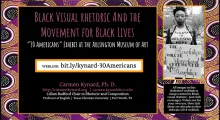
Carmen Kynard
Long before vocabulary like “cultural appropriation” became commonplace for the everyday race-talk of even the minimally informed, I was clear that Black youth creativity set the terms for bodily syntax across the globe. By twenty-one-years old, I lived in what I will call a state of meta-Black-visual-awareness.
Abigail Bakke and Jennifer Turner
Traditional information literacy instruction is no match for our post-truth age. At the early undergraduate level, becoming aware of deliberately false information is a necessary starting point. However, at more advanced levels, students must think beyond the catch-all term “fake news” to the complex range of post-truth rhetoric online. These skills involve identifying not only the problematic information itself, but also the larger systems in which it circulates.
Kathleen Blake Yancey
On February 14, 2018, a former high school student who had been expelled from Marjory Stoneman Douglas High School (MSD) in Parkland, Florida, for “disciplinary violations,” among them fighting, profanity, and an “assault” (Miller and Gurney), returned to school. Entering MSD on that Valentine’s Day, the gunman opened fire with an AK-47, killing 17 human beings—14 students, 1 teacher, 1 coach, and 1 athletic director—and injuring another 17 others, surpassing the carnage at Columbine some 19 years earlier.
Chen Chen and Xiaobo Wang
Chinese rhetorical scholars have argued for using a dialogic comparative rhetorical lens to enrich and diversify our understanding of rhetorical theories, especially in response to the need to understand non-western rhetorics on their own terms. Scholars of Chinese feminisms from rhetorical and literary perspectives have presented good examples of how to read non-western rhetorical texts in ways that enrich feminist theories and methodologies.
Elliot Tetreault
Rhetorical studies has renewed its commitment to understanding how disinformation spreads, and further, what the prevalence of disinformation tells us about the complexity of political rhetoric in an era characterized as “post-truth.” Black rhetorical practices have much to offer to the study of political disinformation. In addition, analyzing the specific practices that Black activist communities use to challenge disinformation can add to the body of work in rhetoric, composition, and communication studies on Black rhetorical practices more broadly.
Maggie Fernandes, Matthew Homer, and Jennifer Sano-Franchini
Over at least the last decade, both academic scholarship and popular media discussions about social media have been rightly concerned with how digital platforms reinforce and perpetuate systemic racism and inequality, largely through an attention to how racist content is distributed through biased algorithms.
Zachary Lundgren
While driven by science and empirical data, the EPA, being a government organization, is far from immune to political forces. The sweeping changes of the Trump administration were made manifest through various means, including the agency’s webpage (EPA.gov), where, practically overnight, links were deleted, topics altered, and information—especially that related to climate change—was nearly scrubbed entirely.
Rory Lee, Matthew G. Davis, and Stephen J. McElroy
Scholars in digital rhetoric are devoting increasing attention to politics because digital rhetoric plays an increasing and convoluted role in politics. One way to pay attention to and unpack these relationships is through familiar frameworks: Big P Politics and little p politics. As Jeremy David Johnson says, we might start by thinking of Big P Politics in the sense of “governmental structure.” Here, we might find ourselves asking questions about the ways in which that structure has changed—or has the potential to change—given current and still emerging digital media and rhetorical practices.