Issue Index
Issue Index
Issue 34
Issue 34
Ecologies of “Sleepy Joe” and “Mini-Mike”: The Affective Politics of Ethos and the Ethics of Ad Hominem Light
Ecologies of “Sleepy Joe” and “Mini-Mike”: The Affective Politics of Ethos and the Ethics of Ad Hominem Light
Published August 24, 2022
I have always been fascinated by name-calling. Unfortunately, this is not because I was any good at it, but because I was mostly on the receiving end. Growing up, my sister was ruthless. She hurled a relentless number of insults. “Reptile Boy” was her favorite. I don’t even know why. I never owned any reptiles. As far as I’m aware, I don’t look very slithery. But at some point in our troubled adolescence, I was any number of reptiles. I was also “Cretin,” “Slow-poke,” “Snot Face,” or “Ewy-goo.” I can hear her voice now: “Get out of my room, Reptile Boy!”
But name-calling is not all bad. In high school, I would be walking through the hallways, and someone would yell out, “Hey, Gruber! Good to see you!” My friends have always called me “Gruber,” “Goober,” or just “Groobs.” When you have a name like Gruber, hearing it out loud sounds a little like being called a name. But these are terms of endearment. (They are, aren’t they?) At my annual family reunion, all my crazy drunk uncles call me “Cub” or “Baby Bear” because my father’s nickname has always been “Bear.” Watching former President Trump carry his term through to the bitter end, I grew both in my distaste and appreciation for the power of name-calling.
We hear it all the time now. French President Emmanuel Macron calls U.K. Prime Minister Boris Johnson un clown and a gougnafier, a vulgar and useless lump of nothing (Miller). President Joe Biden was recently caught calling a reporter “a stupid son of a bitch” (News Wires). Former President Donald Trump, in particular, lobs insults like he’s in a frenzied game of darts, calling Michael Wolff a “total loser,” Senator Kirsten Gillibrand a “total flunky,” and Hillary Clinton a “nasty woman” (Blake).
Without overlooking the sheer quantity and force of Trump’s particular name-calling tendencies, we note that both sides of the aisle have historically dished insults. Scanning political history, it is easy to argue that name-calling is a time-honored political tradition. U.S. Presidential candidates make the point: George Bush, Sr. called Clinton “a bozo” and Trump “a blowhard” (Duffy and Gibbs; Staff). John McCain said Trump “fired up the crazies” (Hensch). John Kerry called George W. Bush “an idiot” (Reid). Further back in time, Abraham Lincoln was called “a barbarian” and “a yahoo” by those who opposed him (Bowden). In 1844, the Whig Party called Louis Cass a “pot-bellied, mutton-headed cucumber-soled” presidential candidate (Gabriel). So, that’s pretty much the whole range.
It’s not very pleasant to watch one adult call another a “sleaze-bag” or a “moron” or a “mutton-headed cucumber.” That kind of talk seems like it should have been abandoned in fifth grade. As we grow up, we learn that bad names hurt people’s feelings, and we should treat others as we want to be treated. That’s what Jesus said (Berean Study Bible, Matthew 7:12). Then, we grow a little older, and we learn that implying bad things about others or outright calling them dirty names crafts a logical irrelevancy called an ad hominem fallacy, which basically means that calling someone a “shithead” is a distraction from the actual argument—it simply does not address claims about, say, nuclear power or tax rates. But it raises the ears.
Democratic debates, we are told in university rhetoric and logic classes, require “good argumentation.” As Professor Christian Kock adamantly says, reasons need to be given for specific proposals, and debates should focus on each participant’s “counter-arguments and criticisms of proposed policies . . . and all these too must meet certain critical standards” (270). Unsurprisingly, calling someone a “shithead” does not meet those standards.
I’m not the first person to notice the political penchant for unpleasant words about opponents. Multiple commentators have bemoaned former presidents conducting verbal attacks (The Editorial Board; Kurtz; Schiff) with some arguing that it lowers the dignity of the office (Fulwood III) or harms the state of the democracy, which requires civil deliberation about what the country should do next (Feffer; Scarborough). Yet, somehow, none of those warnings have (yet) had much effect. Politicians continue to deploy ad hominem attacks, and arguably more and more in recent years. Indeed, watching the political arena today has spurred me to think more seriously about the role of ad hominem in rhetorical studies, how abusive forms of ad hominem, namely insults, relate to constructions of ethos, and whether there is ever a good reason, from the rhetor’s perspective, to fling a few ugly words at an opponent. I think there could be. And if you disagree with me, then you’re a mutton-headed cucumber.
In this paper, I hope to contribute to the conversation around abusive forms of ad hominem. I note first that they function as rhetorical strategies and, as Scott Jacobs rightly says, are therefore relevant to argumentation, even if altering the immediate topic. In like manner, ad hominems can sometimes spur civic discourse—as Douglas Walton has suggested (The Place of Emotion 23)—but I aim to also illuminate how they can more specifically create a contrast with an opponent in such a way that a trait, association, or personality quirk inherent to the opponent or linked to the opponent enters the debate. Beyond this, however, certain kinds of ad hominems also compel us, as rhetoricians, to peer outward to better see our audiences and consider the broader civic situation, since the verbal cut must also be acceptable to audiences, must appeal to those whom the rhetor desires to enchant, and must have specific cultural and symbolic resonances.
My focus here is the way that certain ad hominems accuse opponents in ways that tap into a shared pathos, or a charged political atmosphere that unites audiences. I aim to explore how such instances expose an overlap between ethos and atmosphere—and by “atmosphere,” I mean affective resonance at a time and place, like the felt “weather” of the event (e.g., Slaby)—that complicates traditional rhetorical descriptions of ad hominem. In fact, the link to wild, rowdy, or angry atmospheres alters how we usually imagine ethos exercised as a discursive construction that displays honesty, uprightness, goodness, and/or respect. I suggest toward the end of the paper that ad hominem links intimately to ethos, in part because of what audiences feel at a time and place and how rhetors draw upon those feelings; we must therefore not only consider the role of atmospheres when we teach about ad hominem but also ruminate on the ethical implications of turning to wallops and besmirches. Ethos and ad hominem are not only more nuanced than many would immediately expect insofar as they can both emerge from the rank and raucous side of human relations, but they are also more entwined with what Jenny Edbauer calls the broader “rhetorical ecology” than previously noted.
In brief, certain cunning, snide, and even bratty ad hominems, I argue, do not always operate as distractions but can compel deliberation on points related to the political sphere while showcasing the rhetor’s wit, perhaps making us chuckle, and performing the rhetor’s “good sense” (phronesis) or “good will” (eunoia) toward an audience, usually of friendly listeners who desire to be in on the joke. Accordingly, I argue that these negatively clothed, but positive (for the rhetor) forms of ad hominem are stylistically unique, and they function differently enough from other forms noted in the argumentation literature that they deserve a specific name. Although my feeling is that the term ad hominem may itself be a distraction to the rhetorical functions that I aim to describe, I take the road of least resistance here and propose the name Ad Hominem Light. The following discussion proceeds as follows: I review research on ad hominem; I then explore the definitional specificities of Ad Hominem Light, turning to a few political performances as case studies; I end with a consideration of the ethics of democratic deliberation and how we might include feelings and atmospheres in such discussions, specifically in reference to ethos and ad hominem.
The Reasoning of Ad Hominem
The abusive form of ad hominem is a power move. It is an oppositional exercise that creates a stark contrast with an interlocutor as much as it seeks to soil, roil, and troll. If trolling is the act of “starting quarrels or upsetting people by posting inflammatory or off-topic messages” (Hansen), then ad hominem attacks, although less elaborate and usually less sophisticated than trolling, also function to create the inferior and the superior. In the standard view, neither trolling nor ad hominem seek as a priority to build actual arguments. Instead, they function rhetorically to harm in some way the interests of the other and to get a rise out of them. And like trolling, the abusive ad hominem attempts to brand someone with a disrespectful or bad name (“dumbo,” “loser,” “moron”), harkening back to our childhood; it appeals to those adolescent playground instincts where we pick on others and find a way to skyrocket our popularity if we insult the other kid at precisely the right time. “Four-eyes!” “Momma’s Boy!” “Sissy Pants!” Ad hominem, we all learned at that age, can really hurt, but it can also create serious fans.
Ad hominem can increase the popularity of the rhetor because it functions in much the same way as constitutive rhetoric. “The Peuple Québécois,” as in Maurice Charland’s example of constitutive rhetoric, was supposed to constitute the identity and make the independence of the Quebec initiative more spreadable. Often the same general intentions motivate ad hominem attacks. If there is a difference at play, then the “calling forth” of the other person as X is something that embeds a character jab. It’s a character cutter. The rhetor becomes superior in calling out the name and constructs the Other as weaker or lower in the audience’s eyes. Consequently, audiences tend to get something like “The Devil” or “Billionaire Big Shot.” The first says that the person is evil and the second snobbish or disconnected from real life. The question lingering in the insult, for rhetoricians, is this: If politicians absolutely must appeal to their good character or goodwill, then why would ad hominem be off limits?
Just like some acceptable ethos appeals—such as “I have a good family” and “I love America”—are not necessarily admissible reasons to vote for someone but still par for the course, why would “He’s a bold-faced liar” or “She’s a devil worshipper” be relegated to the trash bin of the unacceptable? Indeed, we can even imagine an ad hominem that gets close to arguments happening in Washington, such as, “He’s a billionaire bigshot,” which is a sarcastic and maybe cunning way to say, “He doesn’t understand the middle class and has ties to big corporate interests.” Is this not a challenge to the other’s staged ethos and, thus, should be admissible? Or do we only call it ad hominem when we don’t like it?
I do not intend to forward an unqualified claim. I am not suggesting that all ad hominem deployments should be admissible, nor do all skillfully advance a rhetor’s position. Some ad hominems are way off-base, totally disconnected from any surrounding debate. Some are so ugly that they work against the person spouting them, like swinging nunchucks so hard that the dummy ends up hitting his own dumb face (yes, “dummy” is an ad hominem—but is it disconnected from the nun chucks case?). In fact, some ad hominem attacks, like “dummy,” can make us giggle; others are hard to hear and harder to take. But whether we giggle or sneer, when well-crafted, they do what they’re designed to do, in a context.
Ad hominems stick. It is hard not to meet a far-right U.S. campaigner who won’t utter the name “Pocahontas” when seeing Elizabeth Warren take the stage. And the media does not resist. They work these names into their headlines. NBC News, for example, printed the following after a 2020 Democratic Presidential debate: “Trump tells ‘Crazy’ Bernie Sanders: ‘Don’t Let Them Take It Away From You’” (Egan).
Communication scholars Kirsten Theye and Steven Melling argue that Trump’s use of common insults, such as “loser,” give him a stroke of authenticity. His merciless speech, they suggest, bolsters his campaign against “political correctness” so much so that his strident and bombastic style represents the endpoint or fulfillment of a “war against political correctness” (333). Rhetorical scholar Jennifer Mercieca calls Trump’s attacks “weaponized communication” that make him look like an aggressive free speech advocate and “a fighter” in a way that can then be defended, on his part, by rhetorically situating himself as nothing but a perfectly valid and skilled “counterpuncher” (275). Thus, it may be the case that Trump, precisely because of his political cachet and style, is able to lob insults at opponents at a much greater rate than more traditional politicians who have platforms based in policy reform or who aim to perform a rhetoric of unity, such as Obama’s emphasis on “Hope” or Hillary’s “Better Together.” That is to say, the proverbial leash of rhetorical vice can only be extended as far as the type of rhetorical dog sauntering into the political park to do some barking.
I am not arguing that ad hominem attacks work, per se, to further extend a politician’s support. That would be a difficult argument to make and probably require social scientific studies. But a starting qualitative assessment of ad hominem attacks suggests that demonizing a member of the opposition or, at minimum, expressing serious concern about the character of the other person can strengthen existing support. Indeed, it is worth considering that Donald Trump deployed ad hominem attacks from the outset of his election campaign and then won the election; he continued to release any number of slanders against those that he perceived as disloyal or disapproving, and his popularity at the end of his Presidency—after four years of repeating words like “loser,” “deranged,” and “crazed, crying lowlife” (Dopp)—stood at an all-time high in the summer of 2020.
Certainly, former President Trump’s popularity cannot be directly attributed to his use of name-calling. There are so many other reasons why people have and continue to support him. But it nevertheless seems to be a primary communications strategy, therefore warranting some investigation. In fact, in a review of one hundred tweets from former President Trump starting from the day that I first sat down to consider his name-calling (February 28, 2020), I counted about fifteen ad hominem attacks on others. Of course, the exact number depends on whether you count tweets appearing on his timeline (retweets) or his personal tweets only. It also depends on whether you count disparaging remarks directed at a group, such as “Democratic Clown Show” (February 29) and exclude or include his indirect disparaging remarks, such as “the real politicians ate them [Tom Steyer and Mike Bloomberg] up and spit them out” (February 29). I did not count these. I only counted the obvious examples, such as when the President called CNN reporter John Harwood “a total loser!” (February 28).[i]
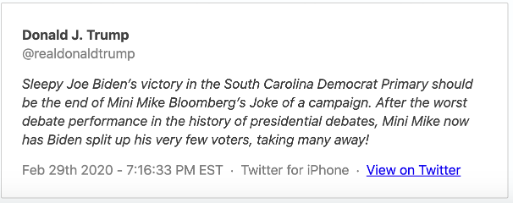
Figure 1
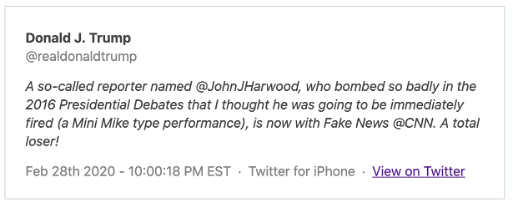
Figure 2
As rhetorical scholars, we could choose to see these ad hominems as another example of Trump’s manner of rejecting deliberation “as a communal goal” (Neville-Shepherd 175). That would position his ad hominems as another device creating what Ryan Neville-Shepherd calls a “post-presumption argumentation,” which cares nothing about truth but seeks only to stoke “conspiracy theorizing” (175). Joshua Gunn might here call Trump’s name-calling another form of “perversion” because Trump seems to get a rise from telling lies and subverting public discourse of mutual exchange (2-3). Yet, this assessment, as Gunn himself points out, does not also therefore mean that the ad hominems cannot participate in forging group solidarity and, indeed, are used to underscore a style of engagement that “expresses a particular worldview” (82). In that sense, ad hominems do help Trump, making him look like an honest rhetor to those also unable to contain a desire for “a newer order, new fundamentalisms” and to “call through all the crap” (Gunn 117). In staging stark contrasts with those who disagree, ad hominems become one way to oil up a political base’s self-confirming biases. But ad hominems can also intensify discourses about other candidates that can ignite deliberations and push toward conversations about their own wealth, patriotism, age, health, race, gender, and general civic judgement.
Ad hominems can be shaped to avoid reactions of revulsion amongst supporters (or undecided voters, for that matter) and stage a superior judgment. It is a matter of emotional management and unleashing just the right word for the context. As Patricia Roberts-Miller points out, many rhetors throughout the Enlightenment, and prior, were “not hostile to the emotions—but of a certain set of emotions (passions as opposed to sentiments)” (“John Quincy” 15). Emotions described as sentiments were seen as expressions beneficial to society and thus useful for constructing the rhetor’s ethos; however, passions relying on an “appeal to sympathy” might slip into “exhibitions of distress,” as John Quincy Adams noted (Roberts-Miller, “John Quincy” 15). In fact, John Quincy Adams himself, Roberts-Miller points out, used passionate emotions in his favor even if he claimed to believe that the “passions” were only weapons for self-serving party factions (“John Quincy” 16). Clearly, “dissent within certain parameters,” or emotional speech within acceptable bounds, proves highly effective, and Adams knew it. In fact, Roberts-Miller suggests that Adams turns to emotional speech precisely when he fears that he will not win through balanced rational argumentation (“John Quincy” 16).
Here, we come to a point: dispositions of mind and of the temper can be seen as virtues for audiences who read them as correct social judgements. Roberts-Miller’s work generally brings this out, especially when she examines attacks and condemnations designed to silence oppositions, drawing the conclusion that even when the attacks are obviously unreasonable, totally outrageous, ugly, and pernicious, some people will repost them and believe “that it made a valid point in a valid manner” (“Dissent” 171). However, we should be careful here and say not only “those people.” Skinnell and Murphy turn the discussion productively on ourselves, saying, “under the right conditions we all choose to step into the role of demagogue, willingly, happily—and without even needing to be convinced” (228). Because we all have in-groups and out-groups, strong senses of identity as well as instabilities, vulnerabilities, and values, any one of us could turn to demagoguery as effective means. Over-righteous, unscrupulous, polarizing, win at-all-costs rhetorics are, as Skinnell and Murphy say, “an ‘us’ problem,” but one that we should work to resist because that kind of speech conjures tribalism, sows distrust, rejects deliberation, and prefers insulation through aggressive forms over resolutions of socio-political anxieties through flexibilities (229-230). In a highly polarized society with deep emotions and resentments on all sides, what becomes most pertinent is to study the “real experience of public persuasion,” and this means pushing past “traditional explanations of expertise and authority” (Roberts-Miller, “Dissent” 172).
I agree; the effort of this article is to better understand the ways that speech, even disgusting and damaging speech, can function to inspire and unite, leading to rhetors on thrones and bringing audiences together. As I try to show in what follows, certain ad hominems are made palatable to multiple audiences through enrolling the fears and disdains that unite groups or through touching the specific social anxieties about an opposition’s personal deficiencies, however minor. Previously unauthorized “passions,” I suggest, can be transformed into acceptable “sentiments” by tapping into those awarenesses with a wink and giggle.
Ad Hominem Light
There is a specific type of ad hominem that Trump uses often, but I do not believe that he is the only one. I recall how Bob Dole used to call Jimmy Carter “Southern-fried McGovern” (Saletan), and people on both sides of the aisle used to call Bill Clinton “slick Willie,” a reference to his “unctuous salesman-cum-preacher mode” (Rozsa). I call it Ad Hominem Light. It is a form of association, stated playfully, sardonically, or comically, which under usual circumstances would not be offensive to the person on the receiving end but would rather be something more like a pet name or a term of endearment—yet once contextualized in a political debate, the name touches anxieties that an audience might have about politicians or more specifically about that person. Accordingly, Ad Hominem Light is designed to undercut key aspects of that opponent’s demeanor, personality, brand, and/or stance.
I could easily call my uncle “Crazy Uncle Ray” to his face, and he would probably smile with satisfaction. Likewise, after watching a co-worker doze off during a meeting, we might start calling him “Sleepy Paul,” and Paul is likely to laugh along. Former President Trump’s use of “Crazy Bernie Sanders” and “Sleepy Joe Biden” encodes, however, a slightly different effect; it functions through negative associations not as easy to simply laugh off. Although we could call our uncle “crazy,” the label, once applied in the current political context, aims to situate Bernie Sanders as unrealistic, underscoring how some see him as too zealous for his left-oriented democratic socialist stances. With respect to associations, the listener is then tempted (or more prone) to associate Bernie with the “mad scientist” figure who has crazy white hair and gets obsessed. Indeed, Trump later called Sanders “the crazy professor,” reinforcing the original association (see Chason and Itkowitz). Likewise, we could call our co-worker “sleepy” in a playful way, but in context, the term associates Joe Biden with his old age, a slow reaction time, and perhaps even a sort of absent-mindedness. The intended effect, then, is negative affective response and the intensification of conversations likely already detected by political operatives. The message aims to strike at precisely what some fear: that the opponent might not actually be fit for the office of the Presidency.
Yet, there is another effect. Little doubt exists that supporters of whomever generates Ad Hominem Lights do laugh. That is crucial to the “Light-ness” quality. At many campaign rallies, Trump gets roars as he doles out special names to Democratic presidential candidates: “Crazy Bernie,” “Mini-Mike Bloomberg,” “Sleepy Joe,” and “Pocahontas” (see Chason and Itkowitz). Each could be used, if situated differently, as a term of endearment. Thus, perhaps, because of each name’s “lighter” quality—lighter than “Idiot” or “Nasty Woman,” for example—the acceptability of laughing at and circulating these terms increases. The terms might also be understood as part and parcel of President Trump’s rhetoric of authenticity (Theye and Melling). In fact, Trump acts not unlike my bratty sister who looked me straight in the eye when I was ten years old, stuck out her sharp little tongue, made a “ssssthhhh, ssssthhhh, ssssthhhh” snake sound and then called me “Reptile Boy.” I was not amused. But her friends laughed.
Clip from Trump Rally
There’s no doubt that Trump can really lay into someone that he utterly despises. We have all seen him use unmistakably serious language. But looking through his tweets from 2020, one gets the overwhelming impression that most of the ad hominem attacks were Ad Hominem Light. They may be mean and certainly have the intention of discrediting the opponent and tend to ignore the specific argument at hand—that is, they are still formally ad hominem attacks—but they do not fit into traditional ad hominem categories.
Douglas Walton divides ad hominem into six categories (Ad Hominem Arguments 2-9). For brevity, I will list them here, putting his terminology in bold text and then using my own words next to simple examples of my creation, except where Walton is cited.
- Abusive, or “You’re a Dumb Jerk.”
“My political opponent is a terrible person!”
- Circumstantial, or “I Smell Something Fishy About That One.”
“He slinked away right before the vote on the house floor!”
- The Smoking Ad Hominem, or “That Person is a Damn Hypocrite.”
“Smoking kills, kid, so you shouldn’t do it,” and the kid quickly replies, “But you’re a smoker!” In this case, calling the person a smoker does not address the argument at hand about the effects of smoking, but it points out a “pragmatic inconsistency,” not a logical one, equivalent to calling the person a hypocrite (Walton, Ad Hominem Arguments 7).
- The Bias Ad Hominem, or “They Can’t Shoot Straight.”
“That judge is deciding on my coal policy? We all know that judge absolutely loves the coal industry!”
- Tu Quoque, or “They Do It Too (and Often Worse).”
“The politician that’s saying I take too much vacation takes vacation all the time, even going as far as Tahiti!
- The Genetic Ad Hominem, or “They’re Guilty by Association.”
“His best friend is a convicted criminal!”
Each could quickly be rephrased, tailored to sound like legitimate arguments. For example, if the politician takes too many vacation days and breaks the human resources rules, then perhaps that is a good reason to believe that she doesn’t always do her job or follow the rules. Likewise, if the argument regards someone’s voting record, then pointing out that a politician missed an important vote on the House floor would be reasonable. The overall question is: Does the statement address the argument, or does it distract with the introduction of slander or negativity?
In each of the six cases that Walton outlines, the example is mean, snarky, and negative. That proves a little distracting itself. Some ad hominems, once heard in context, may not stir us to look at the person next to us and cringe and, for the same reasons, may well be addressing arguments that an opponent makes in favor of her own ethos. The meanness of an ad hominem does not say much about its relevance or correctness, of course, but I argue that “lighter” ad hominems tend toward a point of relevance for audiences being addressed.
Walton admits to a special function for some ad hominems when he writes, “in some cases, at any rate, it would seem that emotional appeals like ad hominem and ad populum arguments are non-fallacious,” namely, when there has not been “a change from one concept of dialogue to another” (Ad Hominem Arguments 23, my emphasis). However, Walton never suggests that there could be a kind of ad hominem specifically geared to address an opponent’s ethos or one that is designed to be palatable to multiple audiences. This form would solidify the rhetor as funny or savvy while undercutting the opponent in a way immediately understood to have relevance to politics.
Here, we can remember that Garssen argues that ad hominems are not noticed at times because they “take on a reasonable appearance,” specifically when they seem to “mimic critical reactions” (207). But no one seriously thinks that “Crazy Bernie” or “Sleepy Joe” is mimicking a critical reaction or slipping past audiences in a disguise of reasoned argumentation. Thus, Ad Hominem Light does not appear well-described. It simply does not hide under a veil of reasonableness; we are more likely to note the insinuation in the suggestion as possibly reasonable, not the phrase itself, such as when the politician is not pretending to present a reason but only composing a contention put in frank terms that sounds familiar to people who talk without pretense. Thus, when we step back and review Garssen’s and Walton’s categories, we are compelled to ask: Where’s that kind of ad hominem? Where’s the half-slight bordering on the comedic?
Karina Korostelina categorizes various forms of “insults,” embarking on a sizeable Aristotelian-styled project of outlining six different types alongside of sub-types with functions fit to various political wars. Her book does not order insults in terms of ad hominem, per se, since she seems unconcerned with how much they distract from a running line of argument. She rather suggests that there are insults focused on the denigration of identity, justification for an action, protection of an in-group, denial of a right, extraction of power, and general delegitimization (Korostelina 2). Although she rightly notes that “insults and responses to them are culturally produced” (5), she asserts that “insults provoke violence and contribute to the worst conflicts in history,” consistently reading insults through a frame of “deeply frustrated” forms of protest, even though she recognizes humor sometimes plays a role (5-7). Her case studies—about murder, violence, and imprisonment—show how she is interested in the ultimate (possible) consequences but not too keen to rhetorically chart how insults sometimes slip through as lovely forms and bypass their own dynamics of offensiveness, bitterness, and slight. Again, we must ask, where’s the jokey branding that zeros in on the potential problem with the opposition’s ethos construction?
We could, of course, categorize a label like “Sleepy Joe” as the “denigration of identity” type of ad hominem (Korostelina) or as the “guilt by association” type or even the “circumstantial” type (Walton, Ad Hominem Arguments) because of the obvious insinuations being delivered. But “Sleepy Joe” and others like it feel qualitatively different. To my mind, what the rhetor is doing rhetorically does not fit perfectly into any of the above categories. Ad Hominem Lights may be associative in nature, but their rhetorical function is more nuanced. They play to the political cheerleading base and compel questioning in those still unsure where they fall politically, operating unlike the ad hominem attack on an opponent that is read immediately by many as contemptible. Ad Hominem Lights circulate like campaign buttons. “Crooked Hillary” is announced, and Trump’s supporters start saying it like it’s her real name. These kinds of attacks get in the brain. They surface around the edges of a smirk. They affect voters by infiltrating affects.
Ad Hominem Light constructs a theatrical frame for the opponents who then risk looking like clownish characters trying to perform in a political circus. And a theatre might be the most appropriate frame, since watching to see if “Crazy Bernie” will truly live up to the designation becomes another mode of popular entertainment. And maybe that is why we laugh (if we do), because we too often see political engagement in that way; it’s not real life, but more like reality TV. In this frame, Ad Hominem Light makes perfect sense. But what do our frames and acceptabilities suggest about the state of our own democracy?
I don’t want to venture down a road where I now try to argue that the political is a total spectacle pandering to consumer consciousness and a simmering skepticism born of corporate capitalist exploitation continually cutting back to increase profits and dominate new markets. That argument has already been made (Kaminski; van Elteren). What I want to say, instead, is that Ad Hominem Light alters political conversations, and this has something directly to do with its light quality. The name becomes a kind of playful or snarky mantra. And if it feels salient, then this is because it is chosen in such a way that the name matches inescapable qualities of the opponent, targeting for enhancement a negative perception of those qualities. For example, every time Bernie argues passionately—which he does often, and often very well—those unsure about voting for him have the potential to then think, “There he is—‘Crazy Bernie.’”
A more sophisticated name than Ad Hominem Light might be Contextual Ad Hominem, because the context determines the difference between the negative and the positive effect, being offended or being delighted. Indeed, a distinctive feature of Ad Hominem Light is that it is so “light” that knowing if it is negative or not must be a matter of the people, the place, and the timing involved. As Roberts-Miller says, it’s whether an audience understands the verbal volley as a sentiment and a legitimate concern or instead a desperate passion deemed delegitimate and despicable (“John Quincy” 15).
This brings me back to my sister. Reminiscing on my childhood, I wish that I had hung a sign on my bedroom door that read, “Keep Out: Home of Reptile Boy!” in big green letters. I wonder what she would have done. Or maybe I could have just adopted her little “ssssthhhh, ssssthhhh, ssssthhhh” snake sound and used it all the time. I bet that would have driven her crazy. She would have dropped it in a second. Reflecting on my childhood experience makes me wonder why “Sleepy Joe” doesn’t refer to himself that way or why “Crazy Bernie” can’t just embrace it and make a mad-scientist-themed video for his own Twitter feed.
The reason is probably twofold. First, these politicians recognize immediately that those branded names rouse the partisan base. The appeal is suited to preconceptions tailor-made for the most vivacious supporters. Thus, there is no need for the opposition to put effort into disarming the strategic intent of the name through an appropriation campaign. If Ad Hominem Light is contextual, then in “Sleepy Joe’s” case, Democratic voters are likely to see out from their own context, too, which means that they will probably comprehend that kind of name-calling as a childish or desperate attempt.
Second, appropriating the name would risk playing on the rhetor’s predesigned verbal battlefield. Helene Shugart argues that strategies of appropriation can be seen as a “reinforcement of existing oppression” possibly reifying oppressive forces more than actually challenging them (210-212). But Shugart also argues that the success of an appropriation is dependent on what is appropriated, who is involved, and how exactly the oppressive term or behavior is being appropriated. As she notes, adopting a label or a negative narrative can operate as a way to “empower” those who are oppressed by it, and this has affective benefits. But if the individuals on the receiving end do find a creative method to escape what is demeaning and exploitative, then they likely do so, Shugart argues, through reimagining the associated narrative, playing it out differently than intended, or undermining the central damaging connotation by embracing it as valiant or valued (210-212). I am reminded of my fat cousin Bobby’s big belly. When he rolls up his shirt at the family reunion, he acts as if he is a king even if people call him a slob; the belly is enrolled into a bodily appropriation of the various degrading names the other cousins use and is then not evidence of his gluttony but only of his glory.[ii]
However, I still have doubts that anything along the lines of appropriation would ever work with my sister. If I started making the little “ssssthhhh, ssssthhhh, ssssthhhh” snake sound, then she will probably just come up with something else, something worse. She’d start croaking like a frog. She’d call me “Frog-Face.” Then what? Am I really willing to go down an endless trail of attempts at (re)appropriating her vicious verbal inventions? More to the point: How could I appropriate that name if my voice actually did sound a little like a croaking frog? (It doesn’t, I don’t think.) Who is going to fight that kind of consistent, well-targeted conniving? Not me. And neither is Crazy Bernie.
Of course, there is one other option, outside of simply ignoring the Ad Hominem Light. That is: fight fire with fire. What if I called my sister “Barbie Girl”? I could zero in on her obsession with clothes and long hours spent in front of the mirror. (I told you I was never very good at name-calling but follow me here.) Everywhere she went, I could slink behind her chanting, “Barbie Girl, Barbie Girl, Barbie Girl.” I would make mocking hand gestures like I’m fixing my hair. Then, when she’s in the bathroom, I would yell, “Hey, Barbie Girl, hurry up!” When some boy called on the phone, I could yell out so that he could hear me: “Hey Barbie Girl, who is that jerk face on the phone?!” I’m dreaming now. Forgive me. The point is: I didn’t do that. But why?
I don’t know. Maybe I’m just a nice guy. I never wanted to throw insults. Or maybe I just knew I’d somehow always lose. See, I was the younger brother. The baby. The power dynamics were too entrenched. Better to be satisfied with Reptile Boy. That’s not so bad, right? Well, that’s what I decided, I guess. I learned how to disregard it and move on because ad hominems are always, even the “light” kind, attempts at hierarchical placement, which means that the target is perceived as encroaching, threatening, or more prominent, even if those perceptions are false. In other words, considering the power dynamics of ad hominems helps to expose perceptions and vulnerabilities. As a result, sometimes it is probably best to laugh along, sometimes to condemn it, sometimes to appropriate it, and sometimes to ignore it all together. The difference is a matter of context and atmosphere, i.e., a matter of what we hope to achieve in tandem with what we feel can be achieved at a moment when we scan those around us and see who is tempted to giggle and sneer.
Examining Ethos within an Ethical Frame
If my sister’s childhood insults were a mix of the playful and personal, then the ones that we hear so often today in the news are also always political, which means that the consequences stretch far beyond the family unit. But what can we, as citizens, do about Ad Hominem Light?
Perhaps the first thing we can do is what Kock suggests we need to do: ask ourselves, is the information that we get from politicians “accurate,” is it “relevant,” and is it “weighty” (281)? If not, we should discard it. The problem there, of course, is that it can be much too easy to say, for example, that Bernie might be a little “crazy” and that the information of his craziness is potentially accurate, and thus relevant and weighty. Discovering who can mediate “truth” in an era of “post-Truth politics” and “fake news” is a challenge by any standards, heavy in our present time, and one likely to give some advantage to name-calling and insinuations difficult to pin down (McIntyre). So perhaps more often than not, Ad Hominem Light will be deemed an acceptable form by the suspicious and the unsure. In this sense, Ad Hominem Light does not operate like the totally unacceptable ad hominem attacks that reveal themselves as repugnant. No, the “Light” attack can be disregarded, nothing more than a humorous observation, a silly side comment, a joke, really. In this, the ad hominem lingering in Ad Hominem Light can be denied if anybody asserts that the cut was unfair, immoral, or wrongly made. In addition, the Ad Hominem Light, as Gunn notes, makes visible the personality and style of the rhetor (82) even while it touches on the Other’s (potential) deficiency, presumably lending more reason to use it, especially if the chances of any lash-back are lower. However, there is a second question that we can ask of political speech, which Professor Kock also suggests to those of us advocating for deliberative democracy: “Is it for the common good?” (285).
Even if contributing to an argument about the opponent’s (possibly poor) character, and even if highlighting the rhetor’s wit or confidence, few would say that an abusive ad hominem spouted vehemently in a debate advances the common good. If only for not teaching our children bad habits and for supporting deliberations full of care and sympathy, the abuse cannot be deemed good. But is the circulation of Ad Hominem Light for the common good?
What good does the more palatable, more spreadable approach achieve? I have tried to argue throughout this essay that it makes people wonder, it infects and affects, it spurs conversation about otherwise simmering anxieties, and it crafts the rhetor’s own ethos. But still, it remains tough to say that it reliably contributes to the common good. Maybe a better question is simply: is it good? That’s a different kind of question than “does it work?” or “is it persuasive?” Is it ethical?
If we ask a question of ethics about the rhetor’s use of good reasons, such as, “He has no experience operating a budget or running a government,” or “Her tax plan will cost farmers more money,” then we are left only undoubtedly with: “Of course! It’s good and ethical to raise such points!” So, if Ad Hominem Light is not a distraction from the opponent’s argument, then must it be ethical as well? The two do not always correlate so easily. I can raise a relevancy unethically, such as by releasing relevant private health information without consent, just as I could make a claim that bears on a debate that ends up dehumanizing one group. But we should not dodge the core question: can we say that Ad Hominem Light is ethical and, thus, should be acceptable?
The answer to the above is messy and, perhaps not surprisingly, value driven. Those working for either party may argue that any attempt, even the crude or rude demonstration, wielded to secure power and to advance a (right or left) government needs to be deemed acceptable precisely because it works for what they see as the common good. As Roberts-Miller argues, “group identity and loyalty” may matter the most in politics today (“Democracy” 1); but “identity and loyalty” are not context-independent either. Loyalty and identity are both enwrapped in perceptions of the common good, at least in relationship to what is good for those inhabiting one’s own group, whether that be Evangelical Christians or atheist gun-owning libertarians. Importantly, lobbing an abusive ad hominem amid a debate—such as, “He’s just a fucking sleazebag!”—would likely never be totally acceptable because there is no clear way to understand the comment as achieving the common good. It far exceeds the normal social parameters. This is why Ad Hominem Light proves to be so powerful and persuasive.
Ad Hominem Light dodges the ethics board in being lightly made. It sounds like something that could be said at the family reunion, the barber shop, or the break room, outside of an explicitly political context. If Garssen’s special subterfuge ad hominem is mistaken for reasonableness, then the Light version is mistaken for acceptability. However, we should not miss the question, not “is Ad Hominem Light for the common good?” but: is it good? Is it ethical?
It is tempting now to return to Jesus’ golden rule: “Treat others as you want to be treated.” If that comes across as childish, then perhaps the feeling of childishness exposes just how buried in discussions of effect for particular audiences rhetorical studies has become. To argue for a deliberative standard based on a condition of mutuality (the “as you want to be treated” part) is not, to my mind, as childish or absolutist as it is derived from the concept of a democracy. If “as you want to be treated” is a statement about equality and one where all people get the same respect—the respect that we, so intimately, feel that we are due—then there is not much ethical wiggle room for Ad Hominem Light.
As a quip, a cunning Ad Hominem Light certainly builds an argument against an opponent’s purported competency, but it still carries along with it a denigration. It is not an argument about in/competency that can parade independently of mockery, cruelty, forgery, exploitation, or maltreatment. What I mean to say is: Those fucking idiots across the aisle keep using this thing called Ad Hominem Light, so it’s in our rhetorical best interests to not focus on ethics. Hell, I’m angry! And the rage streaming across my social media feed keeps firing me up! Here, I drive home a point: audiences, ethos constructions, emotions, and atmospheres are entwined with rhetorics.
Conclusion: Teaching Ethos and Ad Hominem as a Rhetorical Ecology
Ad Hominem Light suggests that rhetorical scholars must continue to re-evaluate how they comprehend and teach ethos. Two points are to be made.
First, ethos is not always neatly divided from logos and pathos, just as ad hominem is not always neatly divided from the classical rhetorical appeals. As Kristina Volmari puts it, the modes are “not clear-cut” because “there is overlap and room for interpretation” when facing any iteration of ethos, logos, or pathos (156). Presentations of facts, for example, show that one knows the facts, thus heightening ethos, whereas stating facts with conviction demonstrates passion, thus invigorating pathos, and so on. Many scholars already stress the non-independence of rhetorical concepts, but Thomas Rickert goes further; he argues that “rhetoricity is an always on-going disclosure of the world shifting our manner of being,” which is a way of saying that human agents engaging in verbal exchanges is only a half-story (xii). A linguistic-centric view of rhetoric is pancake flat, one equivalent to a side-show distracting from the whole ecological human-nonhuman picture of suasion happening through and in an “ambient” context of bodies, media platforms, social media systems, urban infrastructures, social services, financing regulations, and so forth (xii). Thus, Rickert can assert that “feelings are not an impediment to rational activity. Rather, they are fundamental” because they are living ties to environments and atmospheres (15).
Applying Rickert’s general idea to ethos: the prick of the cunning slight delivered with a sly look and a laugh assembles ethos out of the charged political atmosphere. In that atmosphere, audiences salivate for high drama, or want revenge. The ethos here is a pathos, but what hurts the heart is that the Other is demeaned while audiences cannot help but feel invigorated by the anger, sometimes even delighted, a feeling sparking the atmosphere and encouraging the spitting rhetor. So, how do we teach ethos? Is the concept compatible with a spiteful politician or a fiery face? Can we see ethos as constructed through a soundbite transformed into a biting meme?
I confirm Lynn Worsham’s idea that “our most urgent political and pedagogical task remains the fundamental reeducation of emotion” (216). As Julie Nelson argues, emotions in rhetoric “have not been adequately addressed” as rhetoric has experienced “a theoretical and practical divorce between ‘affect’ and ‘emotion’” (2). Although affect is typically taken to be immediate, autonomic, and associated with dispositions whereas emotions are enculturated and rationalized responses, Nelson points out that “they fuel each other” (3). But she says more: “we can (re)produce advantageous affects and emotions through mimesis in our bodies or media,” by which she means bodies not only use and feel rhetorics but become anew through them (4). It is a loop. Thus, the productive and pedagogical task is to find “new or counter relationships among feelings, images, and representations” so that “we can actively respond to harmful discourses and pedagogies of violence” (4). Megan Watkins says something similar, asserting that we must consider the “capacity of affect to be retained, to accumulate, to form dispositions and thus shape subjectivities,” and to engage rhetoric in light of such build-ups (269). Repetition in retweets, punctures of pleasure and pain, facial expressions symbolizing cynicism and outrage, postures of powerfulness and petulance, attitudes of superiority and stupor—everything entailed in making ethos and Ad Hominem Light—builds not only the rhetorical scene but future modes of deliberation and social relations. Future yous and mes are made in the process.
As a second, related, and final point, I want to underscore what may now seem obvious: that ethos can be constructed from negativity, not only from positivity. The point highlights how “beginning with emotion” complicates old rhetorical categorizations as much as it requires considering how atmospheres inform ethical evaluations (Nelson 5). In brief, flagrant uses of ad hominem attacks can solidify a rhetoric of authenticity in some cases, and in that way, they nicely fit the mold of traditional (and otherwise positive) examples of ethos said to work because they demonstrate Aristotle’s “good will” (eunoia), even if only toward the home audience, or display “good sense” (phronesis), if only about the opposing candidate (Aristotle). If we agree that ad hominem can demonstrate a politician’s goodwill toward an audience that dislikes the opposing party or that suspects something must be wrong with the other candidate, then we are saying that ethos is constructed through more than displays of positivity. At points, even the vile word can improve ethos before certain audiences. At that stage, we must think of ethos not only as generated from a broad ecology but as something needing to be enrolled also into an ethical framework, and probably one fitting to democratic deliberation where the goal is to uphold equality, improve dignity, and extend voice.
Traditionally, ethos has not needed much ethical scrutiny—because it has been principally about showcasing the great characteristics of the rhetor. The rhetor focuses on those traits that audiences already approve of and trust in advance of the debate (Halloran; Oft-Rose). If ethics ever came into consideration, it was about critiquing the over-amplification of virtuousness (Caza et al.). But as Ad Hominem Light demonstrates, constructions of “approval” and “trustworthiness” are not always easily identified as virtuous from the get-go. Ethos is sometimes strange and peculiar. Indeed, in the present era, name-calling holds a newly salient, maybe temporary seductive power and one tending toward aggrandization. After Trump’s successes, all kinds of rhetoricians, I am afraid, will be tempted to try it out. And it might just work. But we must ask: to what extent can ad hominem be used, like a knife, without cutting the heart out of the democratic tree? How long can a hollow tree stand? What can we say about the embodied, resonant rhetorical force without encouraging our students to revert to vilification and childish slander?
Here again, we must consider the ecology. If any form of ad hominem is made relevant or palatable through its connection to the simmering effects of a living environment, then contentious times with heightened polarization are likely, seems to me, to be the kind of environments that breed ad hominems. So, we can, as Nelson says, together reflect on the material and social conditions supporting the speech that we hear. And we can ask how ad hominem—even Ad Hominem Light—entrenches the sides. We must see that it contributes to a hardening of the political and social situation, making for ourselves a harsher and ultimately worse place to live.
The broader discussion illuminates how rhetoric sees itself not only as a functional discipline detailing responses but also one deeply concerned with responsibility.[iii] Thus, I suggest that we continue to move away from teaching ad hominem as a necessary irrelevancy functioning as a distraction to argumentation whose forms appear acceptable to audiences only when in “disguise” (Garssen). Similarly, we can choose to not situate ethos as shaped only from the glorious, virtuous, positive statements of rhetors talking about themselves in respectful terms but from what audiences are willing to swallow, not merely from norms that they are eager to praise.
The discussion further suggests that rhetorical scholar-teachers can resist marking ad hominem or ethos as discrete utterances acting independently—because they are not divorced from each other or from the vivacious affects that build up over time in an ecology and embed in civic discourse.[iv] We feel political speech acts in some specific kind of way because we sense the intricacies and alienations of the political atmosphere. We conclude with this: if we laugh now at the degrading joke about who should be respected or trusted, then surely it has already turned on us, and will be turning against us, since we confirm divisive speech as a laudable form of discourse when we rely upon democratic deliberation to stave off internal war and to treat us all as equally valuable. The irony, then, is that the Ad Hominem Light might spur more conversation about candidates’ weaknesses among some audiences, but it might also lead to the dampening of goodwill and to the rise of suspicion, the end of a conversation that could otherwise preserve each rhetor’s willingness to joke and to laugh together in unity.
[i] Tweets can be found on TheTrumpArchive.com
[ii] The name of my actual cousin has been changed to protect the innocent; however, the description could, in reality, fit any number of my family members.
[iii] Here I am attentive to Carolyn Miller’s 2018 call to rhetoricians to answer the question, “What of responsibility?” See: Walsh et al.
[iv] The language here might recall Jenny Edbauer, who says that the rhetorical situation “bleeds.” For discussion, see: Edbauer (9).
Works Cited
Aristotle. Rhetoric. Translated by W. Rhys Roberts. MIT: The Internet Classics Archive. http://classics.mit.edu/Aristotle/rhetoric.1.i.html.
Berean Study Bible. Infinity Concepts, 2016. https://berean.bible/.
Blake, Aaron. “’Nasty’ is Trump’s insult of choice for women, but he uses it on plenty of men, too.” The Washington Post, August 21, 2019. https://www.washingtonpost.com/politics/2019/08/21/nasty-is-trumps-insult-choice-women-he-uses-it-plenty-men-too/. Accessed 16 July 2022.
Bowden, Mark. “’Idiot,’ ‘Yahoo,’ ‘Original Gorilla’: How Lincoln Was Dissed in his Day.” The Atlantic, June 2013, https://www.theatlantic.com/magazine/archive/2013/06/abraham-lincoln-is-an-idiot/309304/. Accessed 3 June 2021.
Caza, Arran, et al. “Ethics and Ethos: The Buffering and Amplifying Effects of Ethical Behavior and Virtuousness.” Journal of Business Ethics, vol. 52, 2004, pp. 169–178.
Charland, Maurice. “Constitutive Rhetoric: The Case of the People Québécois.” Quarterly Journal of Speech, vol. 73, no. 2, 1987, pp. 133–150.
Chason, Rachel and Itkowitz, Colby. “Trump mocks Democratic rivals, engages in name calling in rallying conservatives.” The Washington Post, February 29, 2020. https://www.washingtonpost.com/politics/trump-mocks-democratic-rivals-e…
Dopp, Terrence. “Trump Calls Omarosa a ‘Dog’ and a ‘Crazed, Crying Lowlife.’” Bloomberg News, 14 Aug. 2018, https://www.bloomberg.com/news/articles/2018-08-14/trump-adds-dog-to-litany-of-omarosa-insults-amid-taping-feud. Accessed 3 June 2021.
Duffy, Michael, and Nancy Gibbs. “Inside the Surprising Friendship Between George H.W. Bush and Bill Clinton.” Time, 4 Dec. 2018, https://time.com/5470205/george-hw-bush-clinton-presidents-club/. Accessed 12 December 2020.
Edbauer, Jenny. “Unframing Models of Public Distribution: From Rhetorical Situation to Rhetorical Ecologies.” Rhetoric Society Quarterly, vol. 35, no. 4, 2005, pp. 5–24.
The Editorial Board. “Editorial: Stop the Name-Calling.” Pittsburgh Post-Gazette, 16 July 2019, https://www.post-gazette.com/opinion/editorials/2019/07/16/Stop-the-name-calling-editorial-president-trump-tweets-opinion/stories/201907160044. Accessed 12 Dec. 2020.
Egan, Lauren. “Trump Tells ‘Crazy Bernie Sanders’ Don’t Let Them Take It Away From You. NBC News, 23 Feb. 2020. https://www.nbcnews.com/politics/2020-election/trump-tells-crazy-bernie-sanders-don-t-let-them-take-n1141206. Accessed 12 Dec 2020.
Feffer, John. “Donald Trump’s War on Democracy.” The Nation, 24 Sept. 2018, https://www.thenation.com/article/archive/donald-trumps-war-on-democracy/. Accessed 2 June 2021.
Fulwood III, Sam. “President Trump Has Cheapened the Dignity of his Office.” American Progress, 17 Feb. 2017, https://www.americanprogress.org/issues/race/news/2017/02/17/426616/president-trump-has-cheapened-the-dignity-of-his-office/. Accessed 2 June 2021.
Garssen, Bart. “Ad Hominem in Disguise: Strategic Manoeuvring with Direct Personal Attacks.” Argumentation and Advocacy, vol. 45, no. 4, 2017, pp. 207–213.
Gabriel, Mac. “Ten Most Awesome Presidential Mudslinging Moves Ever.” Mother Jones, 31 Oct. 2008. https://www.motherjones.com/politics/2008/10/ten-most-awesome-presidential-mudslinging-moves-ever/. Accessed 23 June 2021.
Gunn, Joshua. Political Perversion: Rhetorical Aberration in the Time of Trumpeteering. U of Chicago P, 2020.
Halloran, Michael S. “Aristotle’s Concept of Ethos, or if not his Somebody Else’s.” Rhetoric Review, vol. 1, no. 1, 1982, pp. 58–63.
Hensch, Mark. “McCain: Trump ‘Fired Up the Crazies.’” The Hill, 16 July 2015, https://thehill.com/blogs/ballot-box/presidential-races/248232-mccain-trump-fired-up-the-crazies. Accessed 12 Dec. 2020.
Jacobs, Scott. “Nonfallacious Rhetorical Strategies: Lyndon Johnson’s Daisy Ad.” Argumentation, vol. 20, 2006, pp. 421–442.
Kaminski, Matthew. “This Political Spectacle.” Politico, 14 June 2016, https://www.politico.eu/article/this-political-spectacle-extremism-us-shakespeare-clinton/. Accessed 12 Dec. 2020.
Kock, Christian. Deliberative Rhetoric: Arguing about Doing. Windsor Studies in Argumentation, 2017.
Korostelina, Karina V. Political Insults: How Offenses Escalate Conflict. Oxford UP, 2014.
Kurtz, Howard. “Bush Gaffe Becomes Big Time News.” The Washington Post, 5 Sept. 2000, https://www.washingtonpost.com/archive/business/technology/2000/09/05/b…. Accessed 5 March 2022.
McIntyre, Lee. Post-Truth. MIT P, 2018.
Mercieca, Jennifer R. “Dangerous Demagogues and Weaponized Communication.” Rhetoric Society Quarterly, vol. 49, no. 3, 2019, pp. 264-279.
Miller, Jonathan. “How Will Boris Respond to Macron’s Insult?” The Spectator, 2 Dec. 2021, https://www.spectator.co.uk/article/emmanuel-macron-is-an-elite-level-t….
Nelson, Julie D. “An Unnecessary Divorce: Integrating the Study of Affect and Emotion in New Media.” Composition Forum, vol. 34, 2016. https://compositionforum.com/issue/34/unnecessary-divorce.php.
Neville-Shepherd, Ryan. “Post-Presumption Argumentation and the Post-Truth World: On the Conspiracy Rhetoric of Donald Trump.” Argumentation and Advocacy, vol. 55, no. 3, 2019, pp. 175-193.
News Wires. “Joe Biden Caught on Mic Insulting Fox News Reporter over Inflation Question.” France24, 25 Feb. 2022, https://www.france24.com/en/americas/20220125-joe-biden-caught-on-mic-i….
Oft-Rose, Nancy. “The Importance of Ethos.” The Journal of the American Forensic Association, vol. 25, no. 4, 1989, pp. 197–199.
Reid, Tim. “‘I Can’t Believe I’m Losing to this Idiot.’” The Times, 5 Nov. 2004, https://www.thetimes.co.uk/article/i-cant-believe-im-losing-to-this-idiot-hkdmmc7gvkh. Accessed 12 Dec. 2020.
Rickert, Thomas. Ambient Rhetoric: The Attunements of Rhetorical Being. U of Pittsburgh P, 2013.
Roberts-Miller, Patricia. “John Quincy Adams’s Amistad Argument: The Problem of Outrage; Or, the Constraints of Decorum.” Rhetoric Society Quarterly, vol. 32, no. 2, 2002, pp. 5–25.
—. “Democracy and the Rhetoric of Demagoguery.” Patricia Roberts-Miller Blog, 10 Nov. 2018, http://www.patriciarobertsmiller.com/2018/11/10/democracy-and-the-rhetoric-of-demagoguery-odu-talk-hosted-by-rsa/. Accessed 14 Dec. 2020.
Rozsa, Matthew. “From ‘OK’ to ‘Let’s Go Brandon’: A Short History of Insulting Presidential Nicknames.” Salon, 7 Nov. 2021, https://www.salon.com/2021/11/07/from-ok-to-lets-go-brandon-a-short-history-of-insulting-presidential-nicknames/. Accessed 24 Mar. 2022.
Saletan, William. “The Dark Side: What You Need to Know About Bob Dole.” Mother Jones, Jan. 1996. https://www.motherjones.com/politics/1996/01/dark-side-what-you-need-kn…. Accessed 29 March 2022.
Scarborough, Joe. “Trump’s Threat to Democracy.” The Washington Post, 31 Dec. 2019. https://www.washingtonpost.com/opinions/trumps-threat-to-democracy/2019/12/30/c8531bc8-2b2f-11ea-bcd4-24597950008f_story.html. Accessed 22 June 2021.
Schiff, Adam. “Trump’s Foes by Any Other Name.” The New York Times, 19 Nov. 2019. https://www.nytimes.com/2018/11/19/opinion/trump-tweets-adam-schiff.html. Accessed 22 June 2021.
Shugart, Helene. “Counterhegemonic Acts: Appropriation as a Feminist Rhetorical Strategy.” Quarterly Journal of Speech, vol. 83, no. 2, 1997, pp. 210–299.
Skinnell, Ryan, and Jillian Murphy. “Rhetoric’s Demagogue | Demagoguery’s Rhetoric: An Introduction.” Rhetoric Society Quarterly, vol. 49, no. 3, 2019, pp. 225–232.
Slaby, Jan. “Atmospheres—Schmitz, Massumi, and Beyond.” Music as Atmosphere: Collective Feelings and Affective Sounds, edited by Friedlind Riedel and Juha Torvinen. Routledge, 2020, pp. 274-285.
Staff. “George Bush Sr Calls Trump a ‘Blowhard’ and Voted for Clinton.” BBC News, 4 Nov. 2017. https://www.bbc.com/news/world-us-canada-41871958. Accessed 12 Dec. 2020.
Theye, Kristen, and Steven Melling. “Total Losers and Bad Hombres: The Political Incorrectness and Perceived Authenticity of Donald J. Trump.” Southern Communication Journal, vol. 83, no. 5, 2018, pp. 322-337.
van Elteren, Mel. “Celebrity Culture, Performative Politics, and the ‘Spectacle’ of Democracy in America.” Culture, Politics, and Democracy in America, vol. 36, no. 4, 2013, pp. 263-283.
Volmari, Kristina. Half a Century of Forest Industry Rhetoric: Persuasive Strategies in Sales Argumentation. Vaasa: Acta Wasaensia, 2009.
Walsh, Lynda, et al. “Forum: Bruno Latour on Rhetoric.” Rhetoric Society Quarterly, vol. 47, no. 5, 2018, pp. 403-462.
Walton, Douglas N. The Place of Emotion in Argument. Pennsylvania State UP, 1992.
—. Ad Hominem Arguments. U of Alabama P, 1998.
Watkins, Megan. “Desiring Recognition, Accumulating Affect.” The Affect Theory Reader, edited by Melissa Gregg and Gregory J. Seigworth. Duke UP, 2010, pp. 250–68.
Worsham, Lynn. “Going Postal: Pedagogic Violence and the Schooling of Emotion.” JAC, vol. 18, 1998, pp. 213–245.
Issue TOC
Of Sound, Bodies, and Immersive Experience: Sonic Rhetoric and Its Affordances in The Virtual Martin Luther King Project
Of Sound, Bodies, and Immersive Experience: Sonic Rhetoric and Its Affordances in The Virtual Martin Luther King Project
Published May 16, 2022
Introduction
The Virtual Martin Luther King (vMLK) Project is the name for the collective audio and visual experiences, as well as pedagogical techniques and community events, produced by a re-enactment of Martin Luther King, Jr.’s 1960 speech, “A Creative Protest,” which is commonly known as the “Fill Up the Jails” speech. Although there is a transcript of this influential speech, there is no known recording. On June 8, 2014, “A Creative Protest” (originally delivered on February 16, 1960) was re-enacted by voice actor Mr. Marvin Blanks and a public audience, which included members of the White Rock Baptist Church at its new location in Durham, North Carolina. Over 250 people attended the recreation event, 10 to 15 of whom also attended Dr. King’s original speech in 1960; members of the Durham Ministerial Alliance and North Carolina State University (NC State) community were also in attendance. The speaker and audience engaged in a spontaneous call-and-response, meaning that the audible audience engagement heard on the recordings of the recreation event were not scripted. Digital and audio technologies afford subsequent audiences the experience of the re-enactment at sites including NC State University and the National Museum of American History at the Smithsonian.
The vMLK Project engages individuals and groups in the hermeneutic act of experiencing and interpreting what was, what is, and what has never been in relation to public address and civic transformation (e.g., racial justice). The project does so by foregrounding the role of sound to demonstrate how hearing a digitally recreated King speech from 1960 leads to powerful affective and cognitive responses from audiences’ embodied experiences. However, as Erin Anderson articulates the need to avoid reifying visual rhetoric as the modality of public culture, critics, theorists, and designers/composers must also avoid conceptualizing sonic rhetoric as the modality of public discourse. At the same time, because of the shift in rhetorical studies toward considerations of materiality and multimodality, adding to and enhancing conceptual frameworks that take sound seriously and offering both practical and theoretical contributions are worthy tasks. This study is particularly timely given Anderson’s claim that “sound studies scholars have made great strides toward highlighting the role of music, noise, and non-verbal sound as powerful modes of sensory experience, politics and persuasion.” Previous analysis of audience response data has demonstrated how and to what extent embodied experiences of the vMLK Project encourage a readiness for civic engagement (Gallagher et al. 296). This analysis, in turn, illuminates the locative, generative, and comparative aspects of sound that help constitute that embodied experience.
Literature Review: Rhetorical Functions of Sound
Amid a growing material turn in the communication arts and sciences broadly considered, this study proposes sonic rhetoric as a basis for exploring its immersive embodied experience, its materiality, and its consequences. Steph Ceraso’s observation that “[s]ound is an especially ideal medium for better understanding multimodal experiences” because it is “a multimodal event that involves the synesthetic convergence of sight, sound, and touch” offers a succinct justification for our focus on sound (104). Other authors have likewise noted a few of the unique properties of sound and its role in material-cultural embodiment. For instance, Justin Eckstein describes the immersive, immediate, and embodied qualities of sound (165). Jonathan Stone, meanwhile, calls attention to how attending to sound as rhetoric “decenters traditional approaches to and understandings of cultural history and historiography” and instead highlights historical indeterminacies and multiplicities of perspective. His analysis of the Lomax prison recordings engages questions of how the materiality of sound, like all modes, is necessarily curated, remediated, and framed through technological and institutional restrictions and affordances. At the same time, Stone argues that attending to the interaction between the material and symbolic can reveal new (and forgotten) understandings of sonic artifacts. Recent work on the impact of the vMLK Project has already demonstrated the critical importance of sound in situating an audience and fostering historical and civic engagement (Gallagher et al., “Public Address” 281). In that study, student response data demonstrated how and to what extent the vMLK Project situates students in a particular space and historical context, resulting in communication outcomes. These outcomes include a form of cognitive attention that is conducive to reflection and fosters civic engagement.
Together, these and other scholarly contributions provide the basis for exploring how sound’s enargeia, or capacity to bring before the ears, can provoke enriching, culturally situated experiences (Detweiler 214). What remains to be explored in depth is the specific role that sound as material rhetoric plays in immersive embodiment and the construction of this type of experience. By material rhetoric, we mean that which is manifest in a real context and primarily signifies not through symbols or abstraction, but through the physically resonant (both sonically and engaging sympathetic movement) properties of the sound artifact itself (Blair; Dickson). In the review that follows, we outline several embodying functions that sound serves. By synthesizing and expanding on existing literature on sonic effects, we explore the ways in which sound locates an audience, generates a response demand, and highlights the materiality of experience.
Locative
Fundamentally, sound’s locative quality can be attributed to how the brain interprets varied resonances that allow humans to estimate a sound’s source in 3D space. Sound, then, is manipulated and polluted as it moves through an environment, offering contextual information, like ambient noises and reverberation, that illustrate a location in space. The tone, accent, and grain of a voice can provide broader cultural and material context, while customs and institutions shape what, why, when, where, and how sound can be made in any given context.
In her book, Sounding New Media: Immersion and Embodiment in the Arts and Culture, Frances Dyson develops a framework for addressing what she would argue is an ill-attended to aspect of materiality, namely sound in artwork. In doing so, she makes a compelling argument about the emphasis placed on the concept of immersion, particularly in relation to sound and what she describes as new media. Dyson argues that immersion is a condition “whereby the viewer becomes totally enveloped in and transformed by the ‘virtual environment’” (2). However, for her, it is sound that is pivotal for this immersion; it is sound that “surrounds” us. It is the idea of immersion that shifts our focus from “aesthetic” questions turning to those of “embodiment” (Dyson 2). As Dyson and others argue, while human vision is generally 180 degrees, hearing expands our embodied experience to 360 degrees. Dyson’s work is thus, as demonstrated below, particularly useful for illuminating the vMLK experiences and audience responses.
Eric Detweiler, meanwhile, offers a reimagining of the Progymnasmata to teach students the principles of rhetoric in the increasingly influential medium of digital audio. The final two exercises in Detweiler’s lesson plan examine similar concepts to those that students take up in their responses to the vMLK Project. Detweiler’s fourth exercise calls for students to create an immersive soundscape of a particular place, rethinking rhetorical concepts like enargeia and ekphrasis non-discursively—as “bringing-before-the-ears” (214). His fifth exercise involves recreating a historical speech through a combination of imitation and digital sampling, paralleling the vMLK listening experience and drawing attention to historical and acoustic context in a somewhat similar manner (214-215). By focusing the students’ attention on context and sonic immersion (and, as Detweiler emphasizes, careful and respectful engagement with a historical community), these exercises invoke this locative function of sound.
While the discursive and visual elements played an important part, students’ responses indicated that sound was “crucial to positioning them within the experience” (Gallagher et al., “Public Address” 289). Previously, Victoria Gallagher and colleagues examined how the vMLK Project functions similarly to Gould’s work to facilitate engagement with community history, immerse visitors in a historical moment, and deepen their understanding of civil rights history in relation to contemporary civic life. Just as in “The Idea of the North,” Gould’s use of sound locates listeners at the intersection of different ideological perspectives (according to Alexander), so the sonic rhetoric of the vMLK Project locates visitors in different spatial and temporal perspectives. Examining student responses to illuminate this locative function and its consequences is thus central to further explicating how sound appeals to and impacts bodies.
Generative
More than simply immersing audiences, sound has the capacity to hail or call to embodied subjects from whom a response is required. In considering how a soundscape can call audiences not only to attend but also to respond, Detweiler references Al-Ibrahim’s “Calling Thunder,” which utilizes immersive sound in conjunction with visuals to connect a historical past with future action (213). This media experience allows users to explore present-day Manhattan while immersed in the soundscape of the island before European colonization. “Calling Thunder” demands not only an immediate response from users as they engage with the virtual environment, but a civic response as they simultaneously attend to the natural soundscapes of what might have been, according to Dr. Eric Sanderson, “the crowning glory of American national parks” (213).
Drawing equally on the philosophy and science of sound, Paul Jasen explores the generative function of sound through two “myths” of audiogenesis. Based on research and anomalous case studies that illustrate the disorienting multi-sensory effects of powerful and low frequency sounds, he offers productive speculation on Donald Tuzin’s theory of the audiogenesis of religious culture. The theory posits, religious rituals—which often employ instruments designed to make these types of sounds (consider the pipe organ or the bullroarer)—originated, in part, to tie this mystifying embodied experience to a supernatural source. Jasen then considers an audiogenesis of dance. As low frequency sound moves through the body, the sound interrupts other material flows and defamiliarizes movement on both the molecular and the molar level. The discomfort and anxiety that result from the body being shaken according to different rhythmic logics demand movement and exploration to release this tension. He suggests that dance tests flows and motion in a space permeated with interesting vibrations, a response demand from the materiality of sonic experience.
Because the vMLK Project uses immersive sound to invite visitors to engage with the virtual space (for instance, to move around the VR simulation of the church sanctuary or listen to the speech from different perspectives) which, in turn, may engender a sense of responsibility and desire for action in visitors, examining this generative aspect of sound is particularly important. As Patricia Hill Collins and Feminista Jones have demonstrated, the practice of call-and-response is central to the Black rhetorical tradition. Particularly, listeners can participate in the establishment of community through calling by engaging emotionally, physically, and spiritually (Collins 280; Jones 38).
Comparative
Finally, because sound bridges a gap between symbolic text and embodied experience, it serves a comparative function that highlights differences between the materiality of text and of experience. Ceraso specifically connects an awareness of the materiality of sonic experiences with fulfilling, aesthetic experiences (109-110). She takes a multimodal and decidedly material approach to sound, describing sound as experienced not just aurally but visually and tactilely. Ceraso cites Dame Evelyn Glennie (a renowned percussionist who lost her hearing during childhood and learned to listen tactilely and visually) who examines bodily responses to and visual cues of sounds, especially low frequency and high intensity sounds (107-109). Both Glennie and Ceraso advocate for this multimodal listening, which emphasizes acts of listening as fully embodied experiences that have the capacity to shape future experiences. As a method of curating sound experiences (a “sound diet”) and attending to the multimodality of sound, multimodal listening both highlights the specific materiality of experience and enhances one’s abilities to engage meaningfully with experiences in the future (109-110). Both cases, as well, draw particularly on sound’s vividness and capacity to inspire wonder to evoke civic response. So, in addition to examining the three functions of sound indicated above, our analysis also examines the impact of sound on visitors’ bodies and on their perspective taking in response to their experience of the vMLK Project.
In this study, we seek to demonstrate how and to what extent the vMLK project contributes to and extends perspectives on rhetorical sound studies/sonic rhetorics because of its structure, the way in which sound calls to an embodied audience, and the uptake of that embodied experience as indicated by audience feedback. Specifically, this study uses the vMLK Project to examine how the functions of sound are made manifest in users’/audiences’ experiences and how the materiality of sound contributes to the construction of immersive, embodied experience. First, we examine how the locative function of sound positions visitors in relation to the speaker and to others within the immersive space and the contemporary, historical moment. Second, we analyze how sound serves a generative function by hailing visitors’ bodies to enact the role of audience members for the speech and, as a result, as participants in a rhetorical situation that requires something of them in response. Third, we consider how and to what extent sound serves a comparative function by highlighting for visitors the difference between the materiality of texts and of immersive experiences. Finally, we examine the impact of sound on visitors’ bodies and on their perspective in response to their experience of the vMLK Project.
Based on this review of the literature on sonic rhetoric, the following research questions provided a framework for examining how students in the public speaking course characterize their experiences of the vMLK Project:
(RQ1): How do students characterize their experience of the mediated sonic elements of the vMLK Project?
- How do students characterize the locative aspects of sound in the vMLK experience?
- How do students characterize the generative aspects of sound in the vMLK experience?
- How do students characterize the comparative aspects of sound in the vMLK experience?
(RQ2): What are the embodied experiential effects of the vMLK mediated sound exhibits on students in public speaking courses?
- How do individuals describe the impact of sound on their bodies?
- How do individuals describe the role of sound in perspective taking?
The vMLK Experience
The vMLK Project is conceptualized as a “kit of parts,” meaning that experiences/exhibitions of the vMLK Project, both online and in-person, may include any of the following components (see fig. 1):

Figure 1. The vMLK Kit of Parts
- The 8-minute “Royal Ice Cream Sit-in Documentary,” which provides socio-historical context through its depiction of the sit-ins to end segregated seating at Royal Ice Cream in downtown Durham in 1957, setting the stage for King’s invitation to speak at the White Rock Baptist Church in February 1960.
- Individual listening options. The vMLK project website (vmlk.chass.ncsu.edu) features multiple audience perspectives from which one can listen to the entire “A Creative Protest” speech, such as from the podium, front row, and balcony.
- Collective sound experiences. The collective sound experience of “A Creative Protest” can take place in-person or through virtual conferencing. In-person, NC State’s Hunt Library hosts the sound experience in a room with multiple speakers, offering students the capacity to physically move through the different audio perspectives. Online, instructors host collective listening experiences by using video conferencing software and sharing the sound.
- A virtual reality rendering of the 1960 speech; the entirety of “A Creative Protest” can be viewed on an Oculus Rifts Headset or on the vMLK Project’s website as a virtual reality rendering from the perspective of the front row (see Figure 2).
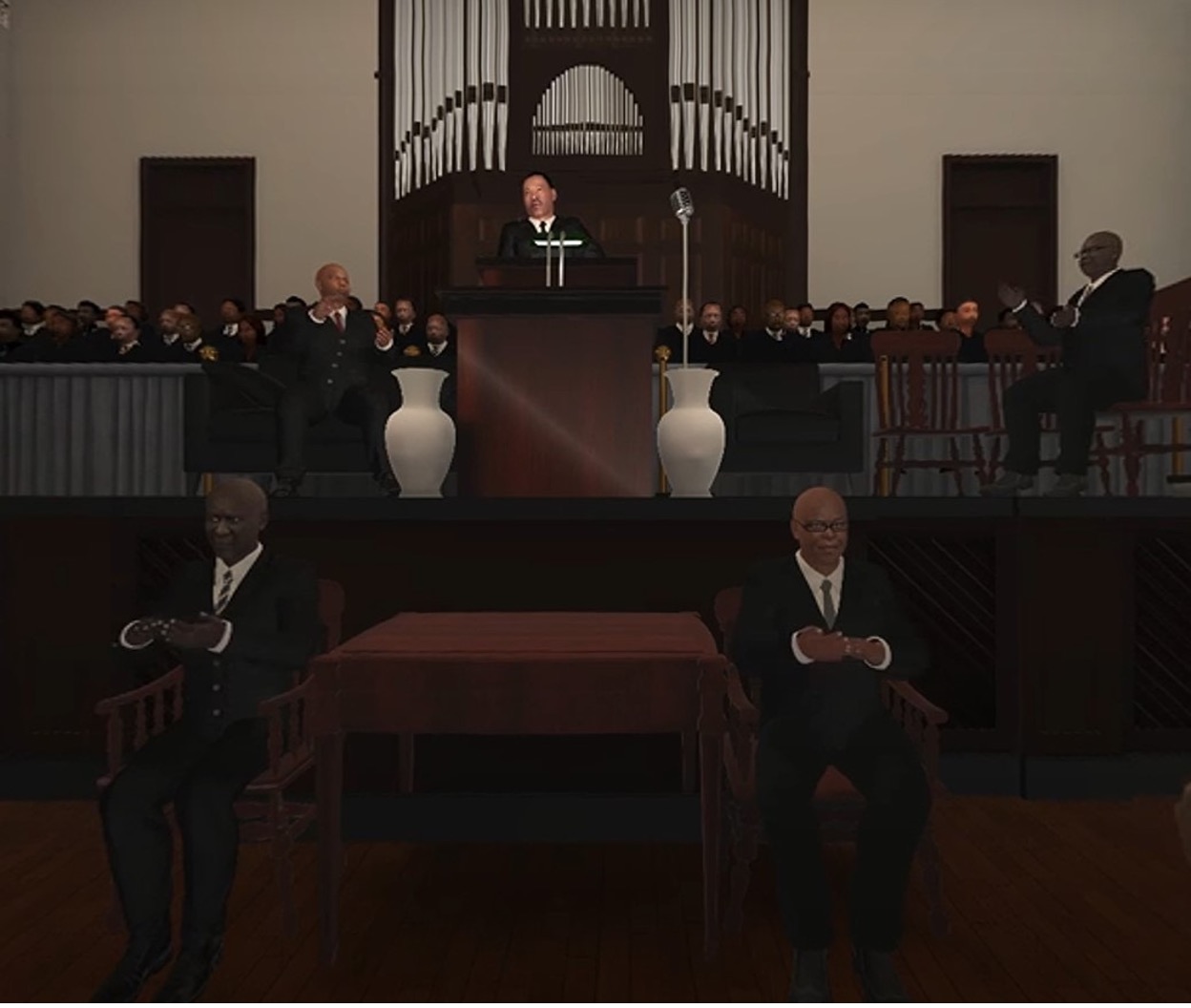
Figure 2. Virtual reality
- Gaming platform experiences. The gaming platform experiences allow participants to move through the virtual reality rendering of “A Creative Protest” on a gaming computer.
- A reflection space known as “Your Creative Protest.” In-person, a separate room is dedicated as a reflection space where participants can write their reflections to the prompts: “An idea whose time has come…,” “A creative protest is…,” and “General reflection.” Online, instructors use shared content-generation platforms, like Google Sheets or Padlet, for students to engage in synchronous reflection on the experience.
Method and Analysis: vMLK and Public Speaking
Data Collection
For the purposes of this study, data was collected from 18 students enrolled in a section of a public speaking course at a state university during the Fall of 2020. Previous exhibitions of the vMLK Project for public speaking at this university primarily took place in technology-equipped spaces within the university’s library. However, the COVID pandemic necessitated a completely virtual experience of the vMLK Project during 2020. At the beginning of the fall semester, public speaking instructors were trained on how to engage with the vMLK Project digitally. The data for this paper focuses on the experience of 18 students enrolled in a hybrid asynchronous/synchronous section of Public Speaking (i.e., the lectures of the course were asynchronous and one class period a week was synchronous and devoted to conversation and activities). This course was also noteworthy because of its vast geospatial dispersion: not only were students learning in their dorms, apartments, and homes across the state and the United States, but this class was also offered to international students in China. The geospatial difference also produced a temporal divide in the class. While the students based in the United States attended the class at 8:30 am, students in China were attending at 8:30 pm.
The course had “vMLK Week” between October 26-30, 2020. Between Monday and Wednesday, students asynchronously watched: (1) a video of their instructor introducing the vMLK Project, contextualizing it for the course, and emphasizing the role of sound in collective experiences; (2) “The Story of the vMLK Project,” a documentary that provided a behind-the-scenes look on the life of the project; (3) “The Royal Ice Cream Sit-in Documentary,” which provided socio historical context for the original speech; and (4) perused the vMLK website (vmlk.chass.ncsu.edu). On Thursdays, students attended one of two synchronous sessions. In these synchronous sessions, students first reflected on what they learned from the documentaries. Next, the instructor shared her screen and audio, and students collectively listened to the recreation of “A Creative Protest” in its entirety. Students then verbally shared their experience of the speech and collaborated on a Google Sheet, which collected their reflections on the following prompts: “A creative protest is…,” “An idea whose time has come is...,” and “General Reflections.” Finally, students were briefly introduced to the VR experience and encouraged to spend more time with the VR experience individually.
To get an idea of the affordances of sound in this digital and distanced terrain, Cynthia Rosenfeld had her public speaking students complete a final examination based on questions typically asked of visitors to the in-person, public vMLK exhibitions and informed by a literature review conducted by Conner Tomlinson and Victoria Gallagher on the locative, generative, and comparative affordances of sound. These questions were:
- How did your position relative to the speaker influence your experience? Did you enjoy the experience more from a certain position in the VR simulation? Was there a position you enjoyed less? Why?
- How did the presence of the audience in the VR influence your experience? Was there a position you enjoyed more in relation to members of the audience?
- How might the acoustic and visual affordances and limitations of the venue at which Dr. King delivered his speech contributed to the delivery and reception of the speech? How might the experience of the speech have been different in another setting (e.g., a speech delivered in an amphitheater or on Zoom)?
- What are some ways a speaker might make use of their location and environment to advance a claim or point of view?
- Describe the characteristics of the speaker's voice (e.g., tone, timbre, fullness, cadence, and other unique aspects of the voice) and discuss how the speaker's voice affected your perception of the speech.
- How might you tailor your own composition and delivery to the unique properties of your voice and the place/space/format in which you give your speech?
Data Analysis
The 18 written responses were originally categorized according to exam questions (exam questions 1-6, described above) and analyzed via qualitative content analysis to make sense of the data. Qualitative content analysis “refers to the description and interpretation of the content, structure, purposes, and consequences” and combines rhetorical analysis with qualitative thematic analysis (Tracy 80). Qualitative analysis allows for self-reflexivity of the researchers, rich contextual information, and thick description of the phenomenon being investigated (Tracy 2-3). It also honors participants’ local meanings and illuminates a multitude of interpretations while drawing attention to theoretically compelling and practically important perspectives (Tracy 7). Qualitative content analysis embodies a “social justice commitment to study the social world from the perspective of the interacting individual” (Denzin and Lincoln xvi). As a result of the historically and culturally specific nature of qualitative content analysis, findings are not readily generalizable. Instead, qualitative content analysis offers “the potential for interpretations to evoke rich and unpredictable associations for readers” who can consider how a study’s claims might transfer to their own situation (Lindlof and Taylor 355).
This project utilized both inductive (emic) and deductive (etic) coding techniques of content analysis to account for both the open-ended nature of the exam and for the theoretically informed prompts. In other words, this project engaged an abductive approach to analysis. Credited to American pragmatist Charles S. Peirce, abduction “refers to the back and forth process” of considering existing theories and emergent qualitative data in content analysis (Tracy 28).
Inductive coding was completed first by the third author. Inductive codes began with in vivo coding, that is codes that are pulled directly from participants’ own language (Saldaña 77). In vivo coding allows analysts to explore the emergent qualitative data (Saldaña 78). In this study, in vivo codes were used to explore what else participants were saying about their experience beyond the questions derived from our literature review. A second level of inductive codes were created from the in vivo codes, an open coding of the actions described by the students (Lindlof and Taylor 318-319). For example, the in vivo code "audience pulls me back and keeps me in check and I feel like I am actually part of it" became the active code “describing embodied sensation produced by audience presence.” Inductive codes were used to add texture to the deductive codes. By first coding the data set inductively, we had a rich variety of descriptions and actions at hand to assist in analyzing the deductive codes.
The deductive codes were derived from a literature review on the locative, generative, and comparative properties of sound. After the codebook was developed, the second and third authors separately coded the entire data set and made process notes while coding. Once both authors were done coding, the codebook was refined. The second and third author then met and talked through each coding discrepancy and completed coding, which included removing some items from the dataset that did not pertain directly to sound. For example, the following response was removed from the dataset because it did not offer insight on the effects of sound:
The location and environment of the speech can be used in the speech to better advance points in the speech. Knowing the time and environment of the speech when it is being given at first can affect the way a speech could be introduced. For example, it could be remarked that it is the anniversary of a certain day, or it could be remarked that in the location the speech is being given, it has been a certain number of years since a certain historical event has occurred, and both can be used as a hook into the topic of the speech.
Inductive and deductive codes were then analyzed together, and exemplary quotes— “selected segments of data that we use to advance an argument by demonstrating and illustrating its claims” –are woven into the analysis below (Lindlof and Taylor 349).
Findings
Characterization of Sound Experience
(RQ1a) Locative Aspects of Experience
Students' responses to the prompts described the most overt and fundamental property of sound: its immersive capacities. To elaborate, sound functions to immerse the listener in the virtual experience and the historical moment of the speech and to position the listener not only physically/spatially in relation to the speaker and virtual audience but also culturally/historically in relation to the original speech and its context. The key to this locative function is the materiality and three-dimensionality of sound, phenomena exemplified by students’ descriptions of how “[t]he sound of the speaker's voice echoing off the walls makes you feel like you can hear it all around you” (Hear Clip 1). Because of this, acoustic cues play an important and distinct role in locating students spatially. Students consistently described how a clearer and more sonically full perception of the voice indicated physical closeness and intimacy with the speaker (Hear Clip 2), while the reverberations of his voice through the virtual church indicated distance from the speaker and highlighted the spectacle of the occasion in a fuller historical context (Hear Clip 3).
Just as essential to this locative function, and even more evident when listening farther from the speaker, are the non-discursive sounds from the audience. "Sitting aways [sic] from the speaker," one student wrote, "the audience’s cheers, claps, and their voices surround me and I feel like I was actually there with them” (Hear Clip 4). Another student concisely explained how sound located them in relation to the audience and the speaker based on their perspective. For them, the sonic clarity of the front row position allowed them to focus on the text, and let them understand "the full range of emotions he was trying to convey through his speech and tone of voice" (Hear Clip 5). From the center of the congregation, where the listener is immersed in the audience but the speaker is still present, "you really have the full experience and range of emotions” (Hear Clip 6). Finally, from the balcony, where the audience is the loudest and most present, a student observed that “you can really feel the energy of the audience and you start feeling the same emotions.”
In addition to physical spatial location, students described how sound virtually situated them in social and historical relations and perspectives that they might not have otherwise experienced. For instance, one respondent wrote that "sitting behind Dr. King inferred a feeling of being on his side and standing with him and his message," while another described how being sonically immersed in the virtual congregation made them feel "a part of something bigger, [...] a movement much larger than yourself." One student detailed how the audience reactions functioned to reorient them to the historical context of the speech. "On one hand you know the context of what he’s speaking on from growing up and learning American history," they wrote, "but on the other hand already knowing what this is about makes it easier to tune out. The audience helps to combat this.” Even when describing the effect of the visuals of the VR experience, one student resorted to auditory metaphors, writing: "seeing the many eyes and heads follow the words that left Martin Luther King Jr’s mouth; [the experience was] almost as if I were a single note in the magnificent orchestral piece that was this speech.” These, and similar responses, address the capacity of immersive sound experiences, as discussed by Alexander, to locate audiences in and between different discourses, ones that might be otherwise inaccessible to the listener.
Beyond the strictly material effects of sound, one student used particularly tactile metaphors to address how the acoustics of the space specifically evoked the rich cultural meanings of a church. “I felt his words at every angle,” they wrote, “and the amplified echoes struck me harder than many I had heard before[...] the area and speech still felt very formal, but also felt hopeful, especially under the protection of god.” Contrasting this distinctive acoustic signature with a space of similar acoustic function, they describe how “[a]n amphitheater would mimic the echo but wouldn’t be able to replicate the power behind the echo.”
(RQ1b) Generative Aspects of Experience
Students articulated the generative property of sound by describing how they were interpellated as audience members and called to act in the immediate virtual moment and/or the contemporary social moment. One student described the experience, stating “it felt as if Martin Luther [King] was speaking directly to me.” The student went on to describe the perspective from the front as feeling “like a citizen standing before the court”—summarizing this sense of being called or hailed and compelled to action (Hear Clip 2). The generative function was found to be particularly intertwined with the other functions, interpellation was typically the result of location within a particular material or social context and action was often prompted by a sonic experience more materially compelling than non-embodied text.
Students articulated several different types of “response demands” with regards to sound. First, an attention demand was consistently foregrounded, as the call and response from the audience indicated moments of collective importance that were deserving of attention. Likewise, the pacing and volume of the speaker's voice “causes the audience to pay attention and really dig in to what he will say next” (Hear Clip 7). Aside from capturing attention, sound was described as demanding an immediate response. This includes engaging with the various virtual perspectives, taking up various historical perspectives (“you can put yourself in the shoes of those who were there, this allows you to feel how the audience felt”), and engaging cognitively and emotionally with the message (one student affirmed that the experience “motivates [the audience] and gives them hope by deeply affecting them”). Closely related, several students remarked on a response demand of silence, describing how periods of silence following important points “allow audience reactions,” “let the crowd ponder on what he just said,” and give audiences a chance to "take a second and be in the moment” (Hear Clip 8). Finally, several students described a social response demand, compelling not just contemplation but sustained action in the contemporary moment. As one student put it, "[t]he speech was more than just an empowering speech where people leave impressed but do not change.”
(RQ1c) Comparative Aspects of Experience
In discussing the effects of the vMLK project, students made comparisons between the materiality of the sound experience (or sound experiences in general) and that of non-embodied text. Often students would articulate energy as a tactile, sonic impression of emotion, with testimonies describing how “the energy of the audience and the emotions of the speaker at the same time” demonstrated “the full experience and range of emotions,” or how “the audience reactions and responses throughout the speech were a reflection of King’s energy just as you could tell he was also feeding off of their energy” (Hear Clip 4). The speaker's voice was consistently described with tactile language as well. One student described how they could "feel what he was saying and not just hear it" and another described "the voice’s fullness[...] his voice is very heavy.” Where energy was described as a force of material tactility, empowerment was similarly articulated as a particularly sonic force of material consequence. This is another point of intersection between the functions of sound. In highlighting the uniquely experiential empowerment of being a part of the congregation, students simultaneously drew on the locative phenomenon of immersion and the generative phenomena of interpellation and movement to action.
Another frequent comparison involved the differences between a richly embodied experience versus one that preserves transparency of text. Importantly, this material comparison is not one of hierarchy, but of different affordances and limitations, with some students preferring one over the other. Those that preferred richness of experience indicated a preference for the congregation perspective over the podium perspective. There, the students sometimes lost a clear understanding of the speaker's words or the full expression of his delivery, but they gained the experience of being surrounded by the reverberations of the speaker's voice and the sense of being part of an embodied audience. One student, who indicated a slight preference for sitting closer to the podium for its clearer sound, described the understanding that “the front is better for focusing on the speech while the back seems to promote more crowd engagement” (Hear Clip 2).
Enargeia and Sound Experience
Impact of Sound on Bodies
Students described the impact that the sound experience had on them beyond the content of the speech. They articulated that sound possessed sensorial (e.g., the feeling of reverberations), affective (e.g., a feeling of intimacy), and material (e.g., “depth” and “fullness”) qualities. Students traced the “energy of the speech” as emanating from the echoes and audience reverberations (Hear Clip 1); the cadence, timbre, and resonance of the speaker’s voice (Hear Clip 7); and the audience’s reactions (Hear Clip 4).
Students frequently articulated a connection between the audience perspective and their experience of the speech. Many students described the balcony as feeling “far away,” with one student even evoking a very visual sense of feeling “more like [they] was watching the experience” as opposed to feeling in the experience. The position from the floor was described as “immersing,” with one student proclaiming, “I felt like I was there.” Both the floor and balcony perspectives encircled students with the sounds of the audience, which one student described both affectively and materially, stating, “I felt as if I weren’t alone, and that I was contributing to an amazingly large phenomenon changing the very environment we sat in.” The auditory perspective offered from the podium was described as clearer and stronger but also “felt more alone.” Across all positions, some students found the effects of echoes to be distancing, while others felt the echoes contributed to the fullness and immersion of the experience.
In addition to the various audience perspectives, students also reflected on the vocal qualities of the voice actor portraying Dr. King. The actor’s voice was frequently described in material terms as possessing “fullness” and “depth.” The material experience of the actor’s voice was perhaps best exemplified by the student who described the voice as “very full and easily filled the room.” This is a striking statement in the context of the listening experience: students engaged in a collective listening experience with the instructor sharing audio over Zoom. Other students reflected on the affective qualities of the actor’s voice; one student described his voice as possessing “authority, passion, and wisdom.” The timbre, resonance, and rhythm of the actor’s voice was said to communicate both “assurance” and “urgency.”
(RQ2b) Role of Sound in Perspective Taking
Students articulated how the sound experience contributed to both a sense of historical perspective taking and to the creation of new perspectives. The vMLK sound experience contributed to a subject position partially afforded by the audible presence of the audience. One student described how the audience pulled the student in and made them “feel like [they were] actually part of it” (Hear Clip 4). Another said that sounds of the audience created a persuasive sense of auditory endorsement. The audible presence of the audience generated a transhistorical sense of community with the congregation of White Rock Baptist Church and a sense of being empowered by and with this community:
[B]eing in the audience helped me feel empowered with everyone clapping and agreeing. If I was the sole person in the audience, the speech would have still been inspiring, but not to the same degree. The presence and the sound of other people make it easier to understand because you can see how other people are reacting.
Further, students found themselves willing to experience the speech in ways they might not be open to in a face-to-face encounter:
My favorite position was on the floor amidst the congregation, as there it felt like I was the most a part of things. This is odd, as usually I don’t like to be in the middle of crowds, however in this situation because it was a virtual reality presentation and I wasn’t actually next to all of those people, it was the best spot to feel a part of things.
This is not to say that all students experienced the presence of the audience as positively contributing to perspective taking. One student expressed displeasure with the audible presence of the audience “as [they] feel the crowd can sometimes take away from the speech, causing the words to be drowned out by the cheering.” This comment speaks to the primacy of the text and emphasizes that one’s perspective of a speech emerges from the capacity to clearly hear and comprehend the content. In contrast, another student articulated that “having other members in the audience during the speech made the simulation a lot more realistic.” The student elaborated that the audible experience of the audience “helped [them] realize how deep the message was that Dr. King was trying to spread,” a realization that the student stated would not have been possible from reading a transcript of the speech.
Discussion
Michelle Comstock and Mary E. Hocks suggest that the material turn in rhetorical studies has resulted in many studies on the visual, but not on sound to the same degree (167). There are certainly scholarly projects that illustrate a material turn in sonic rhetorical studies (Ahern; Eckstein, “Radiolab’s,” “Sound”; Gunn et al.; Rickert), and there are other sonic or sound-based projects that examine sound as central to mental and spiritual transformation. For instance, Farinelli and the King is a story of music as a medium for mental transformation that describes how Spanish King Philip V alleviated his depression by listening to the ethereal voice of the 18th century castrato Farinelli (Bray). This artistic depiction is consistent with contemporary studies that examine how music generates emotions in listeners (Oatley and Johnson-Laird 137). In another instance, a project titled “Hearing the Lost Sounds of Antiquity,” in which researchers sought to create “acoustic photocopies” of ancient sacred spaces to create a sense of the experience of early Greek Orthodox church, articulated the pivotal role of sound in spiritual transformation. They describe their project as a transdisciplinary acoustic archeology and note that “[w]hen you hear and see simultaneously, your body has a very powerful experience” (Abrams).
Like these latter two examples, the Virtual Martin Luther King project developed from a similar desire to explore the role of sound in human transformation. However, in this case, the role of sound in social transformation, particularly in relation to attitudes on race. While rhetorical critics have long theorized and taught that rhetorical performances, particularly public speeches, can lead to the transformation of thoughts, attitudes, and actions, analyses and interpretations have focused more on the words of the speaker than the aural or sound aspects of the experience and on invention and arrangement rather than the sonic qualities of delivery. Additionally, while digital technologies have been described as more or less immersive, there has been relatively little work done on the role of sound in the quality and level of immersion experienced by audiences. By conceptualizing and then testing a materially-grounded notion of sound’s rhetoricity—through our analysis of audience/student response data above—this study provides significant contributions to address these gaps. The first is a conceptualization of sound’s material rhetoricity as being grounded in vivid sonic/multimodal depictions, resulting in immersive experiences characterized by locative, generative and comparative elements/affordances, and leading to self-realization, social and culturally situated fulfillment, and expressions of virtue. The second contribution is a demonstration of how this type of project may be analyzed or assessed in relation to these characteristics.
As the results above indicate, students experienced the shared listening component of the vMLK Project in locative, generative, and comparative ways that afforded an embodied sense of self-realization. Students reported that the vMLK experience immersed them via a vivid sonic depiction that left them feeling empowered and wanting to effect change. The locative, generative, and comparative affordances of sound further illuminate how the vMLK Project helps contribute to a sense of being ready and empowered to engage in civic activity (Gallagher et al., “Public Address” 294).
The students’ descriptions of their embodied experience with sound further illuminates our understanding of how sound destabilizes any conceptualization of an active rhetor speaking to a passive audience and, for that matter, a passive, inert environment, and functions as a synesthetic convergence of (at least) sight, sound, and touch (Ceraso 104). Toward the first point, students often reflected on how the rich relationship between the actor’s voice and the church entangled--the qualities of the voice reflecting off the church walls--to produce an echo that seemed to envelop the listener. This aspect of the sonic experience supports Rickert’s description of a vibrant rhetorical place, or “chōra”, that grounds embodied minds in “material environments, informational spaces, and affective registers” (43, 45). Further, the notion of audience as passive or somehow supplementary to the primacy of the speech is refuted by students’ comments. Even the few students who found the sounds of the audience disruptive to receiving the content of the speech acknowledged how the sounds of the audience constituted the experience of the speech. As one student put it, “The presence and the sound of other people make it easier to understand because you can see how other people are reacting.”
The student’s comment, that the “sound of other people” makes it easier to “see how other people are reacting,” is quite revealing to the second point, that sound functions as a synesthetic convergence of sight, sound, and touch (Ceraso 104). This point is further illustrated by another student’s comment that the student could “feel his [the voice actors’] voice at every angle.” The student who described the effect of hearing others as seeing others also articulated that sensorial experience with feelings of inspiration and empowerment. Just as von Mossner articulates the multimodality of vision and its activation of somatosensory and emotional experiences, students’ comments also speak to the multimodality of sound and the capacity of sound to not only “bring before the ears” but to also engage our other senses and generate an emotional experience (65; Detweiler 214).
Analysis of audience response data demonstrates that experiencing a speech that King gave in 1960 within the context of a digitally recreated and embodied environment does lead to powerful affective and cognitive responses from audiences. These findings, in turn, provide a means for conceptualizing public address as experience, a conceptualization which foregrounds rhetoric’s materiality by attending to the combination of auditory and visually immersive elements that allow audiences to directly experience rhetoric’s affective energies in relation to social transformation. Indeed, the locative, generative, and comparative aspects of sonic rhetorics demonstrated here and conceptualized in terms of public address as experience may serve as the basis for important interventions in classrooms and at public memory sites.
One critique of some public memory sites has been that they can function pedagogically to uphold traditional, unproblematized narratives of U.S. history. For example, Megan Fitzmaurice described how the slavery tours at the homes of Washington, Jefferson, and Madison offer a narrative from the perspective of the former presidents and not from the enslaved people (495). In contrast, as indicated earlier, Jonathan Stone’s work brings together conversations about the power of recorded voice, decentered rhetorical historiography, and an ethic of multimodal listening in his study featuring the Lomax Prison recordings. Jennifer Sano-Franchini's critique of sonic representations (and call for sonic self-representation) of Asian-Americans discusses sonic tropes that are used to inscribe meanings on bodies, while suggesting the possibility of meaningful re-inscription via current networked media technologies. For her, "[s]ound offers a useful way of examining with greater detail the embodied, affective, and material experience of Asian/American rhetoric," and can be used both to oppress, through the codification and racialization of listening practices, and reclaim, through the proliferation of new subjectivities. In the context of contemporary racial identities as well as historical understandings, Sano-Franchini's critique emphasizes the importance and rhetorical power of responsibly amplifying the sounds of marginalized communities. Sonic experiences like those examined by Stone, Sano-Franchini and the vMLK Project thus function as “technologies of recovery” that allow participants to not only learn about but to feel historical events from different, previously excluded or ignored, perspectives (Gallon).
One other productive area for continued exploration that the vMLK Project and this paper illuminate includes examining how and to what extent the locative, comparative, generative, and enargeic (as both impacting individuals through a richly embodied experience and as enabling complex perspective taking) functions of sound can lead to social and culturally situated fulfillment, expressions of virtue, or, as Gallagher and colleagues have theorized, as a form of eudaimonic wellbeing (40). This type of wellbeing has less to do with happiness or pleasure and more to do with creating or experiencing the material conditions of flourishment, including enhanced cultural and civic engagement. Further studies that grapple with the complexities of sound could help illuminate how the resulting perspective taking, including transtemporal perspective taking, and culturally and socially rooted self-realization may be connected to eudaimonia. Our analysis provides the grounds for considering how sonic rhetoric contributes to flourishment by showing that it is not only poetic usage of symbolic language that constructs a vivid mental image for listeners but also the timbre, rhythm, and resonance—the energy—of voice and the active auditory engagement of audiences. Further, these vocal qualities go beyond the construction of mental imagery to affectively produce sensations of both urgency and assurance. And as Carolyn Miller argues, agency is the kinetic energy of rhetorical performance (147). In any case, as this study shows, sonic-based rhetorics, such as the vMLK Project, matter to our civic engagement, to our rhetorical agency, to our self-realization, and to creating the conditions for social and cultural transformation.
Works Cited
Abrams, Zara. “Project Seeks to Capture, Re-Create Auditory Experience of Ancient Buildings.” Houston Chronicle, 4. Mar. 2015, https://www.houstonchronicle.com/lifestyle/houston-belief/article/Project-seeks-to-capture-re-create-auditory-10977337.php#:~:tet=%22When%20you%20hear%20and%20see,powerful%20in%20the%20premodern%0period. Accessed 16 Apr. 2021.
Ahern, Katherine Fargo. “Tuning the Sonic Playing Field: Teaching Ways of Knowing Sound in First Year Writing.” Computers and Composition, vol. 30, no. 2, 2013, pp. 75-86.
Alexander, Jonathan. “Glenn Gould and the Rhetorics of Sound.” Computers and Composition, vol. 37, 2015, pp. 73–89.
Anderson, Erin. “Toward a Resonant Material Vocality for Digital Composition.” enculturation: a journal of rhetoric, writing, and culture, vol. 18, 2014, http://enculturation.net/materialvocality.
Blair, Carole. “Contemporary U.S. Memorial Sites as Exemplars of Rhetoric's Materiality.” Rhetorical Bodies, edited by Sharon Crowley and Jack Selzer, U of Wisconsin P, 1999, pp. 16–57.
Bray, Catherine. “Mark Rylance’s Next Act.” Departures, 6 Feb. 2018, https://www.departures.com/art-culture/actor-mark-rylance-interview. Accessed 16 Apr. 2021.
Ceraso, Steph. “(Re)Educating the Senses: Multimodal Listening, Bodily Learning, and the Composition of Sonic Experiences.” College English, vol. 77, no. 2, 2014, pp. 102–123.
Collins, Patricia Hill. Black Feminist Thought. Routledge, 2000.
Comstock, Michelle, and Mary E. Hocks. "The Sounds of Climate Change: Sonic Rhetoric in the Anthropocene, the Age of Human Impact." Rhetoric Review, vol. 35, no. 2, 2016, pp. 165-175.
Denzin, Norman K., and Yvonna S. Lincoln. The Sage Handbook of Qualitative Research. 5th ed., Sage, 2018.
Detweiler, Eric. “Sounding out the Progymnasmata.” Rhetoric Review, vol. 38, no. 2, 2019, pp. 205–218.
Dickson, Barbara. “Reading Maternity Materially: The Case of Demi Moore.” Rhetorical Bodies, edited by Sharon Crowley and Jack Selzer, University of Wisconsin P, 1999, pp. 297–313.
Dyson, Frances. Sounding New Media: Immersion and Embodiment in the Arts and Culture. U of California P, 2009.
Eckstein, Justin. “Radiolab’s Sound Strategic Maneuvers.” Argumentation, vol. 31, no. 4, 2017, pp. 663-680.
---. “Sound Arguments.” Argumentation and Advocacy, vol. 53, no. 3, 2017, pp. 163–180.
Fitzmaurice, Megan. "Recirculating Memories of the Presidents as Benevolent Slaveholders on Presidential Slavery Tours." Rhetoric and Public Affairs, vol. 22, no. 4, 2019, pp. 495-532.
Fletcher, Guy, editor. The Routledge Handbook of Philosophy of Well-being. Routledge, 2016.
Gallagher, Victoria J., et al. “Visual Wellbeing: Intersections of Rhetorical Theory and Visual Design.” Design Issues, vol. 27, no. 2, 2011, pp. 27-40.
---. “Public Address as Embodied Experience: Using Digital Technologies to Enhance Communicative and Civic Engagement in the Communication Classroom.” Communication Education, vol. 69, no. 3, 2020, pp. 281-299.
Gallon, Kim. “Making a Case for the Black Digital Humanities.” Debates in the Digital Humanities, edited by Matthew K. Gold and Lauren F. Klein, 2016. https://dhdebates.gc.cuny.edu/read/untitled/section/fa10e2e1-0c3d-4519-a958-d823aac989eb.
Gunn, Joshua, et al. “Auscultating Again: Rhetoric and Sound Studies.” Rhetoric Society Quarterly, vol. 43, no. 5, 2013, pp. 475-489.
Gould, Glenn. “The Idea of North: An Introduction.” The Glenn Gould Reader, New York, NY: Vintage, 1984c, pp. 391-393.
---. “The Idea of North.” Compact Disc, CBC Records PSCD2003-3.
Jasen, Paul. Low End Theory: Bass, Bodies, and the Materiality of Sonic Experience. Bloomsbury Academic, 2016.
Jones, Feminista. Reclaiming Our Space: How Black Feminists Are Changing the World from the Tweets to the Streets. Beacon Press, 2019.
Lindlof, Thomas R., and Bryan C. Taylor. Qualitative Communication Research Methods 4th ed., Sage, 2019.
Miller, Carolyn. “What Can Automation Tell Us About Agency?” Rhetoric Society Quarterly, vol. 37, no. 2, 2007, pp. 137-157.
Oatley, Keith, and P. N. Johnson-Laird. “Cognitive Approaches to Emotions.” Trends in Cognitive Sciences, vol. 18, no. 3, 2014, pp. 134-140.
Rickert, Thomas. Ambient Rhetoric: The Attunements of Rhetorical Being. U of Pittsburgh P, 2013.
Saldaña, Johnny. The Coding Manual for Qualitative Researchers. 3rd ed., Sage, 2014.
Sano-Franchini, Jennifer. "Sounding Asian/America: Asian/American Sonic Rhetorics, Multimodal Orientalism, and Digital Composition." enculturation: a journal of rhetoric, writing, and culture, vol. 27, 2018. http://enculturation.net/sounding-asian-america.
Stone, Jonathan W. "10 Listening to the Sonic Archive: Rhetoric, Representation, and Race in the Lomax Prison Recordings." enculturation: a journal of rhetoric, writing, and culture, vol. 19, 2015. http://enculturation.net/listening-to-the-sonic-archive.
Tracy, Sarah J. Qualitative Research Methods: Crafting Evidence, Crafting Analysis, Communicating Impact. 2nd ed., Wiley Blackwell, 2020.
von Mossner, Alexa Weik. Affective Ecologies. The Ohio State UP, 2017.
Issue TOC
Review of Duin and Pedersen's Augmentation Technologies and Artificial Intelligence in Technical Communication: Designing Ethical Futures
Review of Duin and Pedersen's Augmentation Technologies and Artificial Intelligence in Technical Communication: Designing Ethical Futures

Ann Hill Duin and Isabel Pedersen, Augmentation Technologies and Artificial Intelligence in Technical Communication: Designing Ethical Futures, Routledge, 2023. 282 pp. ISBN 9781032263755.
Augmentation Technologies and Artificial Intelligence in Technical Communication: Designing Ethical Futures by Ann Hill Duin and Isabel Pedersen is a comprehensive exploration of the intersection of Artificial Intelligence (AI), augmentation technologies, and human experience. This book offers essential tools for the ethical design and adoption of emerging technologies within technical communication. It is an important read for students, scholars, and professionals in technical and professional communication (TPC), user experience design, computer science, and related fields, providing, in the authors' words, "greater depth for understanding augmentation technologies and, amid enhancement of professional capabilities, a strong focus on building technical and professional communication ability, and strategic knowledge to articulate its benefits, risks, and relevance" (19). Further, it includes links to an online archive, "Fabric of Digital Life," which offers a wide range of materials curated with detailed meta-tagging.
Rhetorical and professional communication scholars Heidi A. McKee and James E. Porter argued in 2017 that, "increasingly, humans are communicating with AI agents, often without knowing they are doing so" (135). They continue, "The implications of AI for professional communication and for organizations and business professionals who deploy AI agents are profound." From a similar viewpoint, Duin and Pedersen believe that the purpose of their research on augmentation technology and AI "is to cultivate an even deeper understanding of human augmentation and AI technology, build technical and professional communication capacity to articulate its benefits and risks, and provide direction for future practice and collaboration" (3). Considering McKee and Porter's conversation on human-AI interaction as their framework, Duin and Pedersen emphasize the importance of integrating ethical principles into developing and applying augmentation and AI technologies in their book. These principles include ensuring privacy, upholding accountability, guaranteeing safety and security, maintaining transparency, fostering fairness and preventing discrimination, adhering to professional responsibility, and advancing human values.
The authors also analyze the societal value systems that shape augmentation technologies, such as beliefs surrounding enhancement and automation. For example, when discussing AI's potential emotional enhancement, they argue, "Critical to emotional enhancement is that ethical design practices must underpin all work in this area to ensure that human rights are always respected" (53). Duin and Pedersen also showcase the socio-technical complexities and ethical implications of human augmentation technologies, challenging the conception of technology as neutral and emphasizing the need for a context-driven approach.
While discussing the "Agency, Affordances, and Enculturation of Augmentation Technologies," Duin and Pedersen opine that advanced, evolving, and integrated augmentation technologies will positively impact various aspects of life, including literacy, culture, art, economy, and social settings. They define augmentation technologies as the catalyst of enhancing human capabilities or productivity "by adding to the body in the name of efficiency and automation" (85). In this leg of the book, the authors provide a helpful analysis of the social and ethical implications of current augmentation technologies, investigating the complexities of human-non-human agency, the role of marketing, and the emerging realities of digital landscapes like the Metaverse.
It is essential to acknowledge the challenges posed by dynamic market forces, political influences, and social disparities that could hinder the implementation of the book's proposed ethical frameworks. While the authors comprehensively document recent technological developments, questions remain regarding the adaptability of these ethical principles amid rapid technological shifts. However, the authors invite a deeper analysis within the text, encouraging a discussion on whether the proposed ethical foundation is robust enough to withstand future technological changes or if it risks obsolescence in the face of evolving digital phenomena. Nevertheless, Ann Hill Duin and Isabel Pedersen's work is an invaluable roadmap for those in the TPC field, prompting a necessary dialogue that urgently needs to be taken up by a broader audience. This book raises the bar for ethical engagement in our technologically augmented lives, urging us to be proactive rather than reactive in shaping an equitable digital future.
Works Cited
Duin, Ann Hill, and Isabel Pedersen. Augmentation Technologies and Artificial Intelligence in Technical Communication: Designing Ethical Futures. Routledge, 2023.
McKee, Heidi A., and James E. Porter. Professional Communication and Network Interaction: A Rhetorical and Ethical Approach. Taylor & Francis, 2017.
About the Author(s)
Mafruha Shifat is a Master's Student and Graduate Teaching Assistant in English at North Dakota State University, Fargo, USA.
The Rhetorical Sound of Access: Captioning Spoken Plays and Musical Theater
The Rhetorical Sound of Access: Captioning Spoken Plays and Musical Theater
Published 24 January 2026
Theatergoers who attend a live play or musical become immersed into the sensational world of the actors' dialogue, musical beats, dancers' steps, and other sound effects. The multisensory stimulation accompanies the mind's exposure to cultural themes, with the rapid and innovative sonic language of Hamilton in the limelight of recent musical theater. Genuine participation in these cultural conversations, however, requires that audience members can fully access these messages. Theaters, as shared cultural spaces, can become accessible when captions are provided to visually represent speech, lyrics, and other sounds through the linguistic, or written, mode. However, as D/deaf, hard-of-hearing, and hearing theatergoers and members of the theater community show later in this article, simply providing captions without considering how they would be experienced by audience members can be insufficient.
Theaters, which are shared cultural spaces that directly bring audience members together, make apparent how we all attend to meaning in different ways while perceiving the same performance—especially when some of us may be reading captions placed elsewhere on stage. These perceptual differences during a live sonic production make it crucial to design our stages for access. To show the importance of more effective and meaningful captions for spoken plays and musicals, this article discusses how cultural spaces can become more accessible when we (creators and audiences) collaboratively attend to audiences' experiences, advocate for the need for access, and incorporate captioned access.
Written through a rhetorical lens, this article frames theaters as shared cultural spaces that illustrate the complexity of designing sonic access and the importance of embracing that complexity as we investigate possibilities for making our shared spaces more accessible. The wide-ranging plays and musicals from varied genres that are performed on different stages are not easily captioned since translating intricate theatrical sounds to the linguistic mode can be a challenge. Captioning the different sonic worlds of each production underscores how working on sound and access (in any theatrical and non-theatrical context) is not a straightforward process with a single solution. As members of our theatrical, scholarly, and cultural communities, we can tackle this challenge together as we learn from each other and the collaborative process of creating accessible and inclusive sonic spaces.
This article advocates for increased attention to audiences' experiences engaging with sound, visuals, and captions and more meaningful incorporation of effective captions. I first build on scholarship in rhetoric and composition and related fields to structure my interrogation of how theatrical spaces can be (re)designed to expedite audience members' attention to each mode, particularly sound and visuals. I then detail my research study in which I interviewed thirty participants about their experiences attending or performing in live productions with captions. As I discuss in the analysis section, these participants' experiences raised the themes of the need for access; how audiences attend to sound, captions, and visuals differently; and how captions can be designed more effectively. These themes reflect our advocacy for captions to be included consistently and meaningfully in theaters—and the need for creators and audiences to (re)imagine strategies for captioning and delivering sonic meaning. After my analysis, I reflect on how creators and audiences can collaboratively participate in the complex and rhetorical process of making the sounds of our shared cultural spaces more accessible.
Sound and Access as a Process
Before analyzing captioned sound in theaters, I begin with an overview of theater captions for spoken plays and musical theater. While the Americans with Disabilities Act (ADA) requires that access be made available in theaters, not all scheduled performances are captioned. Organizations such as TDF and Theatre Access NYC are among those that support access in theaters, and audience members can communicate with theaters to request captions. When theaters do provide captions, the placement of captions may be less than ideal. Broadway and other theaters may place captions on an LED screen that sits to the side of the stage at a distance from the performers to avoid interfering with the action on stage (Piepenburg). Theaters might also provide captions through a mobile app so that individual audience members can read captions in real time on their personal devices or provide caption glasses that individual audience members can wear while watching a production (Kornides). As participants pointed out and as this article explores in the analysis section, captioning approaches differ across theaters and playhouses, and different captioning practices and placements influence audiences' experiences of a live play or musical.
Extending my interview participants' powerful messages and informed by my own experiences as a Deaf theatergoer, I use this article to assert that we can make our shared cultural spaces even more accessible by considering how the (re)design and placement of captions could strengthen audiences' experiences of a theatrical production. Having meaningful access to sound and multiple modes of communication is a basic principle for community engagement and cultural participation, from entering Lin-Manuel Miranda's transformative world of Hamilton to other stages in which we engage with our fellow citizens of society.
The multicultural value of community-based sound has been highlighted in the 2021 special issue of Kairos, "Sound and Social Change," a collection of texts that honors "the relationship between sound, culture, and community" (Leger et al.). These webtexts, many of which center on music, cultural identities, and communities, include a symposium by five colleagues who invite "readers and listeners to reflect on the relationships between textual, linguistic, and musical composing, as well as the companionability of language and sound" (Snyder et al.). Such active projects draw from the power of musical composition in coalescing individuals' senses of empowerment and collective identity, just as Victor Del Hierro's earlier "DJs, Playlists, and Community" brings readers into the world of hip-hop DJs and amplifies how communities inform the design of communication. We can likewise learn from audience members' experiences with captioned sounds to inform the design of sonic access in live theater.
Audiences' experiences with captioned productions are at the heart of this advocacy for more meaningfully captioned productions since we can only immerse ourselves into the world playing out on stage when we can access each moment, sonic and otherwise. Concurrently, we audiences and scholars can learn more about sound and access as we work through the complexity of creating sonic access for live productions. Challenges of captioning sound include the following: captions can be placed in less-than-ideal locations (such as captions at the far side of the stage); audience members have different preferences for captions depending on their access needs, communication practices, and the context; and productions may already have preestablished staging that determines where actors and other elements of the set design are placed (and captions might not feasibly fit in amongst these elements). When we create sonic compositions, there is not a single answer or formula to follow; instead, we must attend carefully to how we can meaningfully incorporate captions to improve audiences' experiences and access.
Methods, Participants, and Themes
This article's commitment to sonic access is a component of my larger IRB-approved research study on captioned live performances. My larger study aimed to identify how individuals experience captioned live performances and the potential affordances of different kinds of captions for theater settings, including how captions may or may not provide attendees with access to sound, music, and the embodied performances of those on stage.
I recruited a total of thirty participants with different hearing levels for my study and placed participants into three separate groups. For the first group, I interviewed 10 participants who have predominantly attended spoken (non-signed) productions with captions, notably Broadway plays and musicals and other spoken (non-signed) productions in theaters nationally and globally. These 10 participants are foregrounded in this article since they discussed plays and musicals in which sound is a major source of meaning.
For the second group, I interviewed 10 participants who have attended simultaneously signed and spoken productions with deaf and hearing actors, such as productions that my home institution's performing arts program stages several times a year. For the third group, I interviewed 10 individuals with experience performing in or being directly involved in producing plays and musicals with captions. While the three groups were distinct, some participants in the second and third group had also attended spoken plays and musicals (the main focus of the first group) and could contribute to the findings that are shared in this article. Each one-on-one interview occurred on Zoom and participants' names have been changed to pseudonyms.
| Category | Code | Number of Participants with Code |
|---|---|---|
| Access | Theater Access, Inclusion, Community | 17 |
| Access to Spoken/Written English Language | 19 | |
| Awareness and Advocacy | 14 | |
| Design | Design of Captions on Margins of Stage | 17 |
| [Descriptive Indicators] | 12 | |
| Attention to Layers | Attention to Layers: Sound, Captions, Visuals | 16 |
| Attention to Layers in Hamilton | 6 |
Data and Analysis
Access
Theater Access, Inclusion, Community
While 10 participants were asked specifically about their experiences attending captioned spoken plays and musicals, other participants also had experiences attending Broadway and other live spoken productions. These individuals' presence in playhouses and theaters across the country embodies the value of access to theater and inclusion in their communities. One participant, Ivy, captured the importance of access to live theater when she emphasized the need "to be part of a community, to be part of artists, to be experiencing new ideas. These shows that are coming out have really important themes. And to enjoy." Enjoyment, cultural exposure, community, art, and the live exchange of ideas are enhanced when effective captions support access.
The benefits of providing captions for more performances are evident. In Ivy's equally expressive words, "having the captions enable me to have equal access, equal opportunity, and an equal experience for everyone. It's inclusive. Without it, I would be missing the punchlines. I wouldn't get the gist of the show." Just as crucially, she would miss "the experience of what the artist was trying to convey." In addition to accessing the world of the show, attendees share the experience with their fellow spectators. Josefina explained, captions "allow accessibility for both me as a deaf person and my hearing husband" who can connect over the exact words that are being said and shown in the captions.
However, if captions are placed in ineffective places in a theater, such as too far offstage, the placement and other issues can prevent attendees from genuinely engaging with a performance and feeling fully included in the theatrical community. Like other participants, Evelynn described her experiences with different types of captions in different theaters and explained: "They're all different and . . . it's all about where the captioning is because you want to be perfect. You want to see the audio and the words. You don't want to be going [to a playhouse]—and then you miss the whole thing." Orlando summarized his perspective as follows: "Generally speaking, my experience with captioning has not been optimal. The captions are often put in the wrong place or they're not done appropriately or it's just overwhelming to look from the captions to the stage and back and forth the entire performance. And when you're doing that, it's hard to capture what's going on onstage well." If the placement of captions prevents full access, the cultural experience is not shared.
Access to Spoken/Written/English Language
In participants' descriptions of why they attend theaters and the positive and negative aspects of captioned productions, the theme of access to spoken and written language emerged. Individuals underscored the value of having access to the source language of the writer and using captions to support their hearing in a setting with multiple speakers, sources of sound, and overlapping stimuli.
Several participants detailed how captions provide them with clarification on what they are hearing. Neve, who wears cochlear implants, explained, "with Broadway shows, I have a hard time understanding between the microphone and the loudspeakers and the music. It all kind of blends together . . . So, I heavily rely on captions for those kind of performances." Helena provided her input: "I have pretty good hearing with my cochlear implants, but when it comes to musicals, my song lyrics are like I'm hearing a play in German or French or Spanish. It's like they're singing and performing and it's beautiful, but what's the meaning?" Access to words is just as necessary for those who do not hear the acoustics at all.
Awareness and Advocacy
Participants also raised key points about advocating for increased awareness on the part of attendees and theaters. While access is always a work in progress, several participants described successful experiences working with certain theaters and captioners. Axel emphasized that large theaters in big cities "typically hire access staff" that people can reach out to and "work with them in changing the placement or access options that are available . . . It's important to reach out to the theaters and educate them along the way as well." After describing several experiences in which theaters "worked with the audience on placement of captions" to ensure "that the placement was just right and that it wasn't too far out of the way," Axel added that "when the theater works with access staff who works with the audience, that's when you get the best result."
Design of Captions
Design of Captions on Margins of Stage
A major trend was participants' criticism of captions on screens that are placed too far from the center of action on the main stage. While the actual distance between a screen and the action on stage depends on the theater, some participants shared especially problematic experiences attempting to swivel their heads back and forth between gazing at the captions in the margins and gazing at the action on stage when the screen was placed especially far off stage. In Cooper's words, "those were a little bit more difficult to use because I felt like I had to move my head to look back and forth from the stage a lot more, and that led me to feeling less connected to the show itself."
Participants also pointed out the limitations of captions that are placed too far above the stage or below the stage. When captions were placed too far above stage for Darrell, he "couldn't see both at the same time," while Yvette in turn viewed captions below the stage and felt that "it was a strain to have to look back up at the stage and see who was talking."
[Descriptive Indicators]
In addition to preferring captions that are placed closer to the action, some participants shared suggestions for more descriptive captions that would provide them with access to the intricate sonic world on stage. They requested that captions indicate speakers' names; the nuances of musical and stage effects; tone, emotion, and inflection; and background sounds. These descriptive indicators could appear in [brackets] like closed captions on television.
Attention to Layers
Attention to Layers of Sound, Captions, and Visuals
I asked each participant about how they or audiences pay attention to captions, the action on stage, and sound during a production so I could learn about how they attend to these layers in real time. Participants' responses show that the placement and delivery of captions can positively or negatively influence how they pay attention to captions and other sources of information.
Lexi reflected on how and why each audience member would choose to focus more on reading captions or to focus more on the embodied sensation of sound and music. As she stated, "different people appreciate sound and music in different ways. And that's true whether deaf or hearing. Some people prefer to feel the music or feel the sounds. Some people want to know all of the lyrics and they feel connected with the lyrics."
Attention to Layers in Hamilton
Throughout these interviews, I learned about individuals' rich experiences attending productions from Aladdin and The Lion King to Wicked and Beetlejuice, among many others. In the midst of this variety, several participants independently shared their experiences seeing captioned productions of Hamilton around the country. This theme encapsulates the affordances of captions in embodying sound, especially when considering the power that is delivered in the rich and fast language of the musical.
Centerstage: Access in Shared Cultural Spaces
These members of theatrical communities represent access as a collaboration in progress and inspire this article's advocacy for integrating captions more thoroughly into our theaters. They make evident that sonic spaces are not defined purely by the presence of sound, but by the comingling of silence, vibration, visual language, embodied messages in addition to spoken voices, music, and background effects. They likewise illustrate that we cannot just "add captions," and that we creators and audiences can be active co-participants in the process of advocating for more awareness and meaningful incorporation of captions and access in theaters.
Works Cited
Ahern, Kati Fargo. "Soundscapes: Rhetorical Entwinements for Composing Sound in Four Dimensions." Tuning in to Soundwriting, edited by Kyle D. Stedman, Courtney S. Danforth, and Michael J. Faris, enculturation/Intermezzo, 2021, http://intermezzo.enculturation.net/14-stedman-et-al/ahern.html.
Bose, Dev K., Sean Zdenek, Prairie Markussen, Heidi Wallace, & Angelia Giannone. "Sound and Access: Attuned to Disability in the Writing Classroom." Tuning in to Soundwriting, edited by Kyle D. Stedman, Courtney S. Danforth, and Michael J. Faris, enculturation/Intermezzo, 2021, http://intermezzo.enculturation.net/14-stedman-et-al/bose.html.
Brewer, Elizabeth, Cynthia L. Selfe, and M. Remi Yergeau. "Creating a Culture of Access in Composition Studies." Composition Studies, vol. 42, no. 2, 2014, pp. 151-154.
Buckner, Jennifer J., and Kirsten Daley. "Do You Hear What I Hear? A Hearing Teacher and a Deaf Student Negotiate Sound." Soundwriting Pedagogies, edited by Courtney S. Danforth, Kyle D. Stedman, and Michael J. Faris, Computers and Composition Digital Press, 2018, https://ccdigitalpress.org/book/soundwriting/buckner-daley/index.html.
Butler, Janine. "Integral Captions and Subtitles: Designing a Space for Embodied Rhetorics and Visual Access." Rhetoric Review, vol. 37, no. 3, 2018, pp. 286-299.
Butler, Janine. "Where Access Meets Multimodality: The Case of ASL Music Videos." Kairos, vol. 21, no. 1, 2016, http://kairos.technorhetoric.net/21.1/topoi/butler/index.html.
Ceraso, Steph, and Kati F. Ahern. "Composing with Sound." Composition Studies, vol. 43, no. 2, 2015, pp. 13-18.
Ceraso, Steph. Sounding Composition: Multimodal Pedagogies for Embodied Listening. University of Pittsburgh Press, 2018.
Charmaz, Kathy. Constructing Grounded Theory: A Practical Guide Through Qualitative Analysis. Sage, 2006.
Danford, Courtney S., Kyle D. Stedman, and Michael J. Faris, editors. Soundwriting Pedagogies. Computers and Composition Digital Press, 2018, https://ccdigitalpress.org/book/soundwriting/.
Del Hierro, Victor. "DJs, Playlists, and Community: Imagining Communication Design through Hip Hop." Communication Design Quarterly Review, vol. 7, no. 2, 2019, pp. 28-39.
Dolmage, Jay. "Disability, Usability, Universal Design." Rhetorically Rethinking Usability, edited by Susan Miller-Cochran, Hampton Press, 2009, pp. 167-190.
Kornides, Alexandra. "Exploring Accessible Technology In Theatre: Captioning. Arts Management and Technology Lab." September 30, 2021. https://amt-lab.org/blog/2021/9/accessible-technology-in-theatre-captioning.
Leger, Shewonda, Eric Rodriguez, Ja'La Wourman, Shannon Kelly, Rosa Tobin, and Benjamin Lauren. "Introduction to the Special Issue: Sound and Social Change." Kairos, vol. 26, no 1, 2021, https://kairos.technorhetoric.net/26.1/loggingon/leger-et-al/index.html.
Piepenburg, Erik. "Making Broadway Accessible for the Disabled." New York Times. March 2, 2010. https://artsbeat.blogs.nytimes.com/2010/03/02/making-broadway-accessible-for-the-disabled/.
Yergeau, M. Remi, et al. "Multimodality in Motion: Disability and Kairotic Spaces." Kairos, vol. 18, no. 1, 2013, http://kairos.technorhetoric.net/18.1/coverweb/yergeau-et-al/pages/space/index.html.
Zdenek, Sean. "Designing Captions: Disruptive Experiments with Typography, Color, Icons, and Effects." Kairos, vol. 23, no. 1, 2018, https://kairos.technorhetoric.net/23.1/topoi/zdenek/.
Zdenek, Sean. Reading Sounds: Closed-Captioned Media and Popular Culture. U of Chicago Press, 2015.
Comments