
Issue 35

Issue 35
Image
An overhead shot of a glowing, branched lava flow moving across a dark, volcanic landscape under a hazy, deep red sky.
Scenes, Sounds, and Systems
2025

“If circulation is material, which physical entity causes an idea to disseminate through a crowd, or a way of thinking to inhabit the minds of millions?"

—Matthew Halm, “Molten Circulation and Rhetoric’s Materiality”
Lava flow, Kilauea volcano, Hawaii Volcanoes National Park. Photo by USGS.

Articles

Janine Butler
Theatergoers who attend a live play or musical become immersed into the sensational world of the actors' dialogue, musical beats, dancers' steps, and other sound effects. The multisensory stimulation accompanies the mind's exposure to cultural themes, with the rapid and innovative sonic language of Hamilton in the limelight of recent musical theater. Genuine participation in these cultural conversations, however, requires that audience members can fully access these messages.
Ryan Cheek, Avery C. Edenfield
Trans* communities across the United States are under assault by radical extremist forces seeking to inflame partisanship by promoting hateful ideologies as wedge issues. This phenomenon is playing out in all manner of mediums—from radio stations, television studios, and the Internet to courtrooms, convention stages, and the halls of Congress.
Lucas Rossi Corcoran
Despite the influence of Paulo Freire's Pedagogy of the Oppressed in North American academic circles, to my knowledge, there has been no significant attempt to rethink the 1970 Myra Bergman Ramos English translation. In this article, I address one aspect of this issue, by attending to how the words ser and estar are rhetorically figured in the Paz e Terra edition of Pedagogia do oprimido. Employing a comparative rhetorical methodology,
Jason Luther, Kristin Prins, Frank Farmer
A woman-owned community print shop. Textile art made from salvaged materials. An open-source feminist hacker zine. A free skool that teaches UX. A makerspace in a public library. An independently published children’s book about lowriders. For the last several years, we have worked with a loose collective of scholars devoted to Do It Yourself (DIY) approaches to teaching writing.
Elena Kalodner Martin, Jeremy Levine
Significant work in rhetoric and composition has been done to connect the value systems surrounding language use to the raced, gendered, and classed structural inequalities that dominate much of life in the United States. This tension is often inscribed in language policy, where how one speaks and writes often becomes a stand-in for who is able to fully access public and social services and resources.

Response Essays

Sonic Projects

Jessie Bullard, University of California, Irvine

This script is a collage of different excerpts from my Master’s Thesis, Voicing the Invisible Body: Electrate Voice in Composition, reflections from Geoffrey V. Carter’s curation The Rocktalog: Scholars Celebrating & Inhabiting Musicians, and new insights written to synthesize and make connections between electrate voice, remix, and aural punctums.

Cooper Casale, University of Colorado Boulder

Dad talked about the clutch of his 2003 Toyota Matrix as though it were the Christ-wafer spinning itself to death somewhere deep inside the car’s crust. Everywhere, cars die on little stone shores of road. You see them sometimes. The driver’s gone. And you wonder where they went. They’re getting gas, or getting help, or they just walked off into the brush beside the road, a place that looks like the absolute end of the world.

Reviews

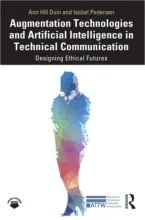
Ann Hill Duin and Isabel Pedersen, Augmentation Technologies and Artificial Intelligence in Technical Communication: Designing Ethical Futures, Routledge, 2023. 282 pp. ISBN 9781032263755.

Coauthors
Mafruha Shifat, Ohio State University